




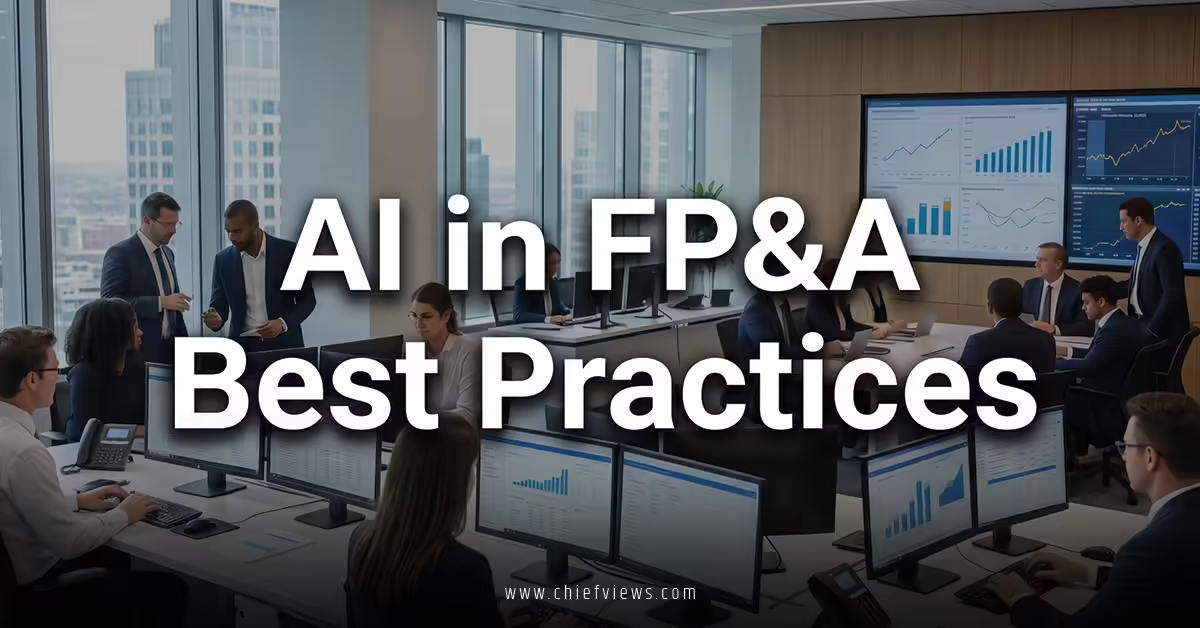
AI in FP&A Best Practices drives the edge finance teams need in 2026. Forget static spreadsheets and backward-looking reports. Smart integration of AI turns FP&A into a forward engine for decisions, forecasts, and strategy. Teams that get this right cut cycle times, sharpen accuracy, and free analysts for what matters—advising the business.
AI in FP&A Best Practices means embedding predictive models, automation, and intelligent insights directly into planning, budgeting, analysis, and reporting workflows. It’s not about replacing people. It’s about amplifying them. In a world of constant flux, this approach helps CFOs and their teams stay proactive instead of reactive.
- Core definition: Using AI tools for real-time forecasting, anomaly detection, scenario modeling, automated variance commentary, and natural language querying of financial data.
- Why it matters now: FP&A teams leveraging AI achieve up to 25% higher forecast accuracy and spend more time on high-value work. Gartner expects 90% of finance functions to deploy at least one AI-enabled solution by 2026.
- Beginner payoff: Start with one process like variance analysis or cash forecasting. Prove quick wins, then scale.
- Strategic link: This sits at the heart of CFO financial strategy AI integration, elevating finance from reporting to true business partnership.
The reality? Many teams still lag. But those following proven practices pull ahead fast.
Why AI in FP&A Best Practices is non-negotiable in 2026
Traditional FP&A chokes on manual data wrangling. AI flips that. It ingests massive datasets—internal ERP feeds plus external signals—and spots patterns instantly. What usually happens is analysts drown in reconciliations while opportunities slip by.
In my experience, the shift happens when you treat AI as a tireless co-pilot. It runs thousands of scenarios overnight. You walk into meetings armed with ranked options, not last month’s numbers. EY research highlights how AI transforms FP&A by boosting efficiency and insight generation.
AI in FP&A Best Practices also tackles talent shortages. Automate the grind. Your team focuses on interpretation, storytelling, and cross-functional influence. That’s the elevation that actually moves the needle.
Key benefits that deliver real ROI
- Forecast accuracy: AI models factor in real-time variables for tighter predictions.
- Speed: Halve budget and close cycles through automation.
- Deeper insights: Anomaly detection and root-cause analysis in plain English.
- Scenario power: Dynamic modeling for uncertainty—think supply shocks or rate changes.
- Team impact: More time on strategy, less on spreadsheets.
Think of it like upgrading from a basic calculator to a live simulation engine. You still steer, but the view is crystal clear.
Step-by-step action plan: Implementing AI in FP&A Best Practices
Beginners and intermediates, this doesn’t require a rip-and-replace. Here’s exactly what I’d do stepping into a new FP&A role today.
- Build strong data foundations (Weeks 1-3): Audit and unify sources. Clean data is everything—garbage in still equals garbage out. Integrate ERP, CRM, and external feeds.
- Choose your first use case (Weeks 4-8): Target high-pain areas like monthly variance explanations or rolling forecasts. Pilot with a tool that fits your stack. Measure baseline vs. AI-assisted results.
- Select and integrate tools: Prioritize platforms with native AI—predictive forecasting, natural language interfaces, and governance features. Test integration depth early.
- Upskill the team: Short sessions on prompt engineering, interpreting AI outputs, and critical review. No coding needed for most modern tools.
- Establish governance and scale: Set validation protocols, ownership, and compliance rules. Review pilots monthly. Expand to full planning cycles once proven.
This iterative path—30/90/365—keeps momentum high without disruption. Many leaders follow similar steps for successful CFO financial strategy AI integration.
Tools powering AI in FP&A Best Practices
Mature platforms now embed AI deeply. Look for predictive engines, agentic capabilities, and seamless ERP connections. Excel-native options suit many teams, while unified platforms shine for enterprises.
Popular choices include tools with strong forecasting, anomaly detection, and narrative generation. The best fit depends on your size, existing tech, and complexity.

AI in FP&A Tools Comparison Table (2026)
| Tool/Platform | Best For | Key AI Features | Maturity & Fit |
|---|---|---|---|
| Planful | Mid-to-enterprise | Predictive forecasting, anomaly detection, narrative insights | Strong for agile teams |
| Anaplan | Complex, connected planning | Scenario modeling, AI agents | Enterprise scale |
| Datarails | Excel-heavy teams | Genius AI for commentary & analysis | Quick wins for SMB/mid-market |
| Workday Adaptive | Cloud-native finance | ML forecasting, real-time insights | Integrated ecosystem |
| Vena Solutions | Excel users | Copilot for modeling & variance | Governance-focused |
Data drawn from industry benchmarks and platform capabilities.
Common mistakes & how to fix them in AI in FP&A Best Practices
Seasoned pros still stumble. Here’s what I see repeatedly—and the fixes.
- Skipping data prep: AI fails on messy inputs. Fix: Prioritize cleaning and integration first. Pilot on a clean subset.
- No human oversight: Blind trust leads to errors. Fix: Always layer review on material outputs. AI assists; you own the judgment.
- Too broad too soon: “Do everything with AI” overwhelms. Fix: Narrow to one or two high-ROI use cases. Scale after proof.
- Ignoring change management: Teams fear job loss. Fix: Highlight how AI frees them for strategic work. Celebrate early wins.
- Weak governance: Compliance and bias risks emerge. Fix: Define clear policies upfront. Involve legal/IT early.
Dodge these, and your implementation sticks.
For proven maturity models, see EY’s guide on AI transforming FP&A. Dive into practical adoption with FP&A Trends research. And check Deloitte’s CFO tech trends for broader strategy context tied to CFO financial strategy AI integration.
Measuring success and scaling
Track metrics like forecast error reduction, cycle time savings, adoption rates, and business impact (better decisions, lower risk). Leading indicators matter early—time saved on manual tasks.
Scale by expanding to driver-based planning, workforce modeling, and enterprise-wide scenarios. The goal: FP&A as a real-time strategic hub.
Key Takeaways
- AI in FP&A Best Practices starts with clean data and focused pilots.
- Prioritize governance and human oversight from day one.
- Expect 20-25% accuracy gains and major efficiency lifts.
- Tools should integrate seamlessly with your existing workflows.
- Upskill teams on interpretation, not just technology.
- Link efforts directly to CFO financial strategy AI integration for maximum impact.
- Measure against clear KPIs tied to business outcomes.
- Iterate relentlessly—finance wins go to the adaptable.
AI in FP&A Best Practices equips your team to thrive amid uncertainty. Schedule a data audit and pick that first pilot this week. The technology exists. Execution separates leaders from the pack.
FAQs
What are the top AI use cases in FP&A Best Practices for beginners?
Focus on automated variance commentary, basic predictive forecasting, and anomaly detection. These deliver fast, visible wins with manageable complexity.
How does AI in FP&A Best Practices connect to broader CFO priorities?
It forms a core pillar of CFO financial strategy AI integration, shifting finance toward proactive strategy, better risk management, and enterprise-wide value creation.
What skills should FP&A teams build for AI success in 2026?
Emphasize data literacy, prompt engineering, critical evaluation of outputs, and business storytelling. Technical depth helps, but judgment remains human.