




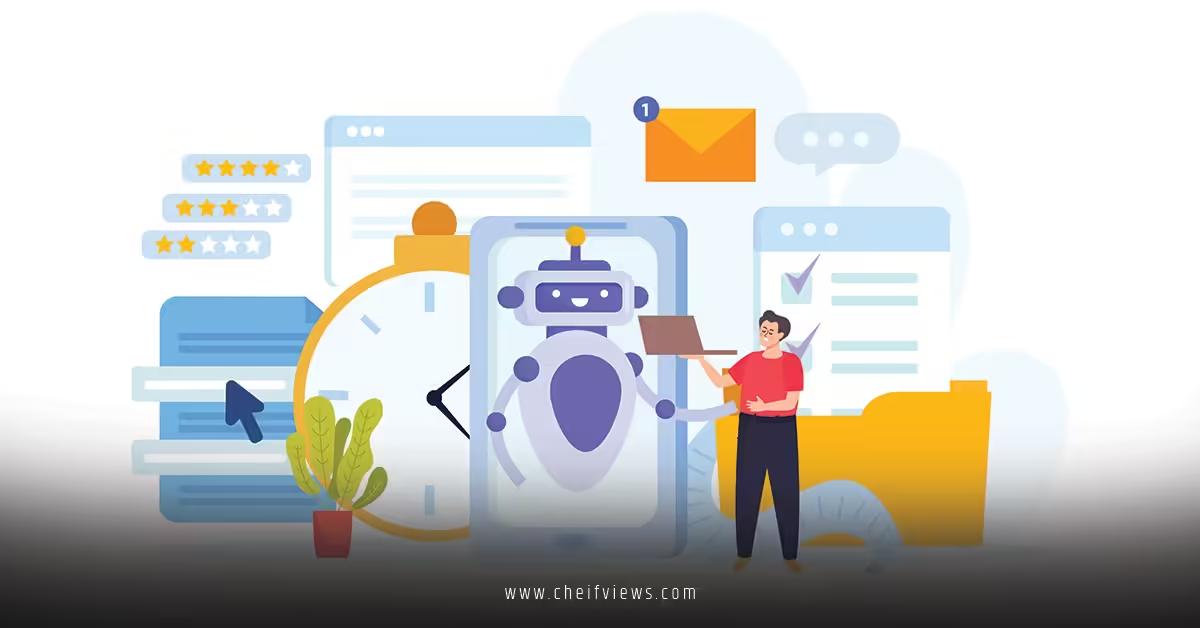
AI-powered marketing strategies for CMOs in 2026 to drive revenue growth aren’t optional experiments anymore. They represent the direct line from marketing spend to measurable pipeline and closed-won deals.
CMOs who treat AI as a bolted-on tool watch budgets evaporate into pilots that never scale. Those who build it into always-on systems see faster conversions, lower acquisition costs, and revenue lifts that finance actually notices.
Here’s what it looks like in practice right now:
- Hyper-personalized customer journeys at scale using real-time behavioral signals
- Predictive analytics that forecast which leads convert and why
- Agentic AI systems that autonomously optimize campaigns while humans steer strategy
- Generative tools that cut content production time without killing brand voice
- Unified data platforms connecting marketing, sales, and customer success for true revenue attribution
These strategies matter because flat budgets (hovering around 7.8% of company revenue) meet sky-high growth targets. AI becomes the multiplier.
Why AI-Powered Marketing Strategies for CMOs in 2026 to Drive Revenue Growth Beat Traditional Playbooks
Old campaign calendars feel quaint. Markets shift hourly. Buyers ghost static ads. AI flips the script by creating responsive, learning systems.
What usually happens is this: A CMO approves a big Q1 push. By week six, performance plateaus. Manual tweaks eat team hours. Revenue misses land on the CMO’s desk.


AI-powered loops catch signals early—cart abandonment patterns, content engagement drops, competitor price moves—and adjust offers, creative, or channels before the damage shows in reports. The result? More predictable revenue and teams that spend time on high-leverage work instead of firefighting.
The kicker? Early movers already report 20-40% efficiency gains in key workflows while protecting or growing pipeline.
Core AI-Powered Marketing Strategies for CMOs in 2026 to Drive Revenue Growth
1. Real-Time Personalization Engines
Forget segments of thousands. Top teams deliver 1:1 experiences using unified customer data platforms. AI analyzes browsing history, past purchases, even external signals like weather or earnings reports to serve the right message at the right moment.
Brands implementing strong AI personalization see significantly higher engagement and customer lifetime value.
2. Predictive Lead Scoring and Next-Best-Action
Stop chasing vanity metrics. AI models trained on your closed-won data rank prospects by conversion probability and suggest exact actions—email sequence, demo slot, discount level—that move deals forward.
3. Agentic AI for Campaign Autonomy
These systems don’t just recommend. They execute within guardrails: adjusting bids, pausing underperforming ads, testing creative variants, and reallocating budget across channels in real time. Humans set goals and review outcomes. AI handles the grind. Gartner predicts major growth in these autonomous setups by end of 2026.
4. Generative AI for Content Velocity
Draft blog posts, email sequences, social variants, and ad copy in minutes. The pros layer human strategy and editing on top. Teams report saving hours weekly while hitting 3x+ ROI on AI-assisted content.
5. Attribution and MMM 2.0
Modern marketing mix modeling powered by AI handles messy multi-touch journeys and privacy-safe data. It tells you exactly which channels drive revenue—not last-click guesses.
| Strategy | Avg. Reported Impact | Implementation Time (Beginner) | Key Tools/Tech | Revenue Tie |
|---|---|---|---|---|
| Real-Time Personalization | 2-3x engagement, higher CLV | 3-6 months | CDP + AI engines (e.g., Dynamic Yield, Insider) | Direct lift in conversion rates |
| Predictive Lead Scoring | 30-40% faster lead conversion | 1-3 months | Salesforce Einstein, HubSpot AI | Shorter sales cycles, higher win rates |
| Agentic Campaign Optimization | 20-25% lower CAC | 2-4 months | Autonomous platforms | Efficient scaling of spend |
| GenAI Content Systems | 3.2x ROI on content | Weeks | Claude, custom workflows | Faster top-of-funnel pipeline |
| AI Attribution | Clearer ROI visibility | 3-6 months | Advanced MMM tools | Better budget allocation to high-ROI channels |

Step-by-Step Action Plan for Beginners and Intermediate CMOs
Start lean. Scale smart.
Week 1-4: Foundation
Audit your customer data. Fix silos. Pick one high-pain area—email nurture or ad optimization—and pilot one AI tool. Measure baseline metrics ruthlessly.
Month 2-3: Pilot and Learn
Deploy predictive scoring or AI content drafting. Run A/B tests against your old process. Document what broke and what delivered. Train a small tiger team.
Month 4-6: Integrate and Expand
Connect the winning pilot to your CRM and analytics stack. Add agentic elements for one channel. Review weekly: What’s the revenue delta?
Ongoing: Govern and Optimize
Build governance—approval workflows, brand guardrails, bias checks. Tie every AI initiative to a revenue KPI. Reallocate budget quarterly from low performers to AI winners.
If I were stepping into a new CMO role tomorrow, I’d lock in data quality first, then chase quick wins in personalization and content before touching full autonomy.
Common Mistakes & How to Fix Them
Teams trip over the same rocks.
- Treating AI as a magic wand. They throw tools at problems without strategy. Fix: Start with business outcomes, then select tech.
- Ignoring data quality. Garbage in, expensive garbage out. Fix: Invest in CDP and cleansing before heavy modeling.
- Over-automation without oversight. Brand voice erodes or compliance slips. Fix: Human-in-the-loop reviews for customer-facing outputs.
- Chasing shiny objects. New tool every month. Fix: Standardize on 3-5 core platforms that integrate.
- No clear measurement. “It feels better” doesn’t impress the board. Fix: Define revenue-linked KPIs upfront.
AI-Powered Marketing Strategies for CMOs in 2026 to Drive Revenue Growth: Advanced Plays
Layer in Generative Engine Optimization (GEO) so your content surfaces in AI chat answers, not just traditional search. Test synthetic data for privacy-safe training. Explore multi-agent systems where one AI handles creative, another media buying, and a third analyzes results.
Privacy remains non-negotiable. First-party data strategies paired with transparent AI use build the trust that drives loyalty.
Key Takeaways
- AI-powered marketing strategies for CMOs in 2026 to drive revenue growth shift marketing from cost center to revenue engine when built on solid data and governance.
- Budget allocation averages 15.3% toward AI, but only mature organizations capture the full upside.
- Quick wins in personalization and content deliver measurable ROI fast.
- Agentic systems represent the next competitive edge.
- Human judgment stays irreplaceable for strategy, creativity, and trust.
- Governance and measurement determine winners from also-rans.
- Continuous experimentation beats perfect plans.
- Revenue impact compounds when AI connects marketing, sales, and customer experience.
The brands pulling ahead treat AI like electricity—not a feature, but infrastructure that powers everything. They move fast on pilots, learn faster from failures, and never lose sight of the buyer on the other side of the screen.
Your next step? Pick one revenue leak in your current funnel and map an AI solution to plug it this quarter. Momentum beats perfection.
FAQs
What are the biggest barriers to implementing AI-powered marketing strategies for CMOs in 2026 to drive revenue growth?
Data integration issues, talent gaps, and lack of mature processes top the list. Only about 30% of organizations feel ready to scale despite high ambitions. Start small, prioritize data foundations, and build cross-functional buy-in early.
How much should we budget for AI-powered marketing strategies for CMOs in 2026 to drive revenue growth?
Gartner data shows an average of 15.3% of marketing budgets going to AI initiatives. Mature teams push closer to 21%. Focus spend on high-ROI areas like personalization and predictive analytics first rather than spreading thin across every new tool.
Can small to mid-size companies compete with AI-powered marketing strategies for CMOs in 2026 to drive revenue growth?
Absolutely. Many accessible platforms offer sophisticated capabilities without enterprise price tags. The edge comes from faster decision-making and tighter integration across fewer tools. Focus on solving one specific revenue problem exceptionally well before expanding.