





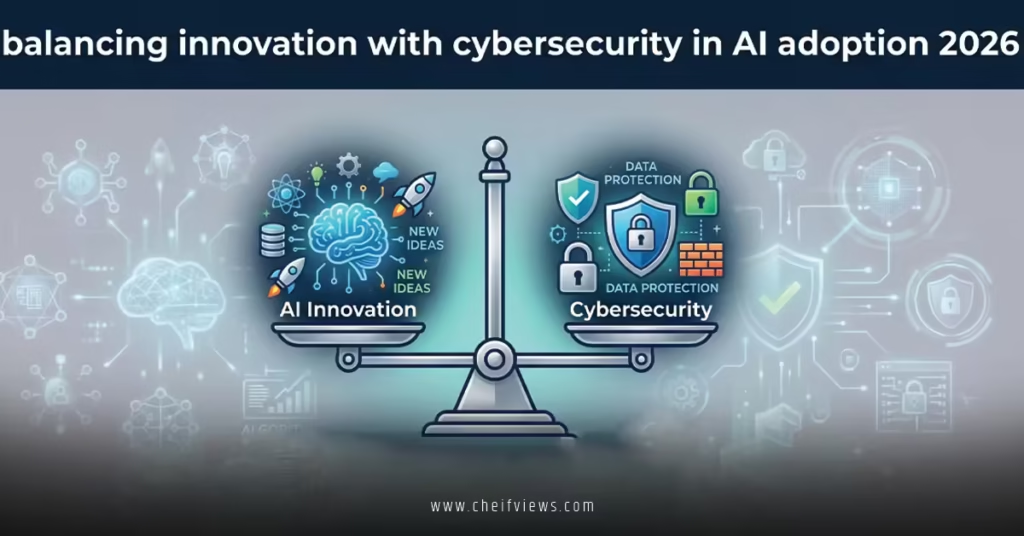
Balancing innovation with cybersecurity in AI adoption 2026 means pushing AI hard for competitive edge while locking down the new attack surfaces it creates. Organizations race to deploy agentic systems and generative tools. Yet many discover too late that speed without guardrails hands attackers a massive advantage.
Here’s the reality in mid-2026: AI adoption exploded, but governance lagged. The result? More sophisticated threats and higher breach costs. Get this balance right, and you unlock efficiency gains while building real resilience. Miss it, and innovation becomes expensive regret.
Why it matters right now:
- 77% of organizations use AI for cybersecurity tasks like phishing detection, per the World Economic Forum’s Global Cybersecurity Outlook 2026.
- Attackers leverage AI in 16% of breaches (IBM Cost of a Data Breach Report data referenced across 2025-2026 analyses), driving phishing and deepfakes with scary effectiveness.
- Average breach costs climb, with AI-related incidents adding hundreds of thousands in extra damage.
The winners treat security as a feature of innovation, not a speed bump.
What Balancing Innovation with Cybersecurity in AI Adoption 2026 Actually Looks Like
It’s not about slowing down. It’s about building AI systems that stay secure by design. Think of it like constructing a high-performance race car with reinforced safety cages and smart brakes from day one. You still go fast — just without the fiery crashes.
In practice, this means embedding risk checks into every stage of AI deployment. From prompt engineering to production monitoring. From data pipelines to agent autonomy.
Early wins organizations see when they nail this balance:
- Faster threat detection without alert fatigue.
- Reduced shadow AI risks from unsanctioned tools.
- Regulatory compliance that actually supports growth instead of choking it.



Key Challenges in 2026
AI expands the attack surface dramatically. Agentic systems act autonomously. That autonomy creates juicy targets. Adversaries use similar tech to craft hyper-personalized attacks at scale.
Data poisoning, model inversion, prompt injection — these aren’t theoretical anymore. They hit production environments regularly. Add supply chain vulnerabilities in the AI stack, and the complexity multiplies.
What usually happens is teams prioritize features over fundamentals. They spin up powerful models, then scramble when incidents expose weak access controls or poor data hygiene.
Pros and Cons: Innovation vs. Security Trade-offs
| Aspect | Innovation-First Approach | Security-Balanced Approach | Real-World Impact (2026) |
|---|---|---|---|
| Deployment Speed | Rapid prototyping and rollout | Structured testing + phased releases | Balanced teams ship 30-40% faster sustainably |
| Threat Exposure | High (shadow AI common) | Lower through governance and monitoring | Fewer AI-specific incidents |
| Cost Efficiency | Lower upfront, higher breach risk | Higher initial investment, lower long-term costs | AI-driven breaches cost ~$4.5M+ on average |
| Regulatory Risk | Frequent compliance headaches | Built-in alignment with NIST and emerging rules | Smoother audits, competitive advantage |
| Talent Utilization | Burnout from constant firefighting | Empowered teams focused on high-value work | Better retention in security and AI roles |
This table reflects patterns seen across enterprise reports and practitioner feedback in 2026.
Step-by-Step Action Plan for Beginners and Intermediate Teams
Start here if you’re still figuring out where to focus.
- Inventory everything. Map every AI tool, model, and data flow in your environment. Shadow AI hides in plain sight — employee use of public LLMs tops the list of surprises.
- Adopt a framework. Use NIST’s Cybersecurity Framework Profile for Artificial Intelligence (Cyber AI Profile) as your backbone. It layers AI-specific risks onto proven controls.
- Implement zero-trust for AI. Treat models and agents like any other privileged user. Enforce least privilege, continuous verification, and strong identity controls.
- Build red team habits. Regularly test for prompt injection, data leakage, and adversarial attacks. Make it part of your development cycle, not a one-off exercise.
- Train relentlessly. People remain the weakest (and strongest) link. Run simulations with AI-generated deepfakes and phishing. Measure improvement.
- Monitor and iterate. Deploy AI-powered detection tools, but keep humans in the loop for high-stakes decisions. Review incidents monthly.
What I’d do if I were stepping into a new org tomorrow? Start with a 30-day discovery sprint focused on visibility, then prioritize quick wins like access controls and data classification.
Common Mistakes & How to Fix Them
Mistake 1: Treating AI security as an IT-only problem.
Fix: Involve legal, compliance, business units, and executives from day one. AI risk is enterprise risk.
Mistake 2: Over-reliance on vendor promises.
Fix: Verify claims. Demand transparency on training data, security testing, and incident response. Read NIST guidelines on AI risk management for independent benchmarks.
Mistake 3: Ignoring supply chain risks.
Fix: Vet third-party models and tools aggressively. Implement software bill of materials (SBOM) for AI components.
Mistake 4: Moving too slow on governance.
Fix: Create lightweight policies first, then mature them. Perfect is the enemy of deployed-and-secure.
The kicker? Most of these mistakes stem from viewing security and innovation as opposites. They’re not.
Advanced Strategies: Where Balancing Innovation with Cybersecurity in AI Adoption 2026 Gets Competitive
Mature organizations go further. They use AI to strengthen defenses — automated anomaly detection, predictive vulnerability patching, intelligent access decisions.
They establish AI red teams that mirror attacker capabilities. They invest in explainable AI so security teams understand why models make certain calls.
Explore practical implementation through resources like Deloitte’s insights on AI reshaping cybersecurity.
Key Takeaways
- Balancing innovation with cybersecurity in AI adoption 2026 delivers sustainable advantage when security enables speed rather than blocking it.
- Visibility into your AI footprint is non-negotiable — start there.
- Human oversight + automated defenses beats either alone.
- Frameworks like NIST Cyber AI Profile provide proven structure without reinventing the wheel.
- Expect AI in more attacks; prepare defenses accordingly.
- Governance done right reduces costs and builds trust.
- Treat every AI deployment as a potential new attack vector.
- Measure success by both innovation metrics and security outcomes.
Nail this balance and your organization moves faster with confidence. You protect what matters while unlocking AI’s real potential.
Ready to level up? Audit your current AI projects against zero-trust principles this week. Identify one high-impact area — like agent permissions or data flows — and tighten it before the next deployment.
FAQs
How does balancing innovation with cybersecurity in AI adoption 2026 differ from previous years?
The stakes rose with agentic AI and autonomous systems. These tools act independently, creating dynamic risks that static controls can’t handle. 2026 demands proactive, integrated approaches instead of bolt-on security.
What role do regulations play in balancing innovation with cybersecurity in AI adoption 2026?
They set minimum bars but smart teams exceed them for advantage. NIST frameworks and emerging standards help align security with innovation goals rather than treating compliance as pure overhead.
Can small businesses effectively balance innovation with cybersecurity in AI adoption 2026?
Absolutely. Start lean with free or low-cost NIST resources, open-source monitoring tools, and phased rollouts. Focus on high-value use cases first. Many SMBs gain edge by being nimble while staying disciplined on basics.