




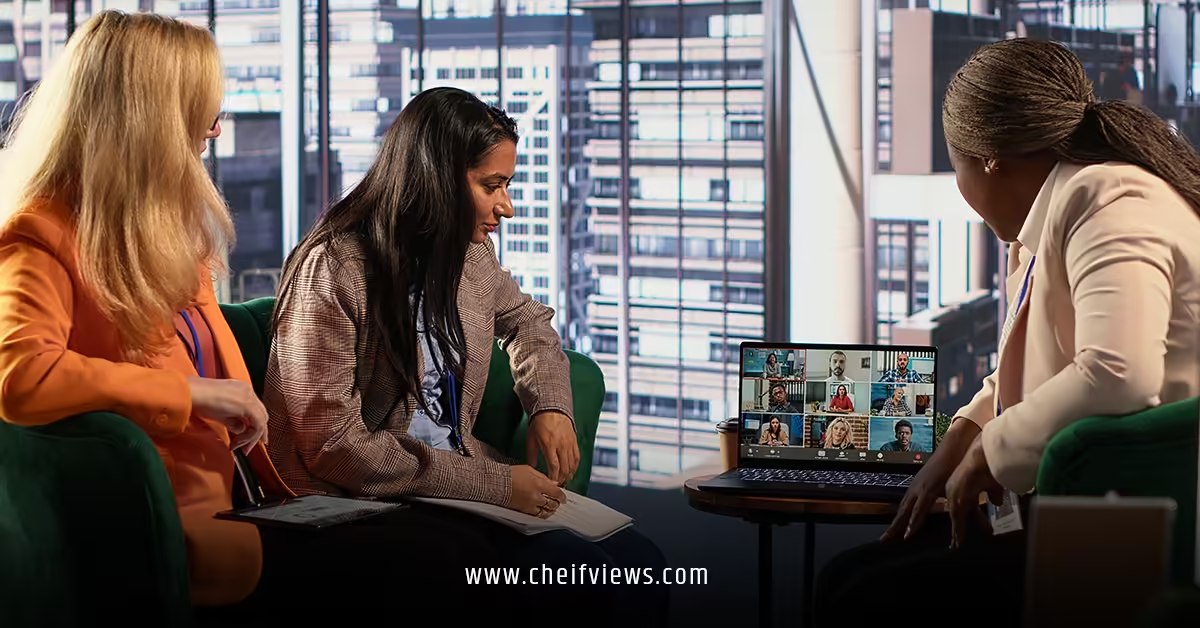
Building inclusive hybrid workplace culture as CHRO is not about splitting time between home and office and calling it a day. It is about designing a workplace where access, visibility, growth, and belonging do not depend on who is physically in the room.
- Inclusion in hybrid work means equal access to information, opportunity, and career growth.
- The CHRO owns the operating system: policy, manager behavior, meeting norms, promotion fairness, and manager accountability.
- Hybrid falls apart fast when in-office employees get the “real” conversations and remote employees get leftovers.
- The fix is not more slogans. It is tighter systems, clearer norms, and better leadership habits.
- Done right, hybrid can widen your talent pool, reduce friction, and improve retention without turning culture into mush.
Here’s the thing: hybrid culture is a coordination problem, not a vibes problem.
Why Building inclusive hybrid workplace culture as CHRO matters now
Hybrid is mainstream in the U.S., but the standard for “working fine” is much higher than it used to be. Employees expect flexibility. Leaders still want speed. Managers want clarity. And if those three forces are not lined up, the culture fractures quietly.
That fracture usually shows up in ordinary places: meetings where remote people speak less, promotions that favor proximity, onboarding that assumes people already know the unwritten rules, and team norms that vary by manager. Not dramatic. Just expensive.
The CHRO sits in the middle of it. Not as a cheerleader. As the architect.
If you want a clean North Star, use this: every employee should have the same shot at information, influence, and advancement, regardless of where they work.



For a practical benchmark, the U.S. Equal Employment Opportunity Commission’s guidance on workplace equity is a useful anchor for fair access and non-discrimination principles. For labor and safety considerations around hybrid setups, the U.S. Department of Labor also offers relevant guidance on remote work and workplace obligations. For broader workforce data and trends, the U.S. Bureau of Labor Statistics remains a strong reference point for labor market context. EEOC guidance on workplace discrimination and fairness, U.S. Department of Labor remote work guidance, BLS labor force data and workplace trends
Building inclusive hybrid workplace culture as CHRO starts with the operating model
Hybrid culture does not come from a deck. It comes from decisions.
If the operating model says “everyone is hybrid,” but senior leaders are in the office four days a week, the culture is not hybrid. It is proximity-based with better branding.
The four rules that shape inclusive hybrid culture
| Area | What good looks like | What goes wrong when it is sloppy | CHRO move |
|---|---|---|---|
| Access to information | Decisions, updates, and priorities are documented and shared in one place | Remote employees miss context and rely on hallway chatter | Standardize written updates and decision logs |
| Meeting design | Remote and in-room employees have equal voice | In-room people dominate and remote people disengage | Require camera, chat, and structured turn-taking norms |
| Performance management | Results matter more than visibility | “Seen more” becomes “rated higher” | Train managers to assess output, not attendance theater |
| Career growth | Promotions and stretch work are transparent | In-office employees get the better projects | Audit talent reviews and assignments for proximity bias |
The culture question is simple. Who gets the signal, and who gets the noise?
What inclusive hybrid looks like in practice
In a healthy hybrid environment:
- Meeting agendas go out early.
- Key decisions are documented in writing.
- People can contribute asynchronously.
- Managers know how to run mixed-format meetings.
- Promotion criteria are explicit.
- New hires are not left to “pick it up as they go.”
That sounds basic. It is. Most hybrid failures are basic failures wearing a modern outfit.
The CHRO playbook for Building inclusive hybrid workplace culture as CHRO
If you are building from scratch, start here. No drama. Just sequence.
Step-by-step action plan for beginners
- Define the hybrid promise
- Spell out what flexibility means in your company.
- Decide which roles are remote, hybrid, or in-person, and why.
- Write the rules in plain English.
- Set non-negotiable norms
- Make meeting practices consistent across teams.
- Require documentation for decisions, project plans, and policies.
- Establish response-time expectations so remote staff are not penalized for not being always-on.
- Train managers hard
- Teach managers how to lead mixed-location teams.
- Focus on coaching, fairness, agenda discipline, and feedback quality.
- Give them scripts and checklists, not just theory.
- Fix performance management
- Tie reviews to outcomes, not visibility.
- Calibrate ratings for proximity bias.
- Review who gets stretch assignments, visibility, and sponsorship.
- Design onboarding for belonging
- Pair every new hire with a human guide.
- Build a 30-60-90 day plan that works for both remote and on-site workers.
- Make the unwritten rules visible.
- Audit inclusion regularly
- Check meeting participation, promotion rates, attrition, engagement, and manager effectiveness by location.
- If one group is consistently getting less access, act fast.
- Hold leaders accountable
- Put hybrid inclusion metrics into leader scorecards.
- Reward consistency, not just charisma.
- Correct drift early.
That last point matters. Culture weakens when leaders are allowed to improvise forever.
What I’d do if hybrid is already messy
Start by fixing the meeting layer.
Why? Because meetings are where hybrid culture either proves itself or falls apart in public. If remote employees cannot speak, cannot see context, and cannot influence the outcome, nothing else you do will fully compensate.
Then move to:
- decision documentation
- promotion calibration
- manager training
- onboarding
- employee listening
The order matters. Don’t boil the ocean.
What inclusive hybrid meetings actually look like
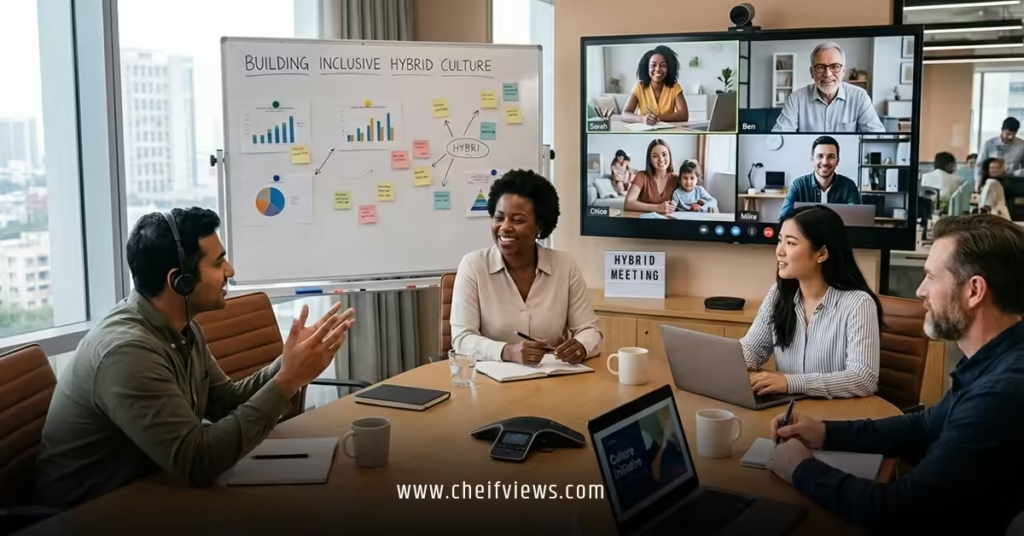
Hybrid meetings are the sharp edge of the whole model. Get them wrong and your culture leaks trust every week.
A good hybrid meeting behaves like a well-run airport control tower. Everyone knows the flight plan. Nobody is guessing who is landing where. Communication is visible, structured, and timed.
Meeting norms that protect inclusion
- One facilitator owns the room.
- One note-taker captures decisions in real time.
- Every meeting has a reason to exist.
- Agendas are shared in advance.
- Important discussions happen in shared documents before or after the meeting.
- Remote voices are invited first when needed.
- Side conversations are not where decisions live.
A few hard truths help here:
- If a meeting could have been an email or a document, it probably should have been.
- If the office crowd is making decisions in the room and remote folks are just absorbing them later, inclusion is already leaking.
- If the loudest voice wins, hybrid is broken.
Building inclusive hybrid workplace culture as CHRO through manager habits
Managers make or break this. Not HR alone.
The best managers in hybrid settings do three things consistently:
- They narrate context.
- They distribute attention evenly.
- They make expectations visible.
That means they do not assume people know what mattered in the exec meeting. They do not only praise the people they see. And they do not let performance discussions get fuzzy.
Common mistakes and how to fix them
1. Treating flexibility as the culture
Flexibility is a benefit. It is not a culture model.
Fix: Define shared norms around collaboration, accountability, and communication. Flexibility should support culture, not replace it.
2. Letting location become status
If people think in-office equals committed, the culture will split fast.
Fix: Retrain leaders on proximity bias. Review promotions, high-visibility work, and leadership opportunities by work location.
3. Assuming managers already know how to lead hybrid teams
Most do not. They are improvising.
Fix: Give managers playbooks, coaching, and consequences. Training without follow-through is theater.
4. Failing to document decisions
When decisions live in side chats, remote employees are stranded.
Fix: Require a written record for major decisions, policy changes, and action items.
5. Measuring attendance instead of outcomes
Presence is easy to count. Value is not.
Fix: Shift performance metrics toward outcomes, quality, collaboration, and impact.
6. Ignoring onboarding and early-career employees
New hires absorb culture through repetition. Hybrid can starve that process if you are careless.
Fix: Build structured onboarding, regular check-ins, and clear team rituals.
How to know if your hybrid culture is actually inclusive
You do not need perfect data to know whether the system is working. You need the right signals.
Look at:
- promotion rates by location
- attrition by location
- engagement scores by manager and work arrangement
- meeting participation patterns
- internal mobility
- new hire ramp time
- access to stretch assignments
If remote employees are consistently slower to get promoted, less visible in talent reviews, or more likely to leave, the issue is not “preferences.” It is design.
The best CHROs do not wait for a crisis to call it out. They treat these patterns like smoke. Because that is what they are.
The leadership mindset behind Building inclusive hybrid workplace culture as CHRO
This work needs backbone.
A CHRO building inclusive hybrid workplace culture as CHRO has to hold two ideas at once:
- People deserve flexibility.
- The company still needs shared standards.
That is not a contradiction. It is the job.
The companies that get this right do not rely on charisma or wishful thinking. They build a system where a person can contribute from anywhere without needing to be physically visible to matter. That is a stronger culture, not a looser one.
And honestly, what is the point of hybrid if it only works well for the people closest to power?
Key takeaways
- Building inclusive hybrid workplace culture as CHRO starts with systems, not slogans.
- Equal access to information, opportunity, and advancement is the real standard.
- Meeting design is a culture lever, not an admin detail.
- Manager training matters more in hybrid because bias travels faster when supervision is looser.
- Performance management should reward outcomes, not visibility.
- Documentation is one of the cheapest and most effective inclusion tools available.
- Promotion, attrition, and engagement data should be reviewed by location.
- Hybrid succeeds when leaders make fairness visible and repeatable.
The payoff is simple: a culture where flexibility does not quietly turn into favoritism. Start with one audit, one manager training push, and one meeting standard. Then build from there.
FAQs
How does Building inclusive hybrid workplace culture as CHRO differ from standard hybrid policy design?
Policy design sets the rules. Inclusive culture design makes sure those rules work fairly in daily life. The CHRO has to go beyond policy and shape meetings, promotions, onboarding, and manager behavior.
What is the fastest win for Building inclusive hybrid workplace culture as CHRO?
Fix meetings first. If remote employees cannot participate fully, the rest of the culture will keep leaking trust. Clear agendas, documentation, and balanced participation create fast momentum.
How can a CHRO reduce proximity bias in a hybrid workplace?
Use explicit promotion criteria, calibrate talent reviews, review opportunity distribution by location, and train managers to evaluate output instead of visibility. If you do not measure bias, you will keep guessing at it.