

CFO investment analysis framework for decision making is your operational North Star for deploying capital strategically, not reactively. It’s the structured methodology that separates CFOs who generate shareholder value from those who simply manage spreadsheets. Think of it as your decision-making immune system—it filters noise, prioritizes signal, and ensures every dollar deployed serves a documented business objective.
Why This Matters Right Now
Here’s the thing: CFOs in 2026 face unprecedented complexity. Interest rates are volatile. M&A landscapes shift monthly. Digital transformation budgets compete with operational efficiency plays. Without a rigorous framework, capital allocation becomes political theater instead of strategic science.
Organizations with defined investment frameworks see measurable improvements in capital efficiency, project outcomes, and strategic alignment. Those without one? They’re essentially throwing darts in a darkened room.
What You Need to Know First: The Quick Overview
Below is what a CFO investment analysis framework actually accomplishes:
• Standardizes evaluation criteria across all capital requests, eliminating bias and subjective decision-making • Quantifies risk and return using consistent metrics (NPV, IRR, payback period, ROI) to compare apples to apples • Accelerates decision velocity by establishing clear approval thresholds and authority matrices • Aligns investments with strategy by weighting projects against corporate priorities and competitive positioning • Creates accountability with transparent post-investment reviews that feed learning back into the system


The Anatomy of a High-Performing CFO Investment Analysis Framework
Let’s break down what actually works.
The Core Components
1. Investment Criteria Matrix
Before you evaluate a single project, define what “good” looks like. Most frameworks collapse around three pillars:
Strategic alignment: Does this investment ladder up to corporate objectives? A new ERP system that nobody asked for isn’t an investment—it’s a sunk cost waiting to happen.
Financial returns: What’s the quantifiable payoff? Set minimum thresholds upfront. Some CFOs use hurdle rates (minimum required return), others use payback periods. The specifics matter less than having a rule.
Risk profile: How likely is this to succeed, and what happens if it doesn’t? A supply chain resilience investment carries different risk than a speculative market entry.
2. The Evaluation Scorecard
Spreadsheet jockeys often miss this: evaluation frameworks live or die on simplicity. Too complex, and nobody uses them. Too simple, and you’re back to gut-feel decision-making.
A solid scorecard typically weights:
| Criterion | Weight | Why It Matters | Scoring Range |
|---|---|---|---|
| Strategic Fit | 30% | Ensures capital serves the master plan, not pet projects | 1–5 (5 = directly advances core strategy) |
| Financial ROI | 25% | Quantifies hard returns; prevents value destruction | 1–5 (5 = >25% IRR; 1 = <5% IRR) |
| Implementation Risk | 20% | Lower probability of success = lower attractiveness | 1–5 (5 = high confidence; 1 = major unknowns) |
| Timeline to Value | 15% | Cash flow timing matters; faster is usually better | 1–5 (5 = <12 months; 1 = >3 years) |
| Competitive Impact | 10% | Does this improve market position or defend it? | 1–5 (5 = significant competitive advantage) |
Weight it according to your business model. A high-tech company might emphasize competitive impact more. A mature industrial business might prioritize payback speed.
3. Authorization Thresholds
This is where execution lives. Define who approves what:
- Under $500K: Department head sign-off (with CFO spot-check)
- $500K–$2M: CFO approval + business unit sponsor
- $2M–$10M: CFO + COO + board finance committee
- Above $10M: Full board
Adjust these numbers to your organization’s risk tolerance and capital availability. The point is: no surprises, no duplicate approvals, no bottlenecks masquerading as governance.
The Step-by-Step Action Plan: Building Your Framework from Scratch
Step 1: Audit Current State (Week 1)
How are investments actually getting approved today? Interview three CFO peers, three business leaders, and three frontline project managers. You’ll hear wildly different stories—which is exactly why you need a framework.
Step 2: Define Investment Categories (Week 2)
Not all capital is equal. Most CFOs bucket investments into categories:
- Mandatory/Compliance: Regulatory, legal, safety requirements (non-negotiable)
- Strategic Growth: New markets, products, capabilities (core to long-term vision)
- Operational Efficiency: Cost reduction, process improvement, automation
- Maintenance: Keeping the lights on; asset refresh cycles
- Opportunistic: High-return anomalies (rare and often worth jumping on)
Each category deserves its own evaluation lens. Mandatory compliance shouldn’t be measured against ROI hurdle rates—it’s a cost of doing business.
Step 3: Build Your Scorecard (Week 3)
Use the example above as your template. Customize the criteria and weights to reflect what actually drives value in your business. Get input from CFO peers, your CEO, and your board—not because they need to approve your methodology, but because they’ll use it.
Step 4: Establish Approval Authority (Week 3)
Work with your COO and General Counsel to define thresholds. Run it past your board’s audit committee. Make it ironclad—no exceptions, no gray zones.
Step 5: Pilot with 3–5 Projects (Month 2)
Don’t flip the switch on all pending investments simultaneously. Use your framework to re-evaluate three to five active projects. Refine based on what you learn. Three months of pilot beats two years of political friction.
Step 6: Implement & Communicate (Month 3)
Roll out the framework with a brief memo from you and the CEO. Explain the “why,” not just the “what.” Provide training to project sponsors and approval authority. Create a simple one-pager template for submissions.

The CFO Investment Analysis Framework for Decision Making in Action: Real Scenarios
Scenario 1: The “Nice-to-Have” Software Platform
A business unit proposes a $1.2M cloud platform that “would improve collaboration.” Strategic fit? Moderate (not core to competitive advantage). ROI? Unclear; lots of “soft benefits.” Implementation risk? High (new vendor, organizational change). Your framework scores this at 2.3/5. Recommendation: Decline or kick to next budget cycle with clearer value proposition. Without the framework, you’d have a political argument. With it, you have data.
Scenario 2: The Mandatory Cybersecurity Upgrade
$3.8M required infrastructure spend. Strategic fit? N/A (compliance). ROI? N/A (regulatory requirement). Risk? Mandatory. Your framework automatically funnels this to “Mandatory/Compliance” track, skipping the ROI hurdle. Approval at the board level, timeline: Q3. Clean. Simple. Done.
Scenario 3: The Unexpected Acquisition Opportunity
A competitor’s subsidiary is for sale at an attractive price. Your framework can’t predict this, but it can rapidly evaluate it against your strategic criteria, risk tolerance, and financial thresholds. You score it, compare to other pending capital, make a recommendation to the board in 48 hours instead of 48 days.
Common Mistakes & How to Fix Them
Mistake 1: Building a Framework So Complex Nobody Uses It
The culprit: Trying to capture every nuance in one scorecard. Result: 47-tab spreadsheet that collects dust.
The fix: Start with five to seven criteria, max. Add detail later if you need it. A framework that gets used is infinitely more valuable than a theoretically perfect one nobody touches.
Mistake 2: Setting Hurdle Rates or Thresholds Based on Guesswork
“Let’s say we need 15% IRR minimum.” Without grounding this in capital cost, market comparables, or strategic reality, it’s arbitrary.
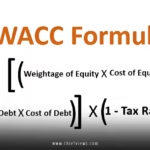
The fix: Calculate your weighted average cost of capital (WACC). Use industry benchmarks. Run three to five years of historical data on what’s actually generated returns in your business. Then set thresholds. They’ll still evolve, but they’ll be informed.
Mistake 3: Forgetting About Post-Investment Review
You approve a $5M investment, launch it, and move on. Three years later, it underperformed by 60%. Nobody learns anything.
The fix: Schedule a post-investment review 6–12 months after launch and again at 24 months. Compare actual to projected returns, timeline, and strategic impact. Document lessons. Feed them back into future evaluations.
Mistake 4: Letting Politics Override the Framework
The CEO’s pet project scores 2.1/5, but it gets green-lit anyway. Your framework is now theater, not governance.
The fix: This one’s on you. Defend the framework in the room. If the CEO truly wants to override it, fine—but do it transparently, on record, with clear rationale. Don’t let the framework get death-by-a-thousand-exceptions.
Mistake 5: Not Revisiting Thresholds as the Business Evolves
You set your framework in 2024 based on 8% cost of capital. It’s now 2026, rates have shifted, and your thresholds are stale.
The fix: Audit your framework annually. Recalibrate hurdle rates, approval authority, and category definitions as your business model, market, and competitive landscape shift.
Key Takeaways
• A CFO investment analysis framework for decision making is the operating system for strategic capital allocation—it removes politics and installs discipline
• Start with five to seven weighted criteria tailored to what actually drives value in your business; resist the urge to overengineer
• Define clear authorization thresholds and approval authority upfront; ambiguity breeds delays and political theater
• Build different evaluation tracks for mandatory compliance, strategic growth, efficiency, maintenance, and opportunistic investments
• Pilot your framework with 3–5 active projects before full rollout; refine based on real-world feedback
• Schedule post-investment reviews 6–12 months and 24 months after launch to capture lessons and improve future evaluations
• Defend your framework in the room; if leadership wants to override it, let them—but make it transparent, on record, and intentional
• Revisit and recalibrate your framework annually as business conditions, market dynamics, and capital costs shift
The Path Forward
Here’s what separates competent CFOs from exceptional ones: competent CFOs manage today’s capital. Exceptional CFOs build systems that compound decision quality over decades. A CFO investment analysis framework for decision making is that system.
You don’t need perfection. You need consistency, transparency, and discipline. Start with the scorecard above. Adapt it. Pilot it. Defend it. Within six months, you’ll have replaced gut-feel with data, politics with process, and chaos with clarity.
Your board will notice. Your business unit leaders will adapt. Your balance sheet will thank you.
Frequently Asked Questions
Q: How often should we recalibrate our CFO investment analysis framework for decision making?
A: At minimum, annually during budget planning. Sooner if your business model shifts materially (new market entry, major M&A, leadership change, or macro shifts like interest rate or regulatory changes). The framework should evolve with your business, not lag it.
Q: What’s a realistic IRR threshold for a mature company versus a growth-stage company?
A: A mature company with stable cash flows might set hurdle rates between 8–12% (reflecting lower risk). A growth-stage business might require 20–35% (compensating for higher execution risk and opportunity cost). Calculate your WACC first; use that as your baseline. Verify against your industry peers using resources like SEC 10-K filings or equity research reports from major brokerages.
Q: Can a CFO investment analysis framework for decision making work across multiple business units with very different risk profiles?
A: Yes, but with one caveat: use category-based frameworks (strategic growth vs. operational efficiency) combined with unit-specific hurdle rates. A fintech subsidiary needs different IRR thresholds than a legacy manufacturing division. The framework’s structure stays consistent; the parameters adapt to each unit’s reality.