

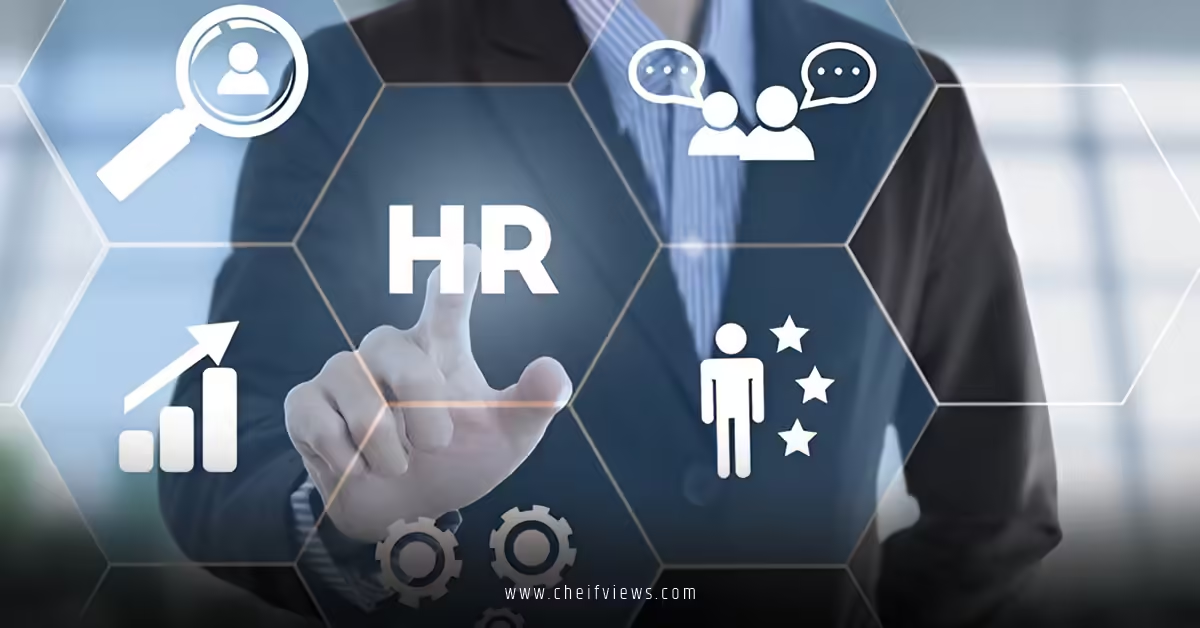
CHRO Guide to AI in HR means shifting from reactive HR admin to proactive architect of human-AI workplaces. You orchestrate tools that boost productivity, personalize talent decisions, and protect fairness across hybrid setups.
Here’s the reality check: Adoption remains uneven. Only about 46% of organizations expect to use AI in HR this year, creating massive gaps between leaders and laggards. CHROs who master this now shape culture, skills, and strategy before competitors catch up.
- Strategic oversight, not just tools: Move beyond chatbots to integrated AI that drives decisions in recruiting, learning, performance, and workforce planning.
- Why it matters: AI amplifies emerging CHRO skills in people analytics and hybrid work models by delivering predictive insights that make flexible work actually work.
- Business stakes: Higher productivity, smarter talent allocation, and lower risk when you govern it right.
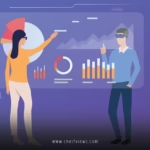
- Hybrid connection: AI helps analyze collaboration patterns, burnout signals, and engagement in distributed teams.
- Your role: Lead governance, ethics, and change so AI augments humans instead of replacing them.
Why CHROs Must Own AI in HR Right Now
AI hype meets stubborn reality in most organizations. Tools scatter across departments while HR stays fragmented.
The kicker? 91% of CHROs surveyed name AI and digitization as their top immediate concern. Yet many still treat it as an IT project.
Smart CHROs flip the script. They build HR-focused AI strategies that evolve the operating model itself — the area predicted to unlock the biggest productivity gains.
This ties directly into emerging CHRO skills in people analytics and hybrid work models. AI supercharges your ability to read hybrid team dynamics, forecast talent needs, and design work that fits both humans and algorithms.
Core AI Applications CHROs Should Prioritize
Focus where impact hits hardest:
Talent Acquisition: AI screens resumes, crafts job descriptions, and predicts candidate success. The win comes from bias audits and human oversight that keep hiring fair.
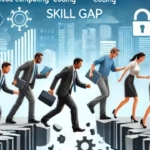
Learning & Development: Personalized learning paths adapt in real time. AI identifies skill gaps and recommends micro-learning that sticks.
Performance & Engagement: Sentiment analysis on communications, predictive turnover models, and intelligent feedback tools. Great for spotting hybrid-specific issues early.
Workforce Planning: Scenario modeling for human-AI team configurations. Essential as jobs get redesigned, not eliminated.
Administrative Automation: Free your team from repetitive tasks so they focus on strategy.
Comparison: Traditional HR vs. AI-Augmented HR (2026)
| Area | Traditional Approach | AI-Augmented Approach | Measurable Edge |
|---|---|---|---|
| Recruiting | Manual screening, gut decisions | Predictive matching + bias checks | Faster, fairer hires |
| Learning | One-size-fits-all courses | Personalized, adaptive paths | Higher completion & retention |
| Performance | Annual reviews | Continuous insights & coaching signals | Better engagement |
| Analytics | Backward-looking reports | Predictive & prescriptive | Proactive talent strategy |
| Governance | Ad-hoc policies | Structured ethics framework | Lower risk, higher trust |

Step-by-Step Action Plan for CHROs
Start here. No PhD required — just consistent moves.
- Assess your current state (Week 1-2): Inventory AI tools in use. Map data sources and gaps. Talk to your teams about pain points.
- Build AI literacy across HR (Month 1): Run practical workshops on prompting, data interpretation, and tool evaluation. Focus on HR workflows first.
- Pick one high-impact pilot (Month 2): Maybe AI-assisted candidate matching or engagement pulse analysis. Define success metrics upfront.
- Establish governance early: Create a cross-functional AI review board with HR, legal, IT, and ethics leads. Prioritize transparency and human oversight.
- Integrate with hybrid realities: Use AI to analyze virtual vs. in-office patterns. Link insights back to your broader people analytics strategy.
- Scale and measure: Expand winning pilots. Track productivity, employee satisfaction, cost savings, and fairness metrics.
- Partner relentlessly: Work hand-in-glove with CIOs and business leaders. Own the people side of AI transformation.
What I’d do? Start every leadership meeting with one AI insight tied to a business outcome. Visibility builds momentum fast.
Common Mistakes & How to Fix Them
Chasing shiny objects without strategy. Fix: Anchor every tool to a clear business or talent problem.
Ignoring ethics and bias. Fix: Build audits and human review into every process from day one.
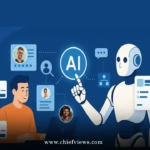
Treating AI as a replacement for judgment. Fix: Position it as a co-pilot. Employees stay excited when they see augmentation, not threat.
Poor data foundations. Fix: Clean and integrate data before scaling models.
Under-communicating. Fix: Be radically transparent about how AI works and what it means for roles.
Key Takeaways
- CHRO Guide to AI in HR puts you at the center of transformation, not the sidelines.
- Link AI efforts tightly to emerging CHRO skills in people analytics and hybrid work models for maximum leverage.
- Governance and ethics separate winners from those facing backlash.
- Start small, measure obsessively, scale what works.
- Focus on human-AI collaboration — redesign jobs around strengths of both.
- Literacy across the HR team beats one expert in the corner office.
- AI frees capacity for strategic work that drives real business value.
- The organizations thriving treat AI as a people strategy, not just a tech one.
Master this CHRO Guide to AI in HR and you don’t just keep up — you set the pace. Pick one process this week. Map where AI could add value and run a quick proof of concept. Momentum builds from there.
The future belongs to CHROs who turn AI from experiment to everyday advantage.
FAQs
What should be in a CHRO Guide to AI in HR?
Clear strategy, prioritized use cases, governance frameworks, skills development plans, and tight integration with people analytics and hybrid work practices.
How does AI in HR connect to emerging CHRO skills in people analytics and hybrid work models?
AI powers deeper analytics on hybrid team performance, predicts needs, and enables personalized experiences that make flexible models sustainable and effective.
How can CHROs get started with AI responsibly?
Begin with a pilot, establish ethics guidelines with human oversight, build basic literacy, and measure both efficiency gains and employee trust.