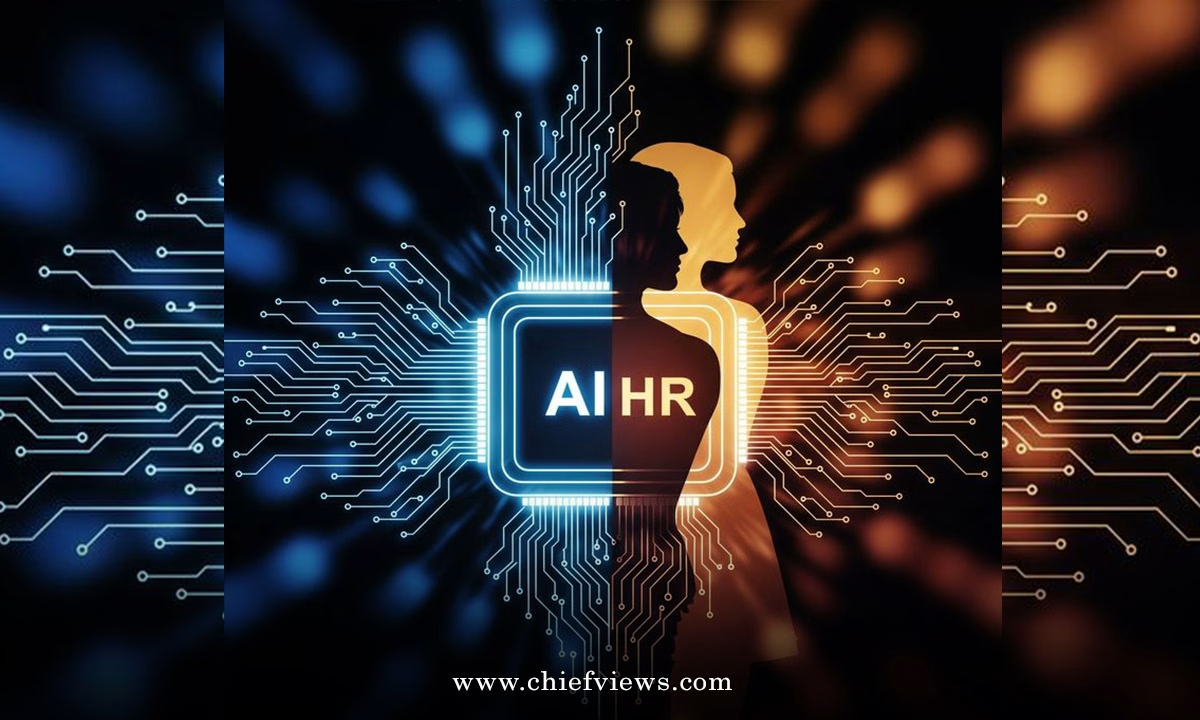



How CHRO can balance AI adoption with human centered culture starts with a simple truth: AI should remove friction, not erase trust. The best CHROs treat AI like a force multiplier for judgment, speed, and consistency, while protecting the parts of work that make people feel seen, heard, and valued.
- What it is: a people-first way to adopt AI without turning the workplace into a black box of tools and rules.
- Why it matters: employees will not rally behind automation if it feels like surveillance, layoffs by stealth, or decision-making without explanation.
- The CHRO job: set guardrails, redesign work, retrain managers, and keep humans accountable for high-stakes decisions.
- The payoff: faster operations, better employee experience, and a culture that still feels human when AI is everywhere.
- The trap: chasing efficiency so hard that you quietly damage engagement, retention, and trust.
That balance is not soft. It is strategic. And in the USA market, where AI governance, skills gaps, and employee expectations are all moving at once, the CHRO sits in the middle of the whole mess—in the best possible way.[17][16]
how CHRO can balance AI adoption with human centered culture starts with one rule: use AI to elevate people, not replace the relationship
The smartest AI programs in HR do not begin with tools. They begin with a decision: what should never be automated?
That answer usually includes coaching, conflict resolution, performance nuance, inclusion calls, and any high-stakes employment decision where context matters. AI can sort, summarize, recommend, and surface patterns. It should not be the final voice on human dignity.
Here’s the thing. People do not resist AI because they hate technology. They resist it when the rollout feels hidden, rushed, or one-sided. Google’s SEO starter guidance says content should be unique, easy to follow, and well organized; the same logic applies to change inside the company—clarity beats cleverness every time.[17]
The real CHRO balancing act
A human-centered culture is not anti-AI. It is anti-anxiety.

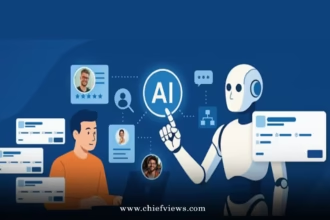
If AI saves time but makes managers less present, that is a bad trade. If AI reduces admin but employees do not understand how it is being used, that is a trust leak. If AI improves throughput but nobody can explain the decision trail, that is a governance problem wearing a productivity badge.
What usually works is this: automate the repetitive, centralize the risky, and keep humans close to the moments that shape careers.
Answer-ready comparison: where AI fits, and where people should stay in the loop
| HR use case | Best AI role | Human role | Culture risk if mishandled |
|---|---|---|---|
| Resume screening | Rank, filter, identify patterns | Set criteria, review edge cases, approve shortlists | Bias, opacity, candidate distrust |
| Employee FAQs | 24/7 answers, routing, summarizing policies | Escalate exceptions, clarify sensitive issues | People feel brushed off |
| Performance support | Summarize feedback, spot themes, draft talking points | Deliver coaching, context, and judgment | Managers hide behind the tool |
| Learning recommendations | Suggest pathways based on skills data | Validate career fit, sponsor growth plans | Training becomes generic and ignored |
| Workforce planning | Model scenarios, detect gaps, forecast demand | Make final calls tied to business strategy | Leaders overtrust the model |
Step-by-Step / Action Plan for beginners
1. Start with a work audit
List the HR processes that are slow, repetitive, or inconsistent. Then flag the ones that are emotional, sensitive, or legally risky. Those two buckets should never be treated the same.
2. Define the non-negotiables
Write down the tasks that must keep a human in the loop. Hiring decisions, performance actions, employee relations, and pay conversations usually belong here.
3. Pick one AI use case with a low culture risk
Start small. HR service delivery, policy search, and meeting summarization are safer entry points than promotion decisions or disciplinary workflows.
4. Build guardrails before rollout
Set rules for data access, bias review, escalation paths, audit logs, and human override. The point is not to slow things down. The point is to avoid building a fast system that breaks trust.
5. Train managers, not just HR
Most employees experience AI through their manager first. If managers cannot explain the why, the how, and the limits, the rollout will wobble.
6. Explain the “why” in plain English
Employees want to know what problem AI solves, what data it uses, who can see outputs, and what happens when it is wrong. The more specific the explanation, the less room there is for rumor.
7. Measure culture, not just efficiency
Track employee trust, manager confidence, adoption quality, escalation rates, and employee sentiment. If cycle time improves but trust drops, the implementation is off track.
8. Keep adjusting
AI programs age fast. Refresh policy, retrain teams, and retire use cases that create confusion or drag down the employee experience.
how CHRO can balance AI adoption with human centered culture without turning HR into a machine shop
The mistake is thinking culture is a vibe. It is not. Culture is what people consistently experience when rules, incentives, tools, and leaders all collide.
The CHRO’s job is to make sure AI reinforces the behaviors the organization claims to value. If the company says it values transparency, then AI decisions need explanations. If it says it values inclusion, then data and model reviews need bias checks. If it says it values managers, then AI should give them more time to lead, not more dashboards to babysit.
A good mental model: AI is the engine. Culture is the steering wheel. Fast without direction just gets you lost quicker.
The operating model that keeps trust intact
That last layer matters more than leaders admit. People believe what the organization corrects, not what it announces.
According to the U.S. Department of Labor’s guidance on worker-centered technology and workplace rights, employers should pay attention to transparency, fair treatment, and the human impact of digital systems.[18] The National Institute of Standards and Technology’s AI Risk Management Framework also emphasizes governance, mapping, measurement, and management of AI risks—not just performance goals.[19] And Google’s Search Central guidance on helpful content reinforces a broader point that applies here too: clarity, originality, and organization beat noise.[17]

Common mistakes & how to fix them
1. Rolling out AI as a cost-cutting message
Problem: Employees hear, “we’re automating because we want fewer people.”
Fix: Frame AI around removing low-value work, improving service, and freeing managers for real leadership.
2. Letting vendors define the process
Problem: The tool dictates the workflow.
Fix: Define your HR principles first, then fit the tool to the process.
3. Underestimating manager behavior
Problem: Managers either overuse AI or ignore it.
Fix: Give them simple use cases, guardrails, and examples of what good looks like.
4. Ignoring transparency
Problem: People do not know how decisions are being made.
Fix: Publish plain-language explanations of what AI does, what it does not do, and where humans step in.
5. Measuring only speed
Problem: Adoption looks successful because turnaround time dropped.
Fix: Add culture metrics: trust, fairness perception, manager confidence, and employee satisfaction.
6. Automating sensitive moments
Problem: AI gets too close to performance, pay, or discipline decisions.
Fix: Use AI to inform, not decide, in high-stakes moments.
how CHRO can balance AI adoption with human centered culture when leaders want faster results
This is where the tension gets real. Business leaders want momentum. Employees want reassurance. The CHRO has to translate between those two instincts without sounding like a bureaucrat or a cheerleader.
Ask two blunt questions in every AI conversation:
- What human problem does this solve?
- What trust risk does this create?
If the answer to the first is weak, skip it. If the answer to the second is messy, redesign it.
The best CHROs do not sell AI as magic. They make it feel orderly. Predictable. Fair. That is how adoption sticks.
What to link, train, and communicate next
The strongest AI rollout usually pairs three moves:
- Internal communication: a simple employee FAQ, manager script, and escalation path
- HR enablement: training on prompt use, review standards, and bias awareness
- Change management: pilot groups, feedback loops, and visible corrections
If you want trust, show your work. If you want adoption, make the path easy. If you want both, keep humans in the loop where judgment matters most.
Key Takeaways
- AI should reduce friction, not erase trust.
- The CHRO must define which decisions stay human.
- Start with low-risk use cases before touching sensitive workflows.
- Guardrails matter as much as the tool itself.
- Managers need training, scripts, and clear escalation paths.
- Transparency is not optional; it is the price of adoption.
- Measure culture health, not just productivity gains.
- The best outcome is a faster HR function that still feels personal.
The real win is not “more AI” or “less AI.” It is a workplace where technology removes the grunt work and humans keep the judgment, empathy, and accountability. Start with one use case, one guardrail set, and one manager training plan, then build from there.
FAQs
How CHRO can balance AI adoption with human centered culture without slowing innovation?
By setting clear decision boundaries. Let AI handle repetitive, low-risk work and keep humans responsible for sensitive calls, employee trust, and final judgment.
What is the biggest mistake CHROs make when adopting AI?
They often lead with efficiency instead of trust. If employees think AI is a shortcut to cut people out, adoption gets toxic fast.
How should a CHRO explain AI adoption to employees?
Use plain language. Say what the tool does, what data it uses, who reviews the output, and where humans still make the call.