








CHRO Priorities for AI Transformation Leadership Development and Culture in 2026 set the agenda for human resources leaders navigating one of the biggest shifts in modern business.
CHRO Priorities for AI Transformation Leadership Development and Culture in 2026 focus on turning AI hype into real capability while keeping people at the center. Organizations that get this right will outpace competitors. Those that don’t risk talent flight, stalled adoption, and culture erosion.
- AI strategy ownership: CHROs now co-lead tech transformation instead of just supporting it.
- Leadership readiness: Managers must handle human-AI teams, not just traditional ones.
- Culture as competitive edge: Embedding adaptability and trust prevents atrophy amid rapid change.
- Workforce redesign: Shifting from headcount to skills and hybrid human-machine roles.
Here’s the thing. AI won’t transform your company. People using AI will. That’s why CHROs sit at the intersection of technology, talent, and performance in 2026.
Why These Priorities Dominate the CHRO Agenda Right Now
Gartner’s research of hundreds of CHROs across industries shows four clear focus areas for 2026: harnessing AI in HR, redesigning work for the human-machine era, mobilizing leaders amid uncertainty, and fighting culture atrophy.
Leadership development tops the list again this year. Evanta’s 2026 CHRO survey confirms it remains priority number one for the second straight year.
The kicker? AI accelerates everything. Decisions happen faster. Roles blur. Expectations skyrocket. Leaders who learned in slower times now coach teams where half the “colleagues” are algorithms.



Culture ranks high too. It’s not about ping-pong tables anymore. It’s about whether people trust the system enough to experiment with AI without fear of replacement.
What usually happens is companies buy tools first, then scramble to train people later. The winners build culture and leadership muscles before the heavy rollout.
Core Elements of CHRO Priorities for AI Transformation Leadership Development and Culture in 2026
Building AI-Ready Leaders
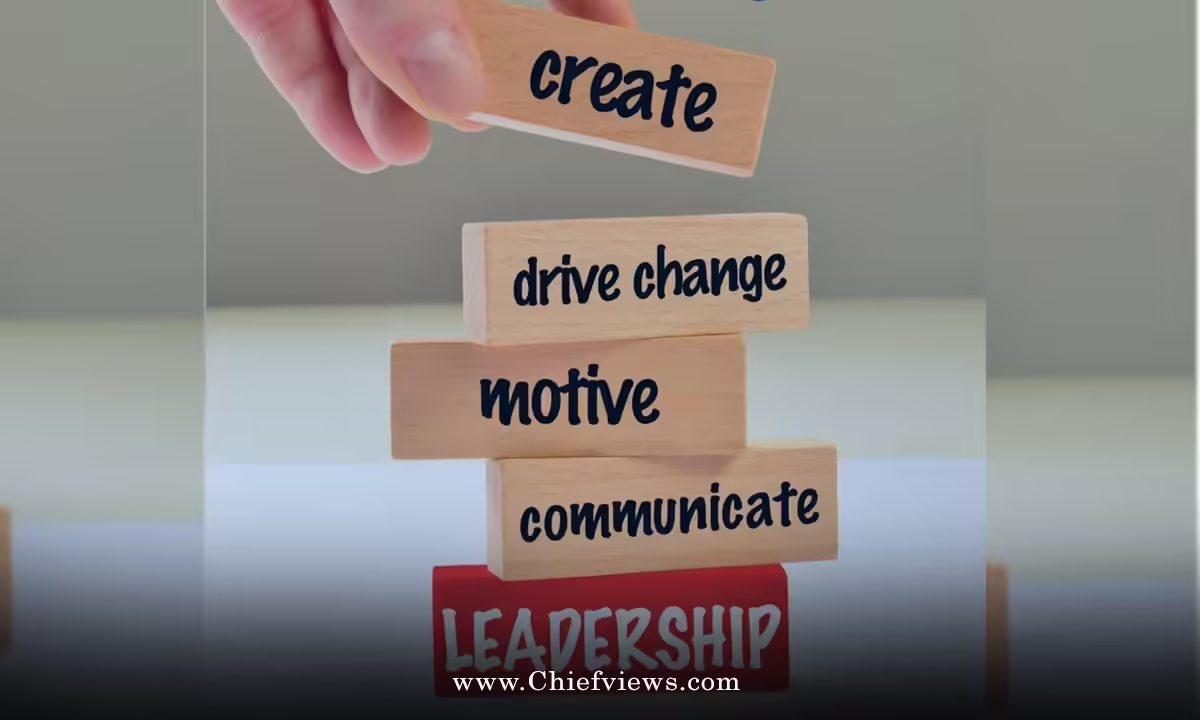
Leaders today need more than vision statements. They need fluency in AI alongside emotional intelligence.
Think of it like captaining a ship where the crew includes both sailors and AI-powered navigation systems. The captain doesn’t need to code the system, but must know when to trust it and when human judgment overrides.
Priorities here include:
- Developing “AI augmentation” skills – knowing what to automate versus what stays human.
- Training managers to lead hybrid teams.
- Creating psychological safety so people admit what they don’t know about new tools.
What I’d do if I were stepping into a new CHRO role tomorrow? Start with a leadership audit focused on AI comfort levels. Not just technical knowledge, but decision-making confidence.
Reshaping Organizational Culture for AI
Culture atrophy hits hard during tech shifts. People disengage. Innovation stalls. Resistance builds quietly.
Strong CHROs treat culture as infrastructure. They embed it into daily workflows rather than posters in break rooms.
Key moves:
- Transparent communication about AI’s impact on roles.
- Recognition systems that reward AI experimentation and knowledge sharing.
- Continuous feedback loops instead of annual surveys.
Like tending a garden in changing weather – you can’t control the rain (AI disruption), but you can prepare the soil (culture) so everything grows stronger.
HR Operating Model Evolution
CHROs must redesign their own functions too. Gartner notes that evolving the HR operating model delivers the highest predicted impact on AI productivity gains – 29%.
This means moving from administrative gatekeepers to strategic orchestrators of human + machine capability.
Comparison of Traditional vs. AI-Transformed Leadership Approaches
| Aspect | Traditional Leadership | AI-Transformed Leadership (2026) | Key CHRO Action Needed |
|---|---|---|---|
| Decision Making | Hierarchical, experience-based | Hybrid: Human judgment + AI insights | Train leaders on AI interpretation |
| Team Management | People only | Human-AI collaboration | Develop hybrid team protocols |
| Skill Development | Periodic training | Continuous, in-flow learning | Invest in just-in-time learning tools |
| Performance Metrics | Output volume | Value creation + innovation | Redesign KPIs for augmented work |
| Change Response | Reactive | Proactive orchestration | Build change resilience programs |
This table highlights the practical shifts CHROs must drive.
Step-by-Step Action Plan for Beginners and Intermediate HR Leaders
Getting started doesn’t require a massive budget. It requires focus.
- Assess Current State – Survey leaders and employees on AI comfort, fears, and readiness. Do this quarterly.
- Define Success – Work with the C-suite to clarify what AI transformation looks like for your business. Revenue growth? Innovation speed? Talent retention?
- Build Leadership Capabilities – Launch targeted programs. Start small: 90-day AI fluency cohorts for managers.
- Pilot Culture Initiatives – Create “AI experimentation zones” where teams test tools with safety nets and share learnings.
- Measure and Iterate – Track adoption rates, engagement scores, and productivity metrics tied to AI use. Adjust monthly.
- Scale with Governance – Establish cross-functional AI councils that include HR, IT, and business leaders.
Follow this and you’ll move faster than most competitors.
Common Mistakes & How to Fix Them
Mistake 1: Treating AI as purely a technology project.
Fix: Position CHRO as co-owner from day one. Partner tightly with CIOs on people aspects.
Mistake 2: Over-focusing on technical skills while ignoring mindset.
Fix: Balance training with sessions on ethical AI use, creativity, and human strengths.
Mistake 3: Rolling out tools without addressing job impact fears.
Fix: Communicate openly about role evolution, not elimination. Highlight new opportunities.
Mistake 4: One-size-fits-all leadership development.
Fix: Segment programs by role level and department. What a sales leader needs differs from engineering.
Mistake 5: Setting and forgetting culture efforts.
Fix: Make culture monitoring continuous. Use pulse surveys and real-time feedback tools.
CHRO Priorities for AI Transformation Leadership Development and Culture in 2026: Making It Stick
The real test comes in execution. Many organizations talk a good game about AI. Few integrate it into leadership DNA and daily culture.
Explore Gartner’s latest HR priorities research for deeper benchmarks on these shifts.
Leaders who succeed will create environments where people and AI amplify each other. Not compete.
Key Takeaways
- Leadership development remains the top CHRO priority, now redefined for human-AI collaboration.
- Culture isn’t soft – it’s the make-or-break factor for sustainable AI adoption.
- CHROs must evolve their own operating models to drive transformation.
- Start with assessment, pilot, then scale with clear metrics.
- Transparent communication beats top-down mandates every time.
- Hybrid skills (technical + human) define future-ready leaders.
- Measure what matters: adoption, engagement, and business outcomes.
- Act now. The window for competitive advantage closes fast.
CHRO Priorities for AI Transformation Leadership Development and Culture in 2026 aren’t optional. They’re how forward-thinking organizations build resilience and growth in uncertain times.
Your next step? Schedule that cross-functional AI strategy session this week. Don’t wait for perfect data. Start building momentum.
FAQs
How do CHRO Priorities for AI Transformation Leadership Development and Culture in 2026 differ from previous years?
They shift from awareness-building to deep integration. Leadership now focuses on execution in hybrid environments, while culture efforts target daily behaviors rather than annual events.
What skills should CHROs prioritize in leadership development programs for 2026?
Focus on AI literacy for decision-making, change orchestration, ethical judgment, and hybrid team management. Technical skills matter, but human-centric abilities differentiate great leaders.
How can smaller organizations address CHRO Priorities for AI Transformation Leadership Development and Culture in 2026 without big budgets?
Start with low-cost pilots, leverage free or affordable AI tools for learning, and build internal mentorship networks. Partner with industry groups for shared resources and benchmarks.


