









Digital resilience and compliance with AI regulations is the practical ability to keep operations running when AI systems glitch, get attacked, or run into new legal requirements—and to prove you’re doing it the right way under U.S. rules.
Here’s the quick take:
- Digital resilience means preparing for, absorbing, and bouncing back from AI-related disruptions—cyber incidents, model failures, data issues, or regulatory shifts—while staying operational.
- In the U.S. in 2026, there’s still no single federal AI statute. Compliance lives in a mix of state laws, NIST guidance, executive orders, and sector rules.
- Organizations that treat resilience and compliance as one program avoid costly surprises and keep innovating.
- Beginners start with inventory and risk mapping; intermediates layer in continuous testing and documentation.
- The payoff is fewer outages, lower legal exposure, and clearer board-level confidence.
Most teams I talk to still treat AI compliance as a legal checklist and digital resilience as an IT project. That split is expensive. When a model drifts or a new state rule lands, the same gaps surface: incomplete inventories, weak testing, and zero audit trail. The smart move is to build one operating system that covers both.
Why Digital Resilience and Compliance with AI Regulations Matter Right Now
The United States still lacks a comprehensive federal AI law. What exists is a live patchwork. California’s frontier-model rules, Texas’s Responsible Artificial Intelligence Governance Act, Colorado’s automated-decision requirements, and Illinois employment rules all carry real teeth. Federal side, the NIST AI Risk Management Framework remains the practical gold standard most companies reference, and recent executive actions push voluntary pre-release access for certain frontier models plus stronger cybersecurity expectations for critical systems.
Digital resilience sits underneath all of that. It’s the capacity to keep core services available when an AI system fails, gets manipulated, or suddenly needs human override. Think of it like a commercial aircraft’s redundant systems: the plane keeps flying even if one engine or sensor drops out. AI systems without that layer become single points of failure the moment regulation or an adversary pokes them.
In my experience, the companies that wait for “clarity” end up rewriting processes twice—once for the first state law that hits them, and again when the next one arrives. The ones that treat digital resilience and compliance with AI regulations as a single workstream move faster and spend less.


The Current U.S. Landscape in Plain English
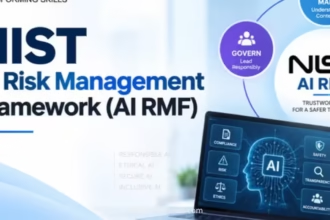
Federal posture in 2026 prioritizes American competitiveness and security over heavy-handed pre-approval. Executive Order 14409, for example, sets up voluntary frameworks for certain advanced models and directs agencies to harden systems against AI-enabled threats. The NIST AI Risk Management Framework still provides the most usable structure for mapping, measuring, and managing AI risk. You can download the core document and playbook directly from the NIST AI Risk Management Framework page.
State laws fill the gaps with specific obligations around transparency, high-risk decisions, and prohibited uses. Critical-infrastructure operators also face joint guidance from CISA and international partners on safely integrating AI into operational technology—see the CISA principles for secure AI integration in OT.
The practical result: every organization using AI that affects people in multiple states needs a living compliance map and resilience testing program.
Step-by-Step Action Plan for Beginners and Intermediates
Here’s what I’d do if I walked into a mid-sized company tomorrow with limited budget and a board that wants results in 90 days.
- Build the AI inventory (Week 1–2)
List every system that uses machine learning or generative models—internal tools, vendor products, shadow AI. Note owner, purpose, data sources, and whether it makes or influences consequential decisions (hiring, credit, healthcare, etc.). - Map risks against current rules (Week 2–3)
Cross-check the inventory against the NIST AI RMF functions (Govern, Map, Measure, Manage) and the state laws that actually apply to your users or employees. Flag high-risk systems first. - Stand up basic resilience controls (Week 3–6)
Add human-in-the-loop checkpoints for high-impact outputs. Set up model monitoring for drift and anomalous behavior. Document fallback procedures so a model outage doesn’t stop core operations. - Create the evidence package (Week 6–8)
Produce short risk assessments, testing records, and decision logs. These become your audit trail for state AGs or future federal questions. - Test and iterate (ongoing)
Run tabletop exercises that combine a model failure with a regulatory inquiry. Update the inventory every quarter. Assign a single owner who reports to both the CISO and the compliance lead.
Digital resilience and compliance with AI regulations That sequence turns abstract requirements into a working system without boiling the ocean.

Common Mistakes & How to Fix Them
Mistake one: treating every AI tool the same. A chatbot that answers FAQ questions is not the same risk as an automated hiring screener. Fix: tier systems by impact and apply heavier controls only where they matter.
Mistake two: relying on vendor “compliance certificates” without testing. Vendors change models constantly. Fix: require contractual rights to audit outputs and demand evidence of their own NIST-aligned processes.
Mistake three: building the compliance binder after the system is live. What usually happens is the legal team discovers gaps during the first customer complaint or AG letter. Fix: make risk mapping a gate before production deployment.
Mistake four: ignoring operational technology and agentic systems. Guidance from CISA and partners is clear that AI in critical infrastructure needs extra safeguards. Fix: treat OT AI as a distinct category with fail-safes and continuous validation.
Practical Comparison: Reactive vs. Resilient Approach
| Aspect | Reactive Approach | Resilient + Compliant Approach | Typical Outcome Difference |
|---|---|---|---|
| Inventory | Built only when asked | Living list updated quarterly | Faster response to new state rules |
| Testing | One-time validation at launch | Continuous monitoring + tabletop exercises | Fewer production failures |
| Documentation | Scattered emails and slide decks | Structured risk assessments and decision logs | Cleaner audits, lower legal spend |
| Human Oversight | Ad-hoc | Defined checkpoints for high-impact decisions | Reduced bias and error exposure |
| Vendor Management | Trust the contract | Audit rights + shared evidence requirements | Better leverage when models change |
| Time to Fix a Gap | Weeks to months | Days | Lower downtime and regulatory risk |
The table is not theoretical. Teams that run the right-hand column routinely cut both outage time and external counsel hours.
Digital Resilience and Compliance with AI Regulations in Daily Practice
Digital resilience and compliance with AI regulations Once the foundation is in place, the work becomes routine. Leadership gets a simple dashboard: number of high-risk systems, last test date, open findings, and any new state obligations. Engineers get clear acceptance criteria before they ship. Legal gets evidence instead of scrambling.
One fresh way to think about it: digital resilience and compliance with AI regulations is less like building a fortress and more like maintaining a well-rehearsed pit crew. When something breaks or a new rule appears, the team already knows the sequence, the tools are staged, and the car is back on the track fast.
Key Takeaways
- No single federal AI law exists in 2026—state rules plus NIST guidance drive real obligations.
- Digital resilience is the operational backbone that makes compliance sustainable.
- Start with a complete inventory and risk tiering; everything else builds on that.
- Continuous testing and human oversight beat one-time certifications.
- Documentation is not bureaucracy—it is your defense and your learning loop.
- Treat vendor AI the same as internal systems for risk and evidence.
- Critical-infrastructure operators have extra CISA-aligned duties around operational technology.
- Assign one cross-functional owner so the work does not fall between silos.
Digital resilience and compliance with AI regulations The organizations that treat digital resilience and compliance with AI regulations as a single, living practice keep shipping while others pause for legal reviews. The next step is simple: pull your current AI inventory this week. If you do not have one, that is the first gap to close. From there the rest of the plan falls into place.
FAQs
How does digital resilience and compliance with AI regulations differ for small companies versus large enterprises?
Smaller teams focus on the highest-impact systems first and lean heavily on NIST resources and vendor evidence. Larger organizations need formal governance structures and multi-state mapping, but the core steps—inventory, tiering, testing—stay the same.
What happens if my company ignores state AI laws while waiting for federal clarity?
State attorneys general are already enforcing. Ignoring applicable rules can trigger investigations, civil penalties, and private lawsuits depending on the jurisdiction. Building the resilience layer now costs less than reacting under pressure.
Can following the NIST AI Risk Management Framework satisfy digital resilience and compliance with AI regulations requirements?
It is the strongest voluntary foundation available and is explicitly referenced in some state safe-harbor language. It does not automatically satisfy every state-specific disclosure or testing rule, so map the framework to the statutes that actually apply to your users and operations.

