






eCommerce cash flow management is the single most underdiscussed reason profitable-looking stores suddenly can’t make payroll — and the most powerful lever founders have to actually scale with control. You can be pulling $5M in annual revenue and still be two bad inventory decisions away from a genuine crisis. That’s not dramatic. That’s just the math of running an online brand.
Here’s a hard truth: according to research cited by the U.S. Chamber of Commerce, 82% of small business failures are tied to poor cash flow management or a poor understanding of cash flow — not bad products, not weak marketing. Cash. And eCommerce makes this harder than almost any other business model, because you’re constantly solving a timing puzzle between money going out and money coming in.
Quick Overview — What You Need to Know:
- 💸 eCommerce cash flow is uniquely difficult because you spend on inventory 60–90 days before you collect revenue from it
- 📊 A 13-week rolling cash flow forecast is the single most impactful tool you can build right now
- 🔁 The Cash Conversion Cycle (CCC) — how fast you turn inventory into cash — is the core KPI every eCommerce brand should obsess over
- 📦 Inventory is simultaneously your biggest asset and your biggest cash trap — managing it tightly is non-negotiable
- 🧠 At $1M+ in revenue, this gets too complex to manage reactively — most brands benefit from structured financial leadership, whether through internal hires or an outsourced CFO for eCommerce businesses
Why eCommerce Cash Flow Management Is a Fundamentally Different Beast
Traditional retail cash flow is complicated. eCommerce cash flow is a different animal entirely.
Here’s why: you’re juggling platform payout delays (Amazon holds funds for up to 14 days), high return rates averaging 20–30% across most categories, inventory you bought months ago with money you haven’t collected yet, and advertising costs that hit your account the same day — while revenue trickles in over the next week.
According to the Federal Reserve’s 2025 Small Business Credit Survey, 51% of small employer firms cited uneven cash flows as a financial challenge in the prior 12 months. And the JPMorgan Chase Institute found that the median small business holds just 27 cash buffer days — less than one month of runway if inflows stop.



For eCommerce brands specifically, three structural forces drive most of the volatility:
- Inventory timing — cash leaves your account weeks or months before revenue arrives
- Channel payout delays — every platform (Amazon, Shopify, TikTok Shop) has a different settlement schedule
- Return exposure — a 25% return rate on a $500K revenue month is $125,000 in cash walking back out the door
The kicker is that all three can hit simultaneously during your biggest sales period. Q4 is when most brands generate 40–50% of annual revenue — and also when cash flow tension is at its absolute worst.
The Cash Conversion Cycle: Your Most Important Number
If you track one metric, make it this.
The Cash Conversion Cycle (CCC) tells you exactly how many days it takes for a dollar you spend on inventory to come back as cash. The formula:
$$CCC = DIO + DSO – DPO$$
Where:
- DIO = Days Inventory Outstanding (how long stock sits before selling)
- DSO = Days Sales Outstanding (how long until you actually get paid)
- DPO = Days Payable Outstanding (how long you have to pay your suppliers)
A shorter CCC means healthier cash flow. A longer one means you’re funding the gap with your own working capital — or borrowing to cover it.
For well-managed eCommerce brands, benchmarks look like this:
| Metric | Healthy Range | Red Flag Zone |
|---|---|---|
| Days Inventory Outstanding (DIO) | 30–45 days | 60+ days |
| Days Sales Outstanding (DSO) | 3–10 days (D2C) | 14+ days |
| Days Payable Outstanding (DPO) | 30–60 days | Under 15 days |
| Cash Conversion Cycle (CCC) | Under 30 days | Over 60 days |
| Cash Buffer (months of opex) | 3–6 months | Under 1 month |
| Return Rate | Under 15% | 25%+ (category dependent) |
The goal is to stretch DPO (pay suppliers later) while compressing DIO (sell faster) and DSO (get paid sooner). Every lever you pull on any one of those three variables directly improves your cash position.
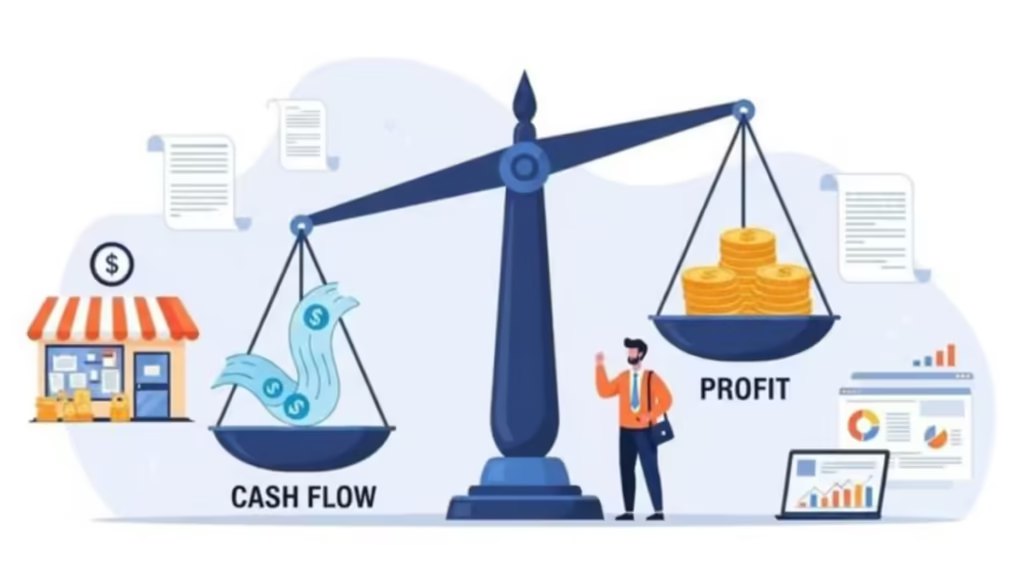
eCommerce Cash Flow Management: A Step-by-Step Action Plan for Beginners
New to managing this systematically? Start here. Build in this order.
Step 1: Get a clean picture of where you actually stand. Pull your last 90 days of bank statements, platform payouts, and supplier invoices. Map the actual timing — not the revenue date, the deposit date. Most founders are shocked by the gap. This is your baseline.
Step 2: Build a 13-week rolling cash flow forecast. This is the foundational tool of every serious eCommerce finance operation. List every cash inflow and outflow by week for the next 13 weeks. Update it every Monday. Use conservative revenue estimates — 10% below your actual projections — and pad expenses by 10% upward. This gives you a stress-tested view of your liquidity runway.
Tools that integrate with QuickBooks or Xero and make this easier: Jirav, Fathom, or Pulse.
Step 3: Classify your inventory using ABC analysis.
- A items = 20% of SKUs that drive 80% of revenue → Never stock out. Prioritize these.
- B items = next tier, moderate investment
- C items = slow movers tying up cash → Run flash sales, bundle them, or cut them
Step 4: Negotiate better supplier payment terms. Most founders accept whatever terms the supplier offers initially. Negotiate. Moving from Net-30 to Net-60 on your top three suppliers can free up meaningful working capital without a single dollar of new financing.
Step 5: Audit your “invisible” cash leaks. Pull every subscription charge, SaaS tool, and 3PL invoice for the last 30 days. Check for dimensional weight overages, unused software, and ad spend with no ROI benchmark. These leaks compound silently.
Step 6: Build a cash reserve during peak months. During Q4, resist the urge to scale overhead. Set aside 20–30% of Q4 profits into a dedicated “slump fund” account. January and February will thank you.
Step 7: Layer in financing — strategically. Revenue-based financing tools like Clearco, Wayflyer, or Shopify Capital can bridge inventory gaps without equity dilution. Use them for ROI-positive activities only — inventory purchases for a proven SKU, scaling a profitable ad channel. Never use working capital financing to cover fixed overhead.
The 5 Biggest Cash Flow Mistakes eCommerce Brands Make
What usually happens is founders don’t realize they have a structural problem — they think they just had a bad month. These are the patterns that make it a bad quarter.
Mistake 1: Confusing Revenue With Cash
Your Shopify dashboard might show $80K in sales this month. But after Amazon’s 14-day hold, Stripe’s settlement timing, $12K in returns, and platform fees — your actual bank deposit is often 30–40% lower and delayed by two weeks. Revenue ≠ cash. Never manage your business off revenue figures.
Mistake 2: Over-Investing in Inventory to Chase a Discount
Getting a 15% discount for ordering 3x your normal quantity feels smart. But if that inventory takes 90 days to sell, you’ve just funded a three-month cash gap to save a few thousand dollars. Unless your cash position is strong, the discount isn’t worth it.
Mistake 3: Ignoring Return Reserves
Every eCommerce brand should be holding a reserve for expected returns. If you’re running a 20% return rate on a $200K month, that’s $40K that will be walking back out the door. Account for it before it happens — not after it hits your account.
Mistake 4: Spending Ad Dollars Without an MER Benchmark
Don’t just track ROAS by channel. Track your Marketing Efficiency Ratio (MER) — total revenue divided by total ad spend across all channels. If your MER is trending down while spend goes up, you’re burning cash faster than it’s coming in. This is one of the most common silent cash drains in scaling DTC brands.
Mistake 5: Reacting Instead of Forecasting
The Federal Reserve’s 2025 SBCS found that only 31% of small businesses actively optimize cash flow rather than reacting week to week. Reactive cash management means you’re always solving last week’s problem. The 13-week forecast flips that. You’re solving next month’s problem — while you still have options.
eCommerce Cash Flow Management Tools Stack (2026)
You don’t need to do this manually. Here’s what the best-run brands use:
| Category | Tools | Purpose |
|---|---|---|
| Accounting | QuickBooks Online, Xero | Books, monthly close, P&L |
| Forecasting | Jirav, Fathom, Pulse | 13-week cash forecast, scenario modeling |
| Inventory | Inventory Planner by Sage, Flieber | Demand forecasting, reorder automation |
| Financing | Wayflyer, Clearco, Shopify Capital | Revenue-based inventory financing |
| Expense Management | Ramp, Parker | Ad spend controls, corporate cards built for eCommerce |
| Payments | Stripe Instant Payouts | Compress settlement timing on demand |
When Cash Flow Complexity Outgrows DIY
Here’s a question worth sitting with: at what point does managing this yourself cost more than getting professional help?
For most eCommerce brands, that inflection point hits around $1M in annual revenue — especially if you’re multi-channel, carrying inventory, or running paid ads at scale. The combination of channel-level profitability tracking, inventory financing decisions, ad spend efficiency analysis, and forward-looking cash forecasting is a full-time financial job.
That’s exactly why many growing brands bring on an outsourced CFO for eCommerce businesses — not because they can’t run a spreadsheet, but because the strategic cost of getting these decisions wrong at $2M, $5M, or $10M in revenue is far higher than the retainer. The U.S. Small Business Administration’s financial management resources consistently reinforce building financial infrastructure proactively — before a crisis forces your hand.
Key Takeaways
- eCommerce cash flow management is structurally harder than most business models because of inventory timing, payout delays, and return exposure
- The Cash Conversion Cycle (CCC) — DIO + DSO − DPO — is your single most important financial metric; shorten it relentlessly
- A 13-week rolling cash flow forecast, updated weekly, is the non-negotiable foundation of any serious eCommerce finance operation
- 82% of small business failures are linked to poor cash flow management (U.S. Bank research, cited by U.S. Chamber of Commerce) — this isn’t a back-office issue; it’s an existential one
- ABC inventory analysis separates cash-generating SKUs from cash-draining ones; cut or liquidate C-items before they become a balance sheet problem
- Negotiating extended supplier payment terms (Net-60, Net-90) is often the fastest, cheapest way to free up working capital — no new financing required
- Revenue-based financing from platforms like Wayflyer or Shopify Capital is a legitimate tool for bridging inventory gaps — but only for ROI-positive uses
- When revenue crosses $1M+ with multi-channel complexity, most brands need structured financial leadership — either internal or via an experienced outsourced finance partner
The bottom line is this: cash flow isn’t a finance problem. It’s a decision-making problem. Every choice you make about inventory, advertising, pricing, and supplier terms is a cash flow decision in disguise. Build the systems to see your cash position clearly, 13 weeks out, and the right decisions become obvious. Wait until the gap hits your bank account to notice it — and you’re always playing catch-up.
Start with the 13-week forecast. Run your ABC analysis. Check your CCC. Do those three things this week and you’ll have more financial clarity than 70% of the eCommerce brands running at your revenue level.
Frequently Asked Questions
Q1: What’s the most common cash flow mistake eCommerce businesses make?
The single most common mistake is managing the business off revenue figures rather than actual cash in the bank. Platform payouts are delayed, returns reduce deposits, and fees eat margins — meaning your Shopify or Amazon dashboard always shows a more optimistic number than your bank account. Build the habit of forecasting and tracking cash, not just sales.
Q2: How does eCommerce cash flow management connect to needing an outsourced CFO?
When cash flow management gets complex — multiple sales channels, inventory financing decisions, seasonal planning, and channel-level profitability analysis all running simultaneously — it moves beyond what a bookkeeper or founder can realistically handle alone. An outsourced CFO for eCommerce businesses provides the strategic financial layer that turns reactive cash management into a proactive system, including building and maintaining the 13-week forecast, optimizing the cash conversion cycle, and advising on financing decisions before they become urgent.
Q3: How much cash reserve should an eCommerce brand carry?
The widely recommended benchmark is 3–6 months of operating expenses in liquid savings. For eCommerce brands with high seasonality, lean toward the 6-month end, since Q1 and Q2 cash gaps after a heavy Q4 inventory build are extremely common. The JPMorgan Chase Institute found the median small business holds only 27 cash buffer days — well below this threshold — which tells you how many brands are operating closer to the edge than they realize.