




By using this site, you agree to the Privacy Policy and Terms of Use.
Accept
chiefviews.com
Subscribe
  • Home
  • CHIEFS
    • CEO
    • CFO
    • CHRO
    • CMO
    • COO
    • CTO
    • CXO
    • CIO
  • Technology
  • Magazine
  • Industry
  • Contact US
Reading: How to Build High-Performing Leadership Teams
chiefviews.comchiefviews.com
Aa
  • Pages
  • Categories
Search
  • Pages
    • Home
    • Contact Us
    • Blog Index
    • Search Page
    • 404 Page
  • Categories
    • Artificial Intelligence
    • Discoveries
    • Revolutionary
    • Advancements
    • Automation

Must Read

IT Financial Management

IT Financial Management: A Practical 2026 Guide to Smarter IT Spend, Better Governance, and Faster Decisions

How CIO can drive CIO CFO alliance for AI tech decisions

How CIO can drive CIO CFO alliance for AI tech decisions: a practical playbook for getting both leaders aligned

AI Governance Framework

AI Governance Framework: the practical guide for building control, trust, and scale into enterprise AI

CTO strategies for orchestrating AI transformation roadmap

CTO strategies for orchestrating AI transformation roadmap: how to turn AI ambition into an operating plan that ships

Enterprise AI Governance Framework

Enterprise AI Governance Framework: The CTO’s Blueprint for 2026 and Beyond

Follow US
  • Contact Us
  • Blog Index
  • Complaint
  • Advertise
© Foxiz News Network. Ruby Design Company. All Rights Reserved.
chiefviews.com > Blog > Business And Finance > How to Build High-Performing Leadership Teams
Business And Finance

How to Build High-Performing Leadership Teams

William Harper By William Harper August 4, 2026
Share
7 Min Read
How to Build High-Performing Leadership Teams
SHARE
flipboard
Flipboard
Google News

How to build high-performing leadership teams begins with a truth every growing business eventually faces: a single strong leader is not enough. You need a group of people who can set direction, make decisions quickly, and keep the whole organization moving in the same direction. When that group is weak, projects stall, talent leaves, and the COO ends up carrying more than any one person should.

In this article, we’re going to be taking a look at how to build high-performing leadership teams, and how you can create a group that delivers results without constant oversight. If you would like to find out more, feel free to read on.

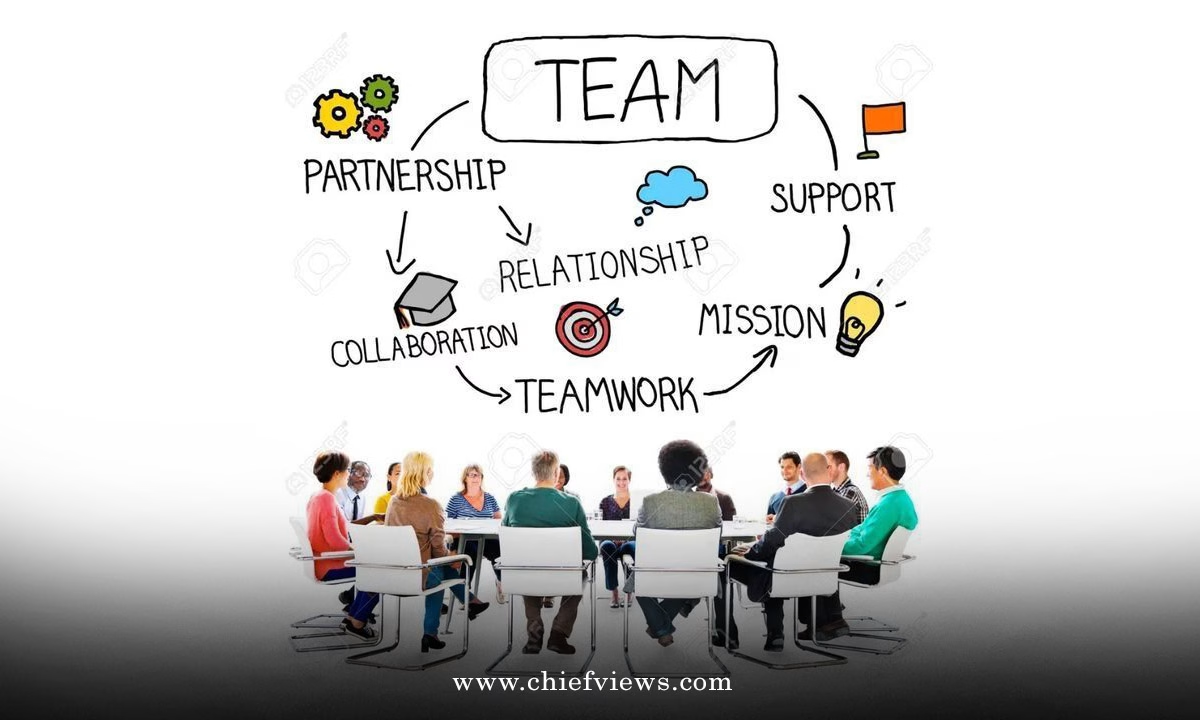
Pic – CC0 License

Start with the right people in the right seats

You cannot coach your way out of a fundamental mismatch. Begin by clarifying the outcomes each leadership role must deliver. Look at skills, experience, and the ability to work across functions. A strong individual contributor does not automatically become a strong leader of people.

Assess current team members honestly. Where gaps exist, decide whether training, coaching, or a new hire is the better path. Involve your existing leaders in the process so they feel ownership rather than threat. When the right people sit in the right seats, the rest of the work becomes far easier.


More Read

IT Financial Management
IT Financial Management: A Practical 2026 Guide to Smarter IT Spend, Better Governance, and Faster Decisions
How CIO can drive CIO CFO alliance for AI tech decisions
How CIO can drive CIO CFO alliance for AI tech decisions: a practical playbook for getting both leaders aligned
AI Governance Framework
AI Governance Framework: the practical guide for building control, trust, and scale into enterprise AI

Create shared purpose and clear priorities

High-performing teams know exactly why they exist and what success looks like this quarter and this year. Bring the group together to define a short list of shared priorities that cut across departments. Write them down and keep them visible.

Revisit these priorities regularly so they stay relevant as the business changes. When everyone understands the same destination, debates become productive instead of political. This clarity also supports best practices for COO managing cross functional teams by giving every leader a common reference point when they work with peers from other areas.

Build trust through consistent behavior

Trust grows when leaders do what they say they will do and treat one another with respect, even under pressure. Model the standard yourself. Show up prepared, listen fully, and give credit where it belongs.

Address tension early. Unspoken frustration damages performance faster than almost any other factor. Create a simple agreement on how the team will handle disagreement and hold one another accountable to it. Over time, this creates a culture where people raise problems early instead of hiding them.

Establish strong decision-making habits

Confusion over who decides what slows everything down. Map decision rights clearly for the leadership group. Spell out which calls stay with the CEO or COO, which ones the team makes together, and which ones individual leaders own.

Push decisions to the lowest practical level. When leaders know they have real authority, they act faster and take greater ownership. Review the decision map every few months as the business grows and roles evolve. Clear decision rights reduce the late-night escalations that drain energy.

Set up simple rhythms of communication and accountability

Regular, focused conversations keep the team aligned without creating meeting overload. A short weekly check-in for status and blockers, a monthly deeper review of results, and a quarterly look at strategy usually cover the essentials.

Keep agendas tight and end every meeting with clear next steps and owners. Track a handful of shared metrics that matter to the whole business rather than department-only numbers. When leaders review the same scorecard together, collaboration improves naturally.

Develop the team as a group, not just as individuals

Individual coaching matters, but high-performing leadership teams also grow through shared experiences. Run short workshops on facilitation, conflict resolution, or strategic thinking. Bring in outside perspectives occasionally so the group does not become too inward-looking.

Create opportunities for leaders to work on cross-functional projects together. These experiences build empathy and practical working relationships that later support smoother collaboration across the wider organization. Investing in the team as a unit pays off when pressure rises.

Measure progress and adjust openly

What gets measured gets managed. Choose a few indicators of team health and performance—decision speed, cross-functional project success rates, or employee engagement scores under each leader—and review them together.

Be willing to change the structure, the people, or the processes when evidence shows they are not working. High-performing teams stay curious about their own effectiveness. They treat feedback as useful data rather than personal criticism.

Protect the team’s focus and energy

Leaders can only do so much. Guard against overload by regularly reviewing the number of major initiatives on the plate. Say no to good ideas that dilute focus on the most important work.

Encourage sustainable working patterns. Burned-out leaders make poorer decisions and set a damaging example for the rest of the organization. A team that manages its energy well outperforms one that simply works longer hours.

We hope that you have found this article enlightening in some way and that these steps help you put a stronger leadership team in place. Start with one or two changes this month, observe the impact, and build from there. A high-performing leadership group multiplies the effort of everyone around them and makes the entire business more resilient.


TAGGED: #chiefviews.com, #How to Build High-Performing Leadership Teams
Share This Article
Facebook Twitter Print
Previous Article Martech and AI marketing leadership Martech and AI marketing leadership
Next Article Scaling engineering teams Singapore Scaling engineering teams Singapore

Get Insider Tips and Tricks in Our Newsletter!

Join our community of subscribers who are gaining a competitive edge through the latest trends, innovative strategies, and insider information!
[mc4wp_form]
  • Stay up to date with the latest trends and advancements in AI chat technology with our exclusive news and insights
  • Other resources that will help you save time and boost your productivity.

Must Read

Why Hiring a Professional Writer is Essential for Your Business

The Importance of Regular Exercise

Understanding the Importance of Keywords in SEO

The Importance of Regular Exercise: Improving Physical and Mental Well-being

The Importance of Effective Communication in the Workplace

Charting the Course for Tomorrow’s Cognitive Technologies

- Advertisement -
Ad image

You Might also Like

IT Financial Management

IT Financial Management: A Practical 2026 Guide to Smarter IT Spend, Better Governance, and Faster Decisions

IT Financial Management is the discipline of making IT spend visible, defensible, and tied to…

By William Harper 12 Min Read
How CIO can drive CIO CFO alliance for AI tech decisions

How CIO can drive CIO CFO alliance for AI tech decisions: a practical playbook for getting both leaders aligned

How CIO can drive CIO CFO alliance for AI tech decisions starts with one simple…

By William Harper 13 Min Read
AI Governance Framework

AI Governance Framework: the practical guide for building control, trust, and scale into enterprise AI

An AI Governance Framework is the operating system for responsible AI: the rules, roles, controls,…

By William Harper 11 Min Read
CTO strategies for orchestrating AI transformation roadmap

CTO strategies for orchestrating AI transformation roadmap: how to turn AI ambition into an operating plan that ships

CTO strategies for orchestrating AI transformation roadmap start with one simple truth: AI does not…

By William Harper 13 Min Read
Enterprise AI Governance Framework

Enterprise AI Governance Framework: The CTO’s Blueprint for 2026 and Beyond

Enterprise AI governance framework isn't a buzzword anymore — it's the difference between shipping agentic…

By William Harper 17 Min Read
CTO Guide to Managing 33% Agentic AI Application Adoption

CTO Guide to Managing 33% Agentic AI Application Adoption

CTO guide to managing 33% agentic AI application adoption starts with one grounding fact: Gartner…

By William Harper 13 Min Read
chiefviews.com

Step into the world of business excellence with our online magazine, where we shine a spotlight on successful businessmen, entrepreneurs, and C-level executives. Dive deep into their inspiring stories, gain invaluable insights, and uncover the strategies behind their achievements.

Quicklinks

  • Privacy Policy
  • Manage Cookies
  • Terms and Conditions
  • Guest Post
  • Contact Us

About US

  • Contact Us
  • Blog Index
  • Complaint
  • Advertise

Copyright Reserved At ChiefViews 2012

Get Insider Tips

Gaining a competitive edge through the latest trends, innovative strategies, and insider information!

[mc4wp_form]
Zero spam, Unsubscribe at any time.