





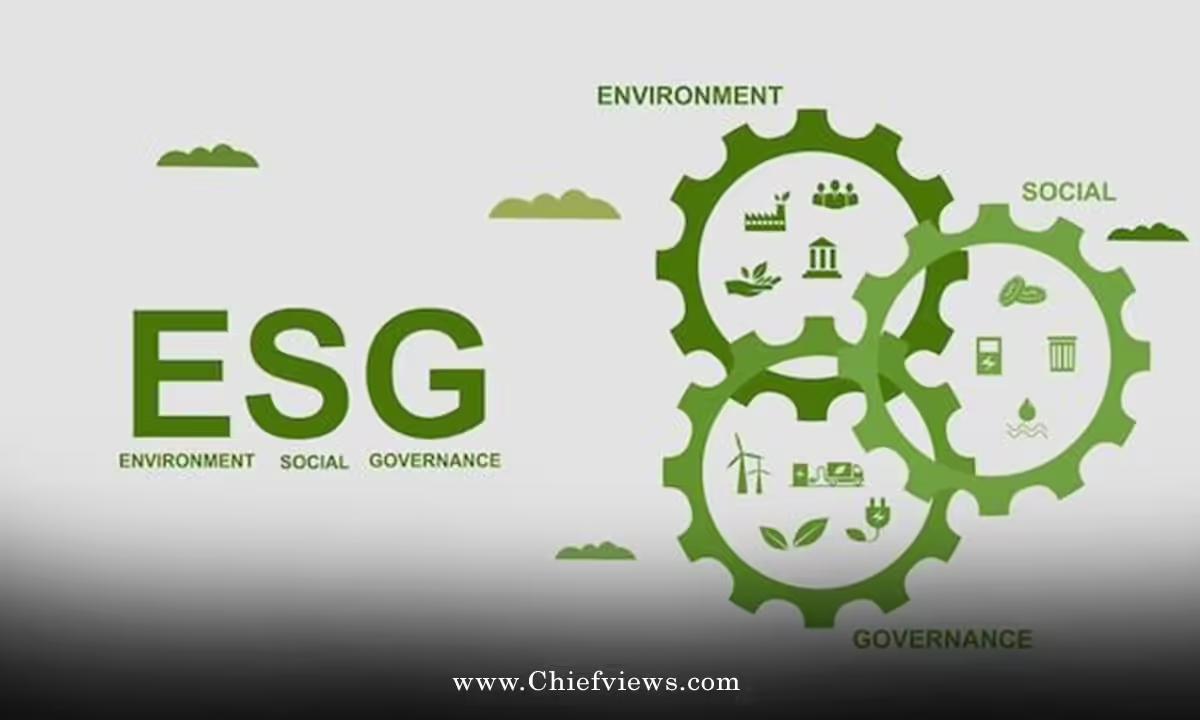
ESG metrics for companies 2026 have evolved from optional disclosures to mandatory performance indicators that directly influence funding, regulatory compliance, and competitive positioning. CFOs and executives now rely on these metrics to justify capital decisions, attract institutional investors, and mitigate risks in a hyper-transparent market.
If you’re tracking ESG metrics for companies 2026, you’re not chasing trends—you’re safeguarding your balance sheet. Poor ESG performance correlates with higher borrowing costs, investor pullbacks, and talent flight. Get this right, and you unlock lower capital costs and premium valuations.
This guide breaks down the essential ESG metrics for companies 2026, with practical tracking methods and integration tips. Perfect for finance teams building robust reporting.
Why ESG Metrics for Companies 2026 Are Non-Negotiable
Institutions manage trillions and won’t touch companies without credible ESG data. By 2026, over 80% of assets under management incorporate ESG screening.
Here’s the hard truth: ESG metrics aren’t just for PR departments. They quantify risk and opportunity in your operations.
Fast facts on impact:



- Companies with top-quartile ESG ratings see 5–10% lower cost of debt.
- Regulatory filings now require climate and social disclosures.
- Talent acquisition costs drop when ESG scores improve.
Ignore them at your peril.
The Core ESG Metrics Categories in 2026
ESG metrics for companies 2026 cluster into environmental, social, and governance pillars. Each has standardized KPIs backed by frameworks like ISSB and TCFD.
Environmental Metrics (E): The Risk Multiplier
Environmental metrics dominate because climate risks are quantifiable and material. Focus here first.
Key metrics:
- Scope 1 Emissions: Direct emissions from owned sources (fuel combustion, manufacturing). Measured in metric tons of CO2e.
- Scope 2 Emissions: Indirect emissions from purchased energy. Track electricity, steam, heating.
- Scope 3 Emissions: Value chain emissions (supply chain, product use, business travel). Often 70–90% of total footprint.
- Water Usage Intensity: Liters per revenue dollar. Critical for manufacturing and agriculture.
- Waste Diversion Rate: Percentage of waste recycled or composted vs. landfilled.
- Renewable Energy Percentage: Share of energy from renewables.
Pro tip: Use science-based targets for emissions (aligned with 1.5°C pathways). Investors demand this.
Social Metrics (S): Human Capital and Stakeholders
Social metrics capture people-related risks. These drive litigation, turnover, and brand risk.
Essential ones:
- Diversity Metrics: Percentage of women/underrepresented groups in executive roles, management, and total workforce.
- Pay Equity Ratio: Ratio of highest to lowest pay within gender/race categories. Aim for <2:1.
- Employee Turnover Rate: Voluntary attrition by department and demographics.
- Health & Safety Incident Rate: Lost time injury frequency rate (LTIFR).
- Supplier Diversity Spend: Percentage of spend with minority-owned businesses.
- Community Investment: Dollars invested in local communities per revenue.
Reality check: High turnover in key roles costs 1.5–2x salary in recruitment and training. Track religiously.
Governance Metrics (G): Trust and Decision Quality
Governance metrics ensure ethical operations and sound decisions.
Track these:
- Board Independence: Percentage of independent directors.
- Board Diversity: Gender, ethnicity, skills diversity.
- Executive Compensation Alignment: Percentage of pay tied to ESG performance.
- Anti-Corruption Policies: Number of training sessions, hotline reports.
- Audit Committee Effectiveness: Meeting frequency, external audit rotation.
- Shareholder Rights: Proxy access, majority voting standards.
Strong governance correlates with lower fraud risk and better capital allocation.
Standardized ESG Metrics Frameworks Driving 2026 Reporting
No more bespoke metrics. Global standards rule.
ISSB (International Sustainability Standards Board): Mandatory baseline for most public companies. Covers general ESG disclosures plus industry-specific metrics.
TCFD (Task Force on Climate-Related Financial Disclosures): Climate metrics standard. Governance, strategy, risk management, metrics & targets.
GRI (Global Reporting Initiative): Comprehensive standards for all ESG topics. Widely used for stakeholder reporting.
SASB (Sustainability Accounting Standards Board): Industry-specific metrics. Now integrated into ISSB.
Science Based Targets Initiative (SBTi): Emissions reduction targets validated by science.
Pick your framework based on audience: ISSB/TCFD for investors, GRI for stakeholders.
For deeper integration with capital decisions, explore sustainable ESG investing frameworks for CFOs optimizing capital allocation 2026.
How to Measure and Track ESG Metrics for Companies 2026
Step 1: Data Collection
- Internal systems: Pull from ERP (energy, waste), HRIS (diversity, turnover), procurement (supplier data).
- Third-party audits: Verify emissions and supply chain data annually.
- Employee surveys: Capture qualitative social data (engagement, inclusion).
Step 2: Normalization
Report metrics per unit of output:
- Emissions per revenue dollar
- Water per production unit
- Turnover per employee
This scales across company sizes.
Step 3: Benchmarking
Compare against:
- Industry peers (via MSCI, Sustainalytics ratings)
- Best-in-class (top 10% performers)
- Internal historical performance
Step 4: Automation
Deploy software:
- Carbon accounting: Watershed, Persefoni for emissions.
- ESG platforms: Workiva, Novisto for integrated reporting.
- HR analytics: LinkedIn, Culture Amp for social metrics.
Manual spreadsheets work for startups. Scale to software at $50M+ revenue.
Tracking table example:
| Metric Category | Key Metric | Target | Q1 2026 Actual | Industry Avg |
|---|---|---|---|---|
| Environmental | Scope 1 Emissions (tCO2e) | 10,000 | 11,200 | 15,000 |
| Social | Turnover Rate (%) | <10% | 12% | 14% |
| Governance | Board Diversity (%) | 40% | 35% | 30% |
ESG Metrics Comparison: 2023 vs. 2026
The shift is dramatic.
| Aspect | 2023 Status | 2026 Reality |
|---|---|---|
| Scope 3 Reporting | Voluntary, inconsistent | Mandatory for material sectors |
| Social Metrics | Basic diversity stats | Pay equity, supplier audits required |
| Governance | Self-reported policies | Third-party verified, compensation linkage |
| Frequency | Annual reports | Quarterly disclosures |
| Standardization | Fragmented frameworks | ISSB convergence |
| Investor Impact | Screening | Active engagement, voting |
Data from established reporting trends shows convergence accelerating.

Integrating ESG Metrics into Business Decisions
Metrics without action are pointless.
For CFOs:
- Tie executive bonuses to 3–5 key metrics.
- Adjust hurdle rates: ESG-aligned projects get 1–2% lower thresholds.
- Use metrics in capital allocation scoring.
For Operations:
- Monthly KPI dashboards.
- Supplier scorecards based on ESG performance.
Risk Management:
- Stress-test scenarios: “What if carbon taxes double?”
- Litigation risk scoring for social issues.
Common Pitfalls in ESG Metrics Tracking
Pitfall 1: Cherry-Picking Metrics You report diversity wins but ignore emissions. Fix: Materiality assessment first.
Pitfall 2: Inaccurate Data Garbage in, garbage out. Fix: Third-party verification for high-risk metrics.
Pitfall 3: No Baselines Can’t improve what you don’t measure. Fix: 3-year historical data minimum.
Pitfall 4: Ignoring Scope 3 Your footprint lives upstream/downstream. Fix: Engage top 20 suppliers for data.
Pitfall 5: Static Targets Business changes. Fix: Annual review and adjustment.
Action Plan: Implement ESG Metrics in 90 Days
- Week 1–2: Conduct materiality workshop. Identify top 10 metrics.
- Week 3–4: Map data sources. Assign owners.
- Week 5–8: Build dashboard. Test data flows.
- Week 9–12: Set baselines, targets. Board presentation.
Budget: $25K–$75K. ROI: Compliance + investor confidence.
Key Takeaways: ESG Metrics for Companies 2026
- Standardization rules: ISSB, TCFD, GRI provide the backbone. No excuses for inconsistency.
- Scope 3 dominates environmental risk—often 70%+ of footprint. Track suppliers rigorously.
- Social metrics drive costs: Turnover, pay equity directly hit P&L.
- Governance builds trust: Investors vote with their feet on weak boards.
- Quarterly tracking beats annual: Real-time dashboards enable course correction.
- Benchmark relentlessly: Peer comparison reveals gaps fast.
- Automate early: Manual processes don’t scale past mid-size.
- Link to incentives: Metrics without accountability are theater.
Tools for ESG Metrics Mastery
- Emissions: Microsoft Cloud for Sustainability, Salesforce Net Zero.
- Social: Visier (workforce analytics), Qualtrics (engagement).
- Integrated: Enablon, IBM Envizi.
- Free starters: EPA calculators, GRI database.
Conclusion
ESG metrics for companies 2026 aren’t checkboxes—they’re your risk dashboard, investor pitch, and competitive edge. Master the core metrics across E, S, G pillars. Standardize with ISSB/TCFD. Track quarterly. Link to decisions.
Strong metrics lower your cost of capital and open doors to premium funding. Weak ones close them.
Grab your materiality matrix today. Assign metric owners tomorrow. Report to the board next month. Momentum builds from there.
Metrics measured get managed. Metrics managed win markets.
Sources
- International Sustainability Standards Board (ISSB) — Core standards for ESG metrics disclosure.
- Task Force on Climate-Related Financial Disclosures (TCFD) — Climate metrics and governance framework.
- Global Reporting Initiative (GRI) — Comprehensive ESG reporting standards used worldwide.
Frequently Asked Questions
Q1: Which ESG metrics matter most for my industry?
Materiality drives this. Tech prioritizes data privacy and diversity. Manufacturing focuses on emissions and safety. Run a double materiality assessment (business impact + stakeholder concerns) to pinpoint yours. ISSB provides industry standards.
Q2: How accurate do ESG metrics need to be for investors?
+/- 5% for financial materiality. Third-party assurance is standard for Scope 1/2 emissions and diversity stats. Scope 3 allows more flexibility but must use recognized protocols (GHG Protocol).
Q3: What’s the cost of ESG metrics tracking software?
Entry-level: $10K–$50K/year (SMBs). Enterprise: $100K–$500K/year. ROI comes from compliance, investor access, and operational savings. Start with spreadsheets if budget-constrained.
Q4: Do private companies need ESG metrics for companies 2026?
Yes, if seeking institutional capital or M&A. Banks increasingly require ESG data for lending. Talent and customers expect it. Public or private, metrics are table stakes.
Q5: How do I set realistic ESG targets?
Use science-based (emissions), peer benchmarking (social/governance), and historical trends. Targets should stretch but be achievable with planned capital. Review annually.