





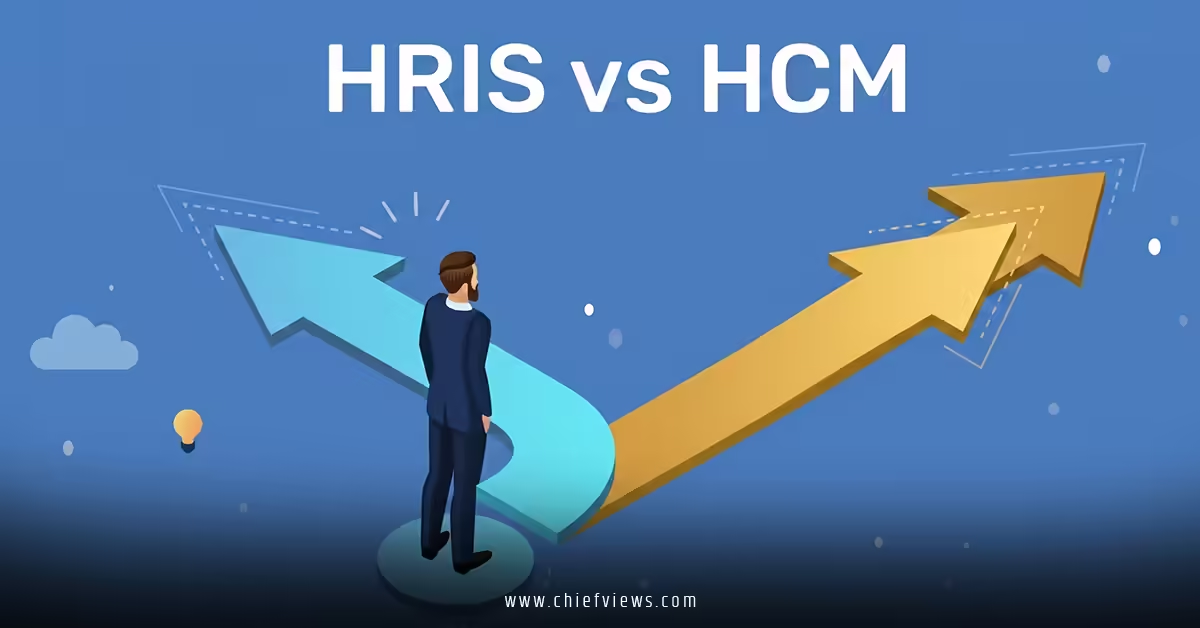
HRIS vs HCM confuses plenty of HR leaders. One handles the basics. The other drives strategy. Pick wrong and you either overspend on unused features or outgrow your system too fast.
Here’s the straight talk: An HRIS (Human Resources Information System) acts as your central employee database. It stores records, manages core admin like benefits and compliance, and keeps payroll accurate. An HCM (Human Capital Management) builds on that foundation with talent management, performance tools, workforce planning, advanced analytics, and full employee lifecycle support.
Think of HRIS as the sturdy filing cabinet that holds everything neatly. HCM? That’s the entire intelligent office that not only files but also predicts what you’ll need next, spots talent gaps, and helps you build a stronger workforce.
- HRIS focuses on data accuracy and daily operations.
- HCM adds strategic capabilities like succession planning, learning & development, and predictive insights.
- Every modern HCM includes strong HRIS functions. The reverse isn’t true.
For US companies juggling multi-state compliance, rising labor costs, and talent shortages, understanding this distinction prevents expensive mistakes.
Core Differences: HRIS vs HCM Breakdown
The gap shows up clearest in scope and ambition.
HRIS shines at:


- Employee records and self-service portals
- Basic payroll integration and benefits administration
- Time & attendance tracking
- Compliance reporting (ACA, FLSA basics)
- Simple onboarding and document management
HCM delivers all that plus:
- Performance management and goal tracking
- Talent acquisition, onboarding, and succession planning
- Compensation planning and pay equity tools
- Learning management systems (LMS)
- Advanced people analytics and workforce forecasting
- AI-driven insights for retention and skills gaps
What usually happens? Growing companies start with an HRIS to escape spreadsheets. Then headaches hit—manual performance reviews, guesswork on headcount planning, or inability to model compensation scenarios. That’s the signal to evaluate HCM.
The kicker is most vendors blur the lines in 2026. Many “HRIS” platforms now bundle light talent tools. True HCM suites go deeper and scale without friction.
HRIS vs HCM Comparison Table
Here’s a no-fluff side-by-side for US organizations:
| Aspect | HRIS | HCM |
|---|---|---|
| Primary Focus | Data storage & core admin | Full employee lifecycle + strategic workforce |
| Key Modules | Records, benefits, basic payroll, time | HRIS + performance, talent, compensation, analytics |
| Analytics | Basic reporting | Predictive, workforce planning, AI insights |
| Best For | Small to mid-sized (<500 employees) | Mid-market to enterprise (growing or complex) |
| Implementation Time | Faster, lighter | Longer but more transformative |
| Pricing Insight | Often $6–$12 per employee/month | $15+ per employee/month + higher implementation |
| Scalability | Good until rapid growth | Built for complexity and expansion |
| Compliance Strength | Solid for domestic US | Stronger for multi-state + global elements |
Pricing varies by headcount, modules, and add-ons. Always model three-year total cost of ownership—implementation and training add up fast.
When to Stick with HRIS (and When to Upgrade to HCM)
Small teams or stable organizations often thrive with a capable HRIS. If your biggest pains are messy data, payroll errors, or slow onboarding, an HRIS solves them without overkill.
Upgrade signals appear when:
- You need robust performance reviews tied to business goals
- Workforce planning becomes guesswork
- Leadership demands better people analytics for board meetings
- Talent retention drops and you lack tools to spot flight risks
- Growth pushes you into new states or complex benefits structures
In my experience, companies hit 200–400 employees and start feeling the squeeze. That’s when HCM’s strategic layer pays off. Ask yourself: Are we just managing people or actively building human capital as a competitive advantage?
For deeper vendor evaluation and rollout steps, see the CHRO HRIS Implementation and Vendor Selection Guide—it walks through practical selection and avoids common traps.

Pros and Cons: Making the Right Call
HRIS Pros: Lower cost, quicker implementation, easier for smaller teams, sufficient for compliance basics.
HRIS Cons: Limited strategic tools, may require bolt-on systems later, weaker analytics.
HCM Pros: Unified platform, better decision-making data, supports talent strategy, scales with growth.
HCM Cons: Higher upfront investment, steeper learning curve, potential for unused modules if not managed well.
The right choice depends on your size, growth plans, and HR maturity. Many mid-market US companies land in a sweet spot with modern platforms that blend strong HRIS foundations with growing HCM capabilities.
Common Pitfalls When Choosing Between HRIS and HCM
- Buying HCM too early and paying for features you’ll never use.
Fix: Map your actual pain points and required outcomes first. - Underestimating change management with either system.
Fix: Involve end users early and communicate “what’s in it for them.” - Ignoring total cost beyond subscription fees.
Fix: Demand clear TCO models including data migration, training, and integrations. - Treating the decision as purely technical instead of strategic.
Fix: Get CHRO, finance, and operations aligned on success metrics.
Slow down on features. Speed up on understanding your real workflows.
Key Takeaways
- HRIS handles the essentials—accurate data and smooth operations.
- HCM adds the strategic muscle for talent development and workforce planning.
- Most HCM platforms include solid HRIS capabilities; choose based on future needs.
- Company size and growth trajectory usually dictate the right fit.
- Model costs realistically and test with your actual processes.
- Implementation success hinges more on planning and adoption than on the acronym.
- Reassess your HR tech every few years as your organization evolves.
Nail the HRIS vs HCM decision and HR stops playing catch-up. You gain time, better insights, and the ability to shape your workforce proactively instead of reacting to problems.
Ready to move forward? List your top three current HR headaches and map them against HRIS and HCM capabilities. Then reference the CHRO HRIS Implementation and Vendor Selection Guide for a proven framework to evaluate and deploy the winner.
FAQs
What is the main difference between HRIS and HCM?
HRIS focuses on core data management and administrative HR tasks. HCM encompasses HRIS functions while adding strategic tools for talent management, performance, analytics, and long-term workforce planning.
Is HCM always better than HRIS for growing US companies?
Not necessarily. HCM makes sense when you need advanced talent and planning capabilities. Many mid-sized organizations do well with a strong HRIS or hybrid platform until growth demands more strategic depth.
Can you start with HRIS and later upgrade to HCM?
Yes, but data migration and process changes add friction. Plan your long-term needs during initial selection to minimize future disruption. The CHRO HRIS Implementation and Vendor Selection Guide offers practical steps to future-proof your choice.