





Internal controls over financial reporting form the practical foundation that makes reliable financial statements possible. Without them, the numbers in a 10-K or 10-Q become assertions rather than assurances, and the entire system of SOX compliance and financial governance loses its teeth.
Here’s the essential overview:
- Internal controls over financial reporting (ICFR) are the processes designed to provide reasonable assurance that financial statements are accurate, complete, and prepared in accordance with GAAP.
- They focus specifically on preventing or detecting material misstatements in external financial reporting.
- Most U.S. public companies evaluate ICFR against the COSO Internal Control—Integrated Framework.
- Effective ICFR supports management’s Section 404 assessment and the auditor’s attestation under PCAOB standards.
- Weak ICFR is one of the most common sources of material weaknesses and restatements.
Get the controls right and everything else in financial reporting becomes more trustworthy. Get them wrong and problems surface late, expensive, and public.
What Internal Controls Over Financial Reporting Actually Cover
The SEC defines internal control over financial reporting as a process, designed by or under the supervision of the principal executive and financial officers, that provides reasonable assurance regarding the reliability of financial reporting and the preparation of financial statements for external purposes. That definition is precise. It is not about operational efficiency or general compliance. It is about whether the financial statements can be trusted.
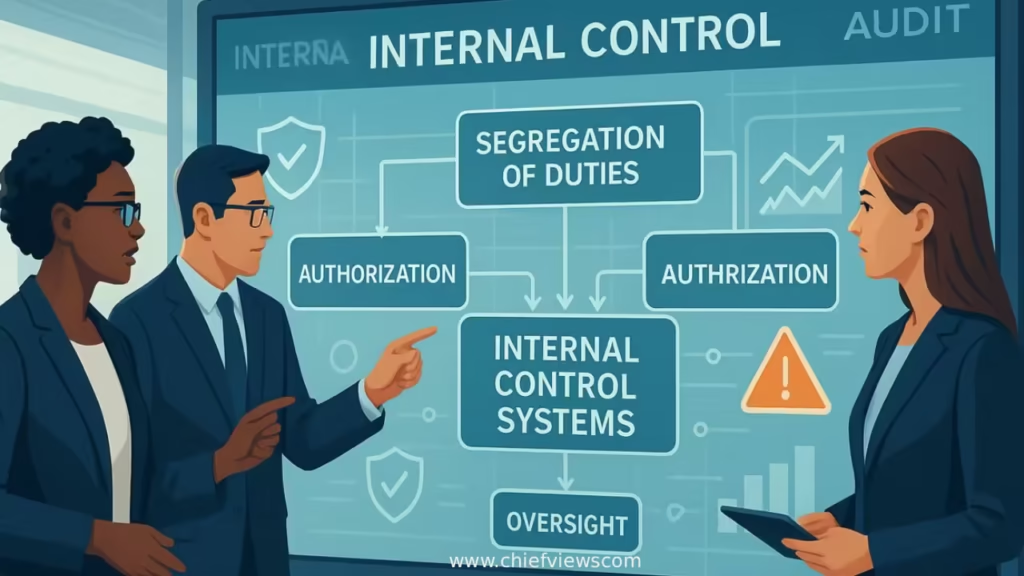
ICFR typically addresses risks in areas such as revenue recognition, significant estimates and judgments, period-end close processes, journal entries, account reconciliations, and the IT systems that support financial data. Entity-level controls—tone at the top, board oversight, organizational structure, and the control environment—sit above the process-level activities and often determine whether the rest of the system can function effectively.
The COSO framework organizes these elements into five components: control environment, risk assessment, control activities, information and communication, and monitoring activities. All five must be present and functioning together for management to conclude that ICFR is effective.


How Internal Controls Over Financial Reporting Fit Into SOX Compliance and Financial Governance
Internal controls over financial reporting sit at the operational center of SOX compliance and financial governance. Section 404 requires management to assess the effectiveness of ICFR annually and, for larger filers, requires the external auditor to attest to that assessment. The personal certifications under Section 302 rest on the assumption that those controls actually work.
In practice, a mature program treats ICFR as a living system rather than an annual compliance exercise. Risks change when the business adds new products, implements new systems, acquires companies, or faces economic pressure. Controls that once operated effectively can become outdated or poorly designed for the new environment. Continuous risk assessment and timely updates keep the system relevant.
Designing Effective Internal Controls Over Financial Reporting
Strong design starts with the risk, not with the control. Identify the significant accounts and disclosures. Determine the relevant assertions—existence, completeness, accuracy, valuation, rights and obligations, presentation and disclosure. Ask what could go wrong that would produce a material misstatement. Then design or select the control that addresses that specific risk at an appropriate level of precision.
A useful control description answers five questions clearly: Who performs it? What exactly do they do? When or how often? What information do they use? What evidence remains? Vague language such as “reviews the account” fails this test. Specific language such as “compares each accrual above $50,000 to supporting contracts or invoices and investigates variances exceeding 5 percent” can be tested.
Prefer automated and preventive controls where the process allows it. Manual detective controls still have a place, but they carry higher residual risk and demand stronger documentation of the reviewer’s work.
Testing and Evaluating Internal Controls Over Financial Reporting
Testing follows a logical sequence. First evaluate design effectiveness. Would the control, if performed as designed by a competent person with appropriate authority, address the risk? Walkthroughs, inquiry, observation, and inspection of documentation support this evaluation.
Only after design is confirmed do you test operating effectiveness. Did the control operate as designed throughout the period? Sample size and nature of testing depend on the risk, the frequency of the control, and whether it is automated or manual. For automated controls, effective IT general controls and unchanged logic can support benchmarking in subsequent years under current PCAOB guidance.
When deficiencies appear, evaluate them carefully. A control deficiency exists when the design or operation does not allow management or employees to prevent or detect misstatements on a timely basis. A significant deficiency is less severe than a material weakness yet important enough to merit attention by those responsible for oversight. A material weakness is a deficiency, or combination of deficiencies, such that there is a reasonable possibility that a material misstatement of the financial statements will not be prevented or detected on a timely basis. Only the presence of a material weakness prevents management from concluding that ICFR is effective.
Common Mistakes in Internal Controls Over Financial Reporting and How to Fix Them
Several patterns repeatedly undermine programs.
Starting with existing controls instead of risks. Teams inherit a control matrix and test what is already listed. The result is often over-testing low-risk activities while missing higher-risk gaps. Fix: Begin every cycle with a fresh risk assessment tied to significant accounts and assertions.
Treating management review controls as check-the-box exercises. A signature on a report does not prove the reviewer applied appropriate criteria or investigated exceptions. Fix: Define the precision expected, require evidence of investigation, and retain that support.
Neglecting IT general controls. Access, change management, and computer operations frequently drive findings, especially after system implementations or cloud migrations. Fix: Involve IT early and treat ITGCs as foundational rather than secondary.
Allowing documentation to lag process changes. Businesses evolve faster than control matrices. Fix: Build a change-management trigger that requires control documentation updates whenever processes or systems affecting financial reporting change.
Failing to remediate promptly. Discovering a deficiency late in the year leaves little time for sustainable fixes and retesting. Fix: Spread testing across the year and treat remediation as a priority workstream with clear ownership and deadlines.
Practical Action Plan for Strengthening Internal Controls Over Financial Reporting
- Confirm or refresh the risk assessment for significant accounts and disclosures.
- Map current controls to those risks and identify gaps or redundancies.
- Strengthen the control environment and entity-level controls first.
- Redesign or refine process-level controls with clear, testable descriptions.
- Evaluate and reinforce IT general controls that support financial systems.
- Test design, then operating effectiveness, on a risk-based schedule.
- Evaluate and remediate deficiencies with documented root-cause analysis.
- Maintain evidence packages that support management’s annual assessment and the external audit.
This sequence works for both first-time compliance efforts and ongoing program improvement.
Key Takeaways
- Internal controls over financial reporting exist to provide reasonable assurance that financial statements are free of material misstatement.
- They form the operational core of SOX compliance and financial governance under Sections 302 and 404.
- The COSO framework remains the predominant structure for design and evaluation.
- Effective programs start with risks, not with existing controls.
- Design effectiveness must be established before operating effectiveness testing has meaning.
- Precision, documentation quality, and timely remediation separate strong programs from those that generate findings.
- Entity-level and IT general controls often determine the success of process-level activities.
- Continuous attention beats annual fire drills.
Reliable financial reporting depends on controls that actually work under real operating conditions. Teams that treat internal controls over financial reporting as a core business process rather than a compliance obligation usually produce cleaner assessments, fewer surprises, and stronger confidence from both management and external stakeholders.
Begin with a clear risk assessment tied to significant accounts. Design controls that address those risks at the right level of precision. Test them rigorously. Fix what does not work. That discipline keeps the system effective year after year.
FAQs
What is the difference between internal controls and internal controls over financial reporting?
Internal controls is a broad term that can cover operational, compliance, and reporting objectives. Internal controls over financial reporting are the specific subset focused solely on the reliability of external financial statements. Not every strong internal control qualifies as an ICFR control.
Why do companies use the COSO framework for internal controls over financial reporting?
SEC rules require management to use a suitable, recognized control framework for the annual ICFR assessment. The 2013 COSO Internal Control—Integrated Framework is the one nearly every U.S. public company selects because it is comprehensive, widely understood by auditors, and explicitly addresses financial reporting objectives.
How do updates to PCAOB standards affect testing of internal controls over financial reporting?
Amended standards reinforce a top-down, risk-based approach that prioritizes entity-level controls and significant accounts. They also clarify opportunities for benchmarking certain automated controls when IT general controls remain effective and the control logic has not changed. Programs should align scoping and documentation with this emphasis.