









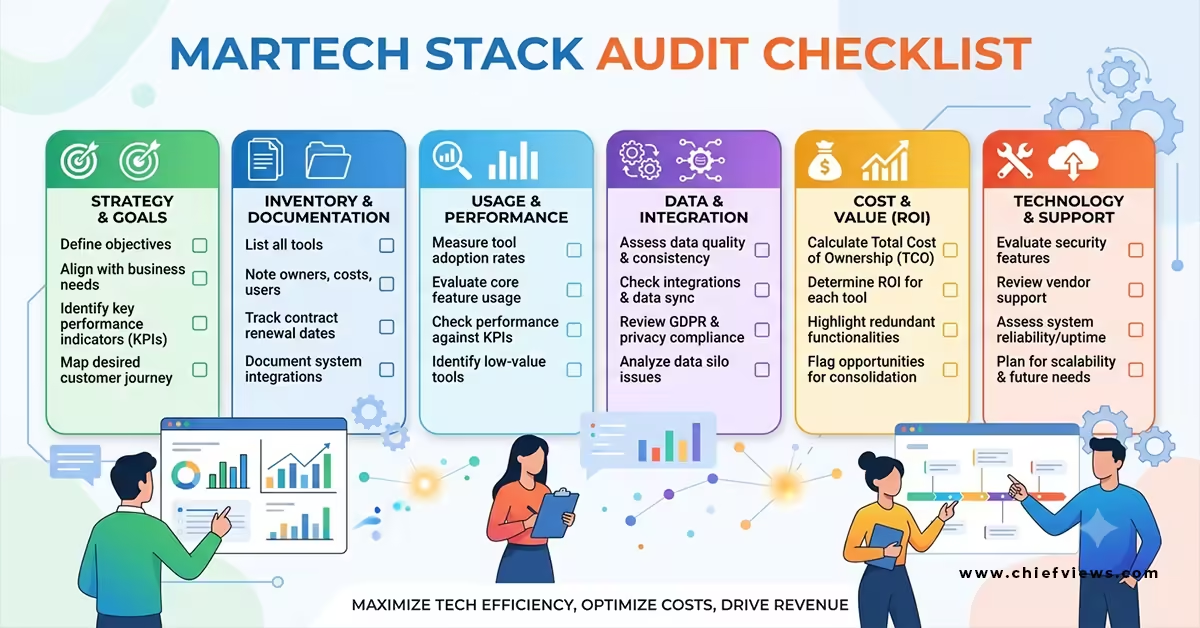
Martech stack audit checklist is the single highest-leverage exercise most marketing leaders skip until the pain becomes impossible to ignore. Here’s the rapid overview:
- A proper audit maps every tool, data flow, owner, cost, and usage rate in under three weeks.
- It surfaces dead weight, broken integrations, and data quality leaks that quietly destroy ROI.
- The goal is not a longer tool list—it’s a cleaner, more connected foundation ready for AI and real-time activation.
- Teams that run this checklist regularly cut waste, improve attribution, and stop fighting their own systems.
- This process pairs directly with the broader work of modernizing legacy platforms and closing data gaps.
You open the budget spreadsheet and the numbers stare back. Dozens of platforms. Renewal dates scattered across the calendar. Half the team can’t name what half the tools even do. Reports never quite match. Campaigns launch late because someone is still waiting on a data export. Sound familiar?
In my experience, most stacks grow the same way: a new need appears, a vendor demo looks shiny, a pilot starts, and the tool never leaves. Five years later you own a collection of partial solutions that refuse to talk to each other. The audit is how you stop the bleeding.
Think of your martech stack like a kitchen drawer stuffed with gadgets. Some still work. Some are broken. Some you forgot you owned. You don’t throw everything out and buy a new kitchen. You empty the drawer, decide what stays, and put the keepers back in a way that actually makes cooking faster.
Why a martech stack audit checklist matters more in 2026
Gartner’s recent marketing technology surveys continue to show utilization hovering around the 49 percent mark. Nearly half the tools companies pay for sit idle or underused. At the same time, data fragmentation remains the top barrier to AI success and personalization at scale. An audit forces the hard questions: What do we actually use? What data do we trust? Where do the handoffs break?
This work sits right next to the larger conversation in any solid CMO guide to fixing legacy systems and closing data gaps. You cannot close data gaps if you do not know which systems create them. The audit is the diagnostic. The modernization plan is the treatment.



Complete martech stack audit checklist: the practical sequence
Run this in order. Do not jump to tool evaluation before you finish the inventory and data-flow map. Most failed audits start in the wrong place.
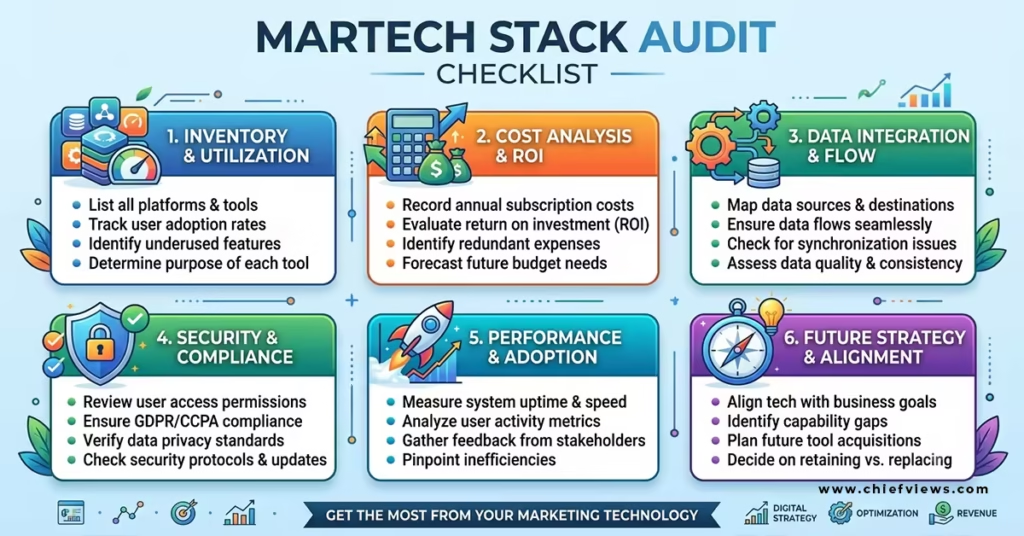
1. Build the complete inventory (Week 1)
Pull every active subscription from finance, procurement, and IT. Cross-check with team logins and credit-card statements. Marketing teams routinely undercount their stack by 20–30 percent because shadow tools live on departmental cards or old free trials that somehow converted.
For each tool record:
- Vendor and product name
- Primary business owner and technical owner
- Annual cost and renewal date
- Number of licensed seats versus active users in the last 90 days
- Stated purpose versus actual observed use
- Environment (production, sandbox, agency instance)
Categorize by function: CRM, marketing automation, CDP or warehouse, analytics and BI, paid media platforms, email/SMS, consent management, personalization, creative tools, and integration middleware.
2. Map the data flows (Week 1–2)
This is the step most teams skip and the one that reveals the real problems. For every tool note:
- What data enters it and from where
- What data leaves it and where it goes
- Sync frequency and known failure rates
- Whether the data is enriched, transformed, or simply passed through
- Manual workarounds still in use (CSV exports, spreadsheet handoffs)
Draw it. A simple diagram in Miro or Lucidchart beats a wall of text. Look for tools that receive data but send nothing useful downstream, tools that duplicate the same transformation, and tools that claim integration but actually run on stale or partial records.
3. Score every tool on four dimensions
Use a simple 1–5 scale:
- Utilization: percentage of seats or core features used in the last 90 days
- Data quality contribution: does this tool improve the customer profile or introduce duplicates and conflicts?
- Business criticality: would losing it break a revenue-driving workflow this quarter?
- Replaceability: can another tool already in the stack do the same job?
Anything scoring low on utilization and data quality is a candidate for retirement. Anything high on criticality but low on data quality becomes a priority fix.
4. Test integration health and identity resolution
Pick your three highest-volume customer journeys. Trace a single record from first touch through conversion and into the CRM or warehouse. Measure latency, field completeness, and identity match rates. If the same person appears under three different IDs, the stack is broken no matter how many logos sit on the architecture slide.
Check consent signals travel with the record. Confirm source and timestamp fields survive every sync. These small details determine whether your AI agents later produce useful recommendations or expensive nonsense.
5. Calculate true cost and ROI signals
Beyond license fees, add the hidden costs: admin time spent on manual fixes, agency hours spent reconciling reports, and opportunity cost of delayed campaigns. Compare that total against the measurable outcomes the tool supports. Many “must-have” platforms look expensive once the full picture appears.
6. Apply the keep / fix / combine / kill decision
- Keep: high utilization, clean data contribution, clear revenue link
- Fix: critical but currently damaging data quality or integration
- Combine: overlapping capabilities that can live under one stronger platform
- Kill: low usage, high cost, or pure redundancy
Document the decision and the owner responsible for executing it.
Scoring table for rapid prioritization
| Tool Category | Utilization Score | Data Quality Impact | Business Criticality | Recommended Action |
|---|---|---|---|---|
| Core CRM | High | Mixed | Critical | Fix data contracts first |
| Marketing Automation | Medium | Often degrades | High | Clean intake rules |
| Secondary Analytics | Low | Neutral | Low | Kill or consolidate |
| Legacy Tag Manager | Medium | Degrades | Medium | Replace with modern alternative |
| Niche Personalization | Low | Neutral | Low | Kill unless proven lift |
Use this matrix in the final review meeting. It keeps emotion out of the room.
Common mistakes that kill audit results
Starting with vendor demos instead of internal data flows. The shiny new platform will not fix broken identity resolution.
Treating the audit as a one-time event. Stacks drift. Schedule a lightweight refresh every six months and a deeper one annually.
Ignoring the people layer. Tools fail because ownership is unclear or because sales and marketing still argue over lead definitions. Fix the definitions before you blame the software.
Measuring only license cost. The real expense is the hours your team burns reconciling numbers that should already match.
How this checklist feeds the larger modernization work
Once the audit is complete you hold a clear map of what must stay, what must improve, and what can leave. That map becomes the foundation for any serious [CMO guide to fixing legacy systems and closing data gaps](CMO guide to fixing legacy systems and closing data gaps). You stop guessing which integrations matter. You stop funding tools that create more debt than value. You gain the evidence needed to secure budget for the data layer work that actually moves the needle.
Key Takeaways
- Inventory everything, including shadow tools, before you evaluate anything.
- Map data flows first; tool scores second.
- Score on utilization, data quality contribution, criticality, and replaceability.
- Trace real customer records through the highest-volume journeys.
- Decide keep / fix / combine / kill with clear owners and timelines.
- Treat the audit as a living process, not a one-off project.
- Use the output to prioritize the data foundation work that unlocks AI and personalization.
The teams that run this martech stack audit checklist with discipline stop fighting their technology and start using it. Your next step is straightforward: block the first week on the calendar, pull the contracts, and start the inventory. Everything else follows from there.
FAQs
How long does a thorough martech stack audit checklist process take?
Most mid-to-large teams complete a solid audit in three to six weeks when they protect time and involve finance and operations from day one.
Who should own the martech stack audit checklist inside the organization?
Marketing operations or a designated martech lead, with active participation from finance, IT, and a senior marketing decision-maker who can enforce the final keep/fix/kill calls.
Does every company need to run a full martech stack audit checklist every year?
A deep audit annually and a lighter utilization-and-cost review every six months keeps the stack honest without creating audit fatigue.
