








Lean Six Sigma implementation guide starts with a clear decision: stop treating improvement as a side project and start running it as a disciplined operating system. When done right, Lean Six Sigma cuts waste, shrinks variation, and delivers measurable gains in speed, quality, and cost—exactly the outcomes that drive process optimization and enterprise efficiency.
Here’s the quick overview of what a solid Lean Six Sigma rollout actually produces:
- Removes non-value steps so teams spend time on work that matters.
- Reduces defects and rework with data, not guesswork.
- Builds a shared problem-solving language across functions.
- Creates repeatable results that survive leadership changes and growth.
This guide is written for beginners and intermediate practitioners who need a practical path, not textbook theory. Follow the sequence and you will avoid the most common traps that kill projects before they scale.
Why Lean Six Sigma Still Works in 2026
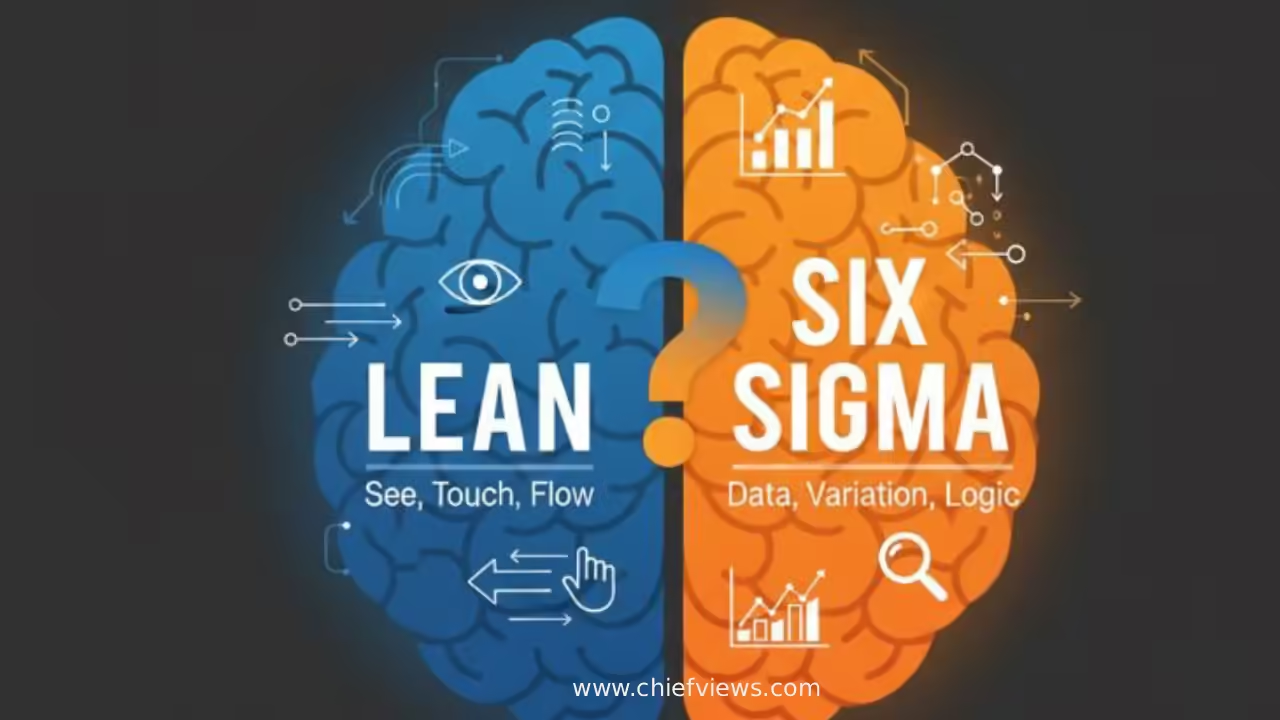
Lean focuses on flow and waste. Six Sigma attacks defects and variation. Together they give you both speed and consistency. The combination remains one of the most reliable ways to improve operations because it forces teams to measure reality, test changes, and lock in the gains.
In my experience, companies that treat Lean Six Sigma as a one-time training event get temporary lifts. Those that treat it as part of ongoing process optimization and enterprise efficiency keep improving year after year. The difference is ownership, governance, and a bias for action over perfect data.



Core Building Blocks Before You Launch
Three foundations decide whether the program lives or dies.
Leadership commitment. Executives must sponsor projects, remove barriers, and review results. Without visible support, middle managers treat it as optional.
Process owners. Every key process needs a named owner with authority over the end-to-end flow. Committee ownership dilutes accountability.
Data readiness. You need reliable metrics for cycle time, defect rates, and cost. Start with what you already have in systems rather than waiting for a perfect data warehouse.
Skip any of these and the projects stall.
Step-by-Step Lean Six Sigma Implementation Guide
Lean Six Sigma Implementation Guide Use this sequence. It works for manufacturing, finance, healthcare, and service operations.
Step 1: Define the business case and scope.
Pick one high-impact process that hurts customers or the bottom line. Frame the problem in dollars or customer impact: “Invoice processing takes 12 days and costs $18 per invoice with 8% error rate.” Avoid vague goals such as “improve efficiency.”
Step 2: Select and train the right people.
Start with a small wave of Green Belts and one or two Black Belts. Choose people who already understand the process and have influence. Train them on DMAIC (Define, Measure, Analyze, Improve, Control) and basic Lean tools—value stream mapping, 5S, standard work. Keep the first training practical and tied to real projects.
Step 3: Map the current state.
Walk the process with the people who do the work. Capture every step, wait, rework loop, and handoff. Use simple swim-lane maps or sticky notes first. Process mining software can accelerate this if your systems log the events, but do not let technology delay the mapping.
Step 4: Establish the baseline.
Collect 30–90 days of data on the critical metrics. Calculate current performance and variation. Without a clean baseline you cannot prove improvement later.
Step 5: Analyze root causes.
Use the data and the people closest to the work. Pareto charts, fishbone diagrams, and the 5 Whys usually surface the vital few causes. Resist the urge to jump to solutions.
Step 6: Design and pilot the improvements.
Eliminate waste first. Standardize the remaining steps. Introduce error-proofing and visual controls. Run a controlled pilot with clear success criteria. Measure the same metrics you baselined.
Step 7: Control and scale.
Document the new standard work. Install simple visual management and process metrics that the team reviews weekly. Hand ownership to the process owner. Only then expand to the next process.
Step 8: Build the sustaining system.
Create a project pipeline, monthly governance reviews, and a light certification path. Celebrate completed projects that hit their targets. Link Belt progression to business results, not just training hours.
Lean Six Sigma Implementation Guide This sequence keeps the first projects small enough to finish in 90–120 days while building the muscle for larger efforts.
Comparison of Roles and Typical Project Scope
| Role | Typical Training | Project Scope | Expected Impact | Time Commitment |
|---|---|---|---|---|
| Yellow Belt | 1–2 days | Support data collection and simple improvements | Local process tweaks | Part-time |
| Green Belt | 1–2 weeks + project | Single process, 3–6 month projects | 20–40% cycle time or defect reduction | 20–30% of time |
| Black Belt | 3–4 weeks + multiple projects | Cross-functional, complex problems | Significant cost or quality gains | Full-time or near full-time |
| Master Black Belt | Advanced + coaching | Program design and mentoring | Enterprise capability | Full-time |
Start with Green Belts on focused processes. Add Black Belts only after the first wave proves value.

Common Mistakes and How to Fix Them
Mistake 1: Training without projects.
People forget tools they never use. Fix: Require every trainee to complete a real project with measurable targets before certification.
Mistake 2: Choosing projects that are too big or too vague.
A project that tries to fix “customer service” dies. Fix: Scope tightly to one process with clear start and end points and hard metrics.
Mistake 3: Ignoring the people side.
Frontline resistance kills good solutions. Fix: Involve the process workers in mapping and solution design from day one. Explain the “why” in their language.
Mistake 4: Stopping at the pilot.
Improvements drift without control. Fix: Install visual metrics, standard work, and process owner reviews before declaring victory.
Mistake 5: Treating Lean Six Sigma as separate from daily operations.
It becomes another silo. Fix: Embed the language and tools into existing management routines so it supports broader process optimization and enterprise efficiency rather than competing with it.
Tools That Deliver the Most Value Early
Lean Six Sigma Implementation Guide Value stream mapping reveals flow and waste faster than almost any other tool. SIPOC clarifies scope. Pareto analysis focuses effort on the vital few causes. Control charts show whether a process is stable. Standard work and visual management lock in the gains.
Advanced tools such as process mining or statistical software help later. Master the basics first.
Measuring Success and Proving ROI
Track three levels of results:
- Project level: cycle time, defect rate, cost per unit.
- Process level: sustained performance against the new standard.
- Program level: number of completed projects, total hard savings, and soft benefits such as capacity freed.
Lean Six Sigma Implementation Guide Report hard dollar savings that finance can verify. Soft benefits matter, but hard numbers keep leadership engaged.
Scaling from Pilot to Enterprise
Lean Six Sigma Implementation Guide Once three to five projects hit their targets, expand the pipeline. Train the next wave of Green Belts. Introduce Black Belts for cross-functional work. Align the project selection criteria with strategic priorities so every effort supports the larger goals of process optimization and enterprise efficiency.
Governance stays light but consistent: monthly steering reviews, clear escalation paths, and public recognition of results. The goal is a self-sustaining system, not a permanent consulting dependency.
Key Takeaways
- Lean Six Sigma works when leadership sponsors real projects, process owners own the flow, and teams measure outcomes that matter.
- Follow the DMAIC sequence tightly on the first projects and keep scope small enough to finish in 90–120 days.
- Map reality with the people who do the work before analyzing data or designing solutions.
- Eliminate waste first; automate or digitize only after the process is clean.
- Install control mechanisms—standard work, visual metrics, and ownership—before scaling.
- Link every project to hard business results so the program earns the right to grow.
- Treat Lean Six Sigma as a core part of process optimization and enterprise efficiency rather than a parallel initiative.
- Start with one high-impact process this quarter. Finish it. Prove the value. Then expand.
Lean Six Sigma Implementation Guide The organizations that win do not wait for perfect conditions. They pick a painful process, apply the tools with discipline, and protect the gains. That is how Lean Six Sigma moves from training slides to operating advantage.
FAQs
How long does a typical first Lean Six Sigma project take?
Most well-scoped Green Belt projects finish in 90–120 days from Define to Control when the team has protected time and clear sponsorship.
Do we need Black Belts to start a Lean Six Sigma program?
No. Begin with Green Belts on focused processes. Add Black Belts once the first wave delivers results and you need more complex, cross-functional capability.
Can Lean Six Sigma work in service or office environments, not just manufacturing?
Yes. The same principles of waste removal and variation reduction apply to invoice processing, claims handling, onboarding, and customer support. The tools simply adapt to transactional data and knowledge work.

