









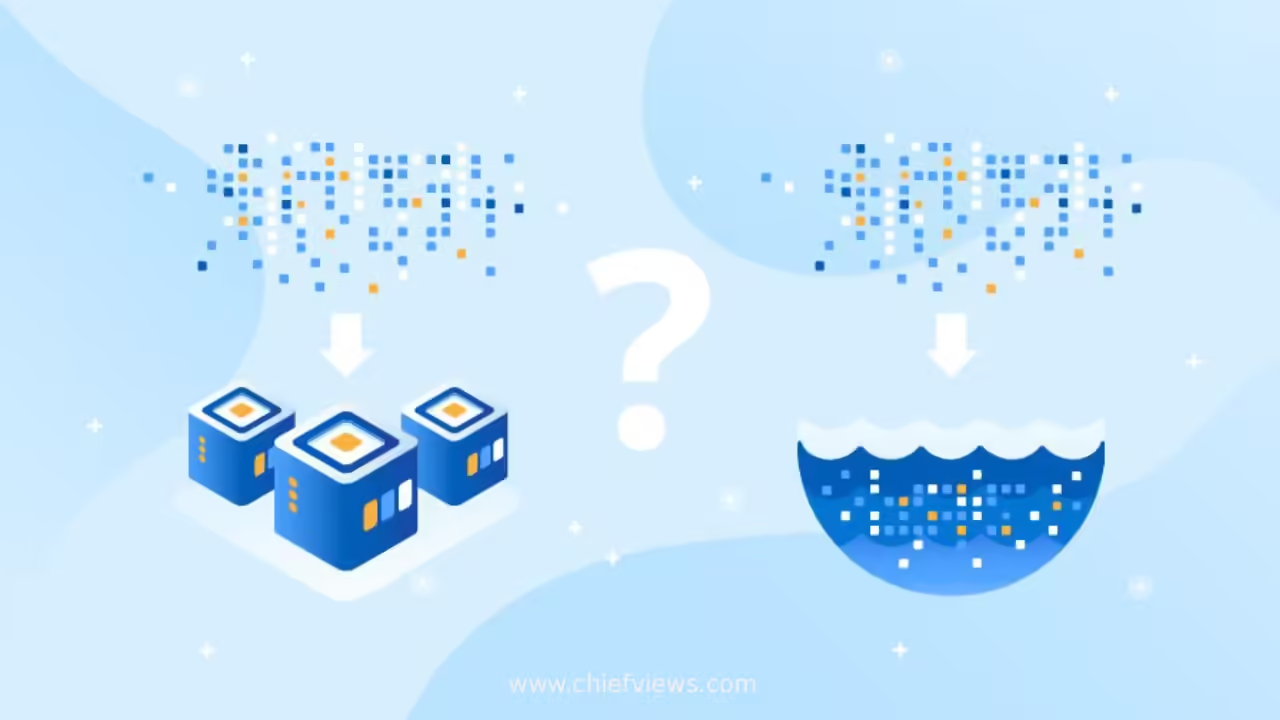
Cloud data warehouse vs lakehouse comparison has become one of the most practical decisions facing data teams right now. The old “warehouse for BI, lake for everything else” split is fading. Most enterprises now evaluate both patterns side by side because the right choice directly shapes cost, AI readiness, and how fast teams can deliver value.
Here’s the short version:
- Cloud data warehouses still excel at structured, high-concurrency BI and reporting.
- Lakehouses unify structured and unstructured data on open formats, making them stronger for mixed analytics and AI workloads.
- The gap is narrowing fast as warehouses add lakehouse features and lakehouses improve SQL performance and governance.
- Your decision should start with workload mix, not vendor marketing.
- This architecture choice is a core piece of Data platforms and enterprise IT transformation.
Quick Definitions
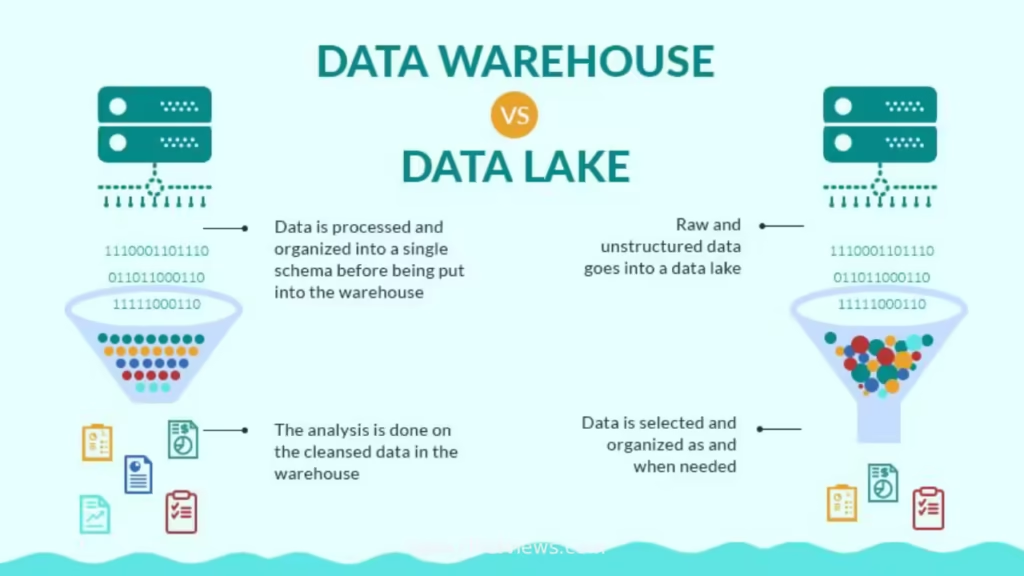
A cloud data warehouse stores structured data in a managed, cloud-native environment optimized for SQL analytics. Think Snowflake, Amazon Redshift, Google BigQuery, or Azure Synapse in warehouse mode. Data is typically cleaned and modeled before it lands (schema-on-write). Performance is predictable for concurrent users running dashboards and reports.
A data lakehouse sits on cheap object storage (S3, ADLS, GCS) using open table formats such as Apache Iceberg, Delta Lake, or Apache Hudi. It supports both structured BI queries and unstructured/semi-structured data for machine learning and AI. Compute is separated from storage, so you can spin up different engines (Spark, Trino, warehouse-style SQL) against the same data. Databricks, Snowflake’s Iceberg support, BigQuery with open formats, and Microsoft Fabric all play in this space.
Head-to-Head Comparison Table
| Factor | Cloud Data Warehouse | Lakehouse | Winner for Most Teams in 2026 |
|---|---|---|---|
| Primary Strength | Fast, concurrent SQL BI & reporting | Unified analytics + AI + streaming | Lakehouse |
| Data Types | Strongly structured | Structured + unstructured + semi-structured | Lakehouse |
| Schema Approach | Schema-on-write | Schema-on-read + schema evolution | Lakehouse |
| Storage Cost | Higher (managed, optimized) | Lower (object storage + open formats) | Lakehouse |
| Compute Cost Control | Excellent with auto-suspend / scaling | Excellent (separate engines, spot instances) | Tie |
| Governance & Security | Mature, enterprise-grade out of the box | Improving rapidly (Unity Catalog, Snowflake Horizon, etc.) | Warehouse still slight edge |
| AI / ML Readiness | Good with recent vector & Cortex features | Native (feature stores, notebooks, GPU) | Lakehouse |
| Concurrent BI Users | Excellent | Very good and improving | Warehouse |
| Open Format Support | Growing (Iceberg, Delta) | Native | Lakehouse |
| Time to First Value (BI) | Faster for pure reporting | Slightly longer setup | Warehouse |
| Long-term Flexibility | Good | Higher | Lakehouse |
When a Cloud Data Warehouse Still Makes Sense
Cloud Data Warehouse vs Lakehouse Comparison Cloud Data Warehouse vs Lakehouse Comparison Choose a warehouse if:



- Your dominant workload is structured BI, financial reporting, and operational dashboards.
- You have a large number of concurrent business users who need sub-second query response.
- Your team is stronger in SQL and dimensional modeling than in Spark or open-table engineering.
- Compliance and fine-grained access control need to be rock-solid from day one with minimal custom work.
Many mid-market companies and finance-heavy organizations still get excellent results with a pure warehouse approach, especially when they layer recent AI features (Snowflake Cortex, BigQuery vector search, etc.).
When the Lakehouse Is the Better Fit
Go lakehouse when:
- You need the same data for BI, machine learning, generative AI, and real-time or near-real-time use cases.
- Unstructured and semi-structured data (logs, documents, images, sensor data) matter.
- Cost control on large volumes of historical data is a priority.
- You want to avoid locking into a single compute engine.
- Agentic AI and semantic layers are on the roadmap — lakehouses generally give cleaner paths to knowledge graphs and continuous data products.
Cloud Data Warehouse vs Lakehouse Comparison In 2026 the lakehouse has become the default recommendation for most organizations pursuing serious Data platforms and enterprise IT transformation because it reduces data movement and supports the full spectrum of modern workloads on one foundation.
Real-World Hybrid Reality
Few large enterprises run a pure version of either. Common patterns include:
- Warehouse as the high-performance serving layer for BI, with a lakehouse as the system of record and AI training ground.
- Lakehouse core with warehouse-style SQL endpoints (Databricks SQL, Snowflake Unistore/Iceberg, Fabric Direct Lake).
- Open table formats as the shared storage layer so both warehouse and Spark engines can read the same tables without copies.
This hybrid approach is exactly how many teams are executing Data platforms and enterprise IT transformation without betting the farm on one architecture.
Cost and Performance Considerations
Cloud Data Warehouse vs Lakehouse Comparison Storage in a lakehouse is almost always cheaper at scale. Compute costs depend heavily on workload. Warehouses can be more efficient for pure concurrent BI because the engine is purpose-built. Lakehouses win when you mix batch ML training, ad-hoc exploration, and streaming in the same environment.
Watch for hidden costs: data egress, poorly tuned Spark jobs, and over-provisioned clusters. Both patterns benefit from strong FinOps practices and query monitoring.
Decision Framework — What I’d Do
- List your top 5–7 workloads by business impact and data type.
- Estimate volume growth and concurrency for the next 18–24 months.
- Score team skills (SQL-heavy vs data engineering/ML).
- Check current platform commitments and multi-cloud needs.
- Run a 6–8 week proof of concept on the two leading candidates using real data and real queries.
If more than 40–50 % of future value depends on AI, ML, or mixed data types, lean lakehouse. If the business lives and dies by polished, concurrent dashboards and regulated reporting, a modern cloud warehouse remains a strong, lower-risk choice.
Key Takeaways
- The cloud data warehouse vs lakehouse comparison is no longer a pure either/or decision.
- Lakehouses have closed most of the BI performance and governance gaps while adding superior AI flexibility.
- Open table formats (especially Iceberg) are reducing lock-in for both patterns.
- Start with workload reality, not architecture fashion.
- Architecture choice is a foundational decision inside broader Data platforms and enterprise IT transformation.
- Hybrid designs are common and often optimal.
- Measure total cost of ownership and time-to-insight, not just storage price.
Cloud Data Warehouse vs Lakehouse Comparison Pick the pattern that matches the work your teams actually need to do in the next two years. Then build the governance, semantic layer, and operating model around it. That combination turns architecture into business advantage.
FAQs
Can I start with a warehouse and move to a lakehouse later?
Yes. Many teams do exactly that. Using open table formats from the beginning makes the transition significantly easier.
Do I still need a separate data lake if I choose a lakehouse?
Usually no. A well-implemented lakehouse replaces the traditional data lake + warehouse combination for most use cases.
Is a lakehouse always cheaper than a cloud data warehouse?
Not always. Storage is usually cheaper, but poorly managed compute can erase the savings. Warehouses often deliver better price-performance for pure concurrent BI workloads.
How does this decision affect AI agent projects?
Lakehouses generally provide cleaner support for continuous data products, feature stores, and semantic layers that agents rely on. Warehouses have improved, but the lakehouse path is currently shorter for most agentic workloads.

