










AI agent workforce management is the new discipline of treating autonomous digital workers as real members of the team—complete with identity, ownership, performance tracking, and clear escalation paths—while keeping humans firmly in charge of judgment and accountability.
Here’s the short version:
- AI agents now handle multi-step tasks, call tools, and act with limited supervision across finance, customer service, HR, and operations.
- Without deliberate management, you get agent sprawl, shadow systems, and costly errors.
- Effective AI agent workforce management assigns every agent an owner, risk tier, permissions, and audit trail.
- It sits at the heart of broader future of work technology enablement, turning tools into reliable digital colleagues.
- Organizations that get this right redesign workflows once and then scale agents safely instead of chasing every new pilot.
Most companies still manage agents the way they managed RPA bots five years ago—lightly, after the fact, and mostly as a technology problem. That approach breaks the moment agents start making decisions that affect customers or money.
Why AI Agent Workforce Management Became Non-Negotiable
Gartner forecasts that the average global Fortune 500 enterprise will run more than 150,000 agents by 2028, up from fewer than 15 in 2025. Only 13 percent of organizations currently believe they have the right governance in place.
That’s not a technology forecast. It’s a management forecast. When agents can initiate actions, move data, and interact with other agents, you no longer have “tools.” You have a non-human workforce that needs the same clarity around roles, boundaries, and performance that you give people.
McKinsey research shows the highest-performing organizations don’t just deploy agents—they redesign the operating model around human-agent collaboration and put clear accountability behind every outcome. The difference shows up in EBIT impact, not just productivity scores.


Think of it like adding a second shift of highly capable but inexperienced contractors. You wouldn’t let them roam free with full system access and no supervisor. Yet plenty of teams still do exactly that with agents.
Core Principles of Effective AI Agent Workforce Management
Four principles separate the teams that scale cleanly from the ones that create chaos:
- Identity and ownership – Every agent gets a unique identity, a named human owner, and a defined purpose. No orphan agents.
- Least privilege and proportional autonomy – Agents receive only the access and decision rights required for their task. Higher-stakes actions trigger human review.
- Runtime observability – You can see what the agent did, which tools it called, what data it touched, and why it made a decision—in real time or near real time.
- Lifecycle discipline – Agents are versioned, tested, monitored, and retired the same way production software is. Sprawl is treated as a risk, not a growth metric.
PwC’s guidance on agent governance is clear: treat agents as workforce counterparts without treating them as employees. Give them verified identity, role-based permissions, and auditable records, then scale oversight with the potential impact of their actions.
How AI Agent Workforce Management Fits Inside Future of Work Technology Enablement
AI agent workforce management is the operational layer that makes future of work technology enablement actually deliver. You can buy the best platforms and train every employee on prompting, but if no one owns the agents, measures their contribution, or redesigns the handoffs, the productivity gains stay theoretical. The two disciplines reinforce each other: enablement redesigns the work; agent management keeps the digital workers reliable and accountable inside that redesigned work.
Step-by-Step Action Plan for AI Agent Workforce Management
Here’s the practical sequence I recommend for any U.S. mid-market or enterprise team starting in earnest:
1. Build a living agent inventory.
Discover every sanctioned and shadow agent currently running. Categorize by business function, risk level, data access, and current owner (or lack of one).
2. Assign a human owner to every agent.
Ownership sits with the business leader whose outcomes the agent affects—not with IT by default. The owner is accountable for performance, cost, and risk.
3. Classify agents by autonomy and impact.
Use a simple tier system: Observe only, Advise (human must approve), Act within guardrails, Act with escalation thresholds. Match controls to the tier.
4. Implement identity and least-privilege access.
Give each agent a distinct identity. Issue short-lived, task-scoped credentials instead of standing access. Log every permission grant and revocation.
5. Stand up runtime monitoring and alerting.
Track task completion rates, error patterns, cost per successful outcome, and deviation from expected behavior. Define clear triggers for human intervention.
6. Redesign the surrounding human workflows.
Update job descriptions, escalation paths, and performance metrics so people know when to review, override, or improve the agent.
7. Create a retirement and consolidation process.
Review the inventory quarterly. Kill redundant or underperforming agents. Merge overlapping ones. Prevent the 150,000-agent future from becoming unmanageable.
Start with one high-volume process, apply the full sequence, prove the model, then expand. Trying to govern everything at once usually produces policy documents no one follows.
Common Mistakes in AI Agent Workforce Management & How to Fix Them
Mistake 1: Treating agents as pure technology assets.
IT can provision them. Only the business can decide whether they are delivering value and staying inside acceptable risk. Fix: Dual ownership—business process owner plus technical steward.
Mistake 2: No inventory or sprawl controls.
Agents multiply quietly through low-code tools and employee experimentation. Fix: Central discovery plus mandatory registration before production use.
Mistake 3: Binary “full autonomy or none” thinking.
Teams either lock agents down so tightly they become useless or give them free rein. Fix: Graduated autonomy tiers tied to demonstrated reliability and business impact.
Mistake 4: Measuring only speed or volume.
An agent that completes tasks fast but creates downstream rework or compliance issues is a net loss. Fix: Track end-to-end outcome quality and total cost of ownership, including human oversight time.
Mistake 5: Forgetting the people side.
Managers suddenly responsible for both human and digital reports often lack guidance. Fix: Explicit training on agent orchestration, escalation judgment, and performance coaching for hybrid teams.
Comparison: Traditional Automation Management vs. AI Agent Workforce Management
| Dimension | Traditional RPA / Bot Management | AI Agent Workforce Management (2026) |
|---|---|---|
| Primary Focus | Script reliability and exception queues | Outcome ownership, identity, and proportional autonomy |
| Accountability | Usually sits in IT or shared services | Named business owner + technical steward |
| Access Model | Broad system credentials common | Least privilege, short-lived, task-scoped |
| Monitoring | Mostly technical (uptime, error rate) | Technical + business outcome + behavioral drift |
| Lifecycle | Deploy and maintain | Version, monitor, improve, consolidate, retire |
| Human Role | Handle exceptions | Orchestrate, coach, and continuously redesign work |
| Risk of Sprawl | Moderate | Extreme without deliberate controls |
| Link to Broader Strategy | Often isolated efficiency play | Core part of future of work technology enablement |
The table shows why the old playbook fails. Agents are not faster bots. They are digital workers that require management discipline closer to people leadership than pure systems administration.
Building the “Agent Manager” Capability
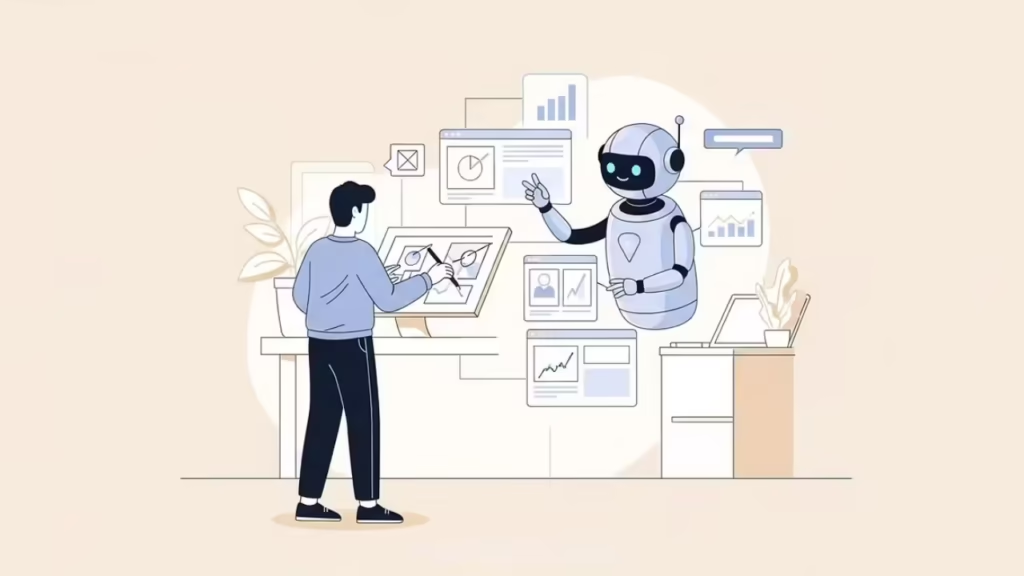
A new role is emerging: the agent manager. These are the people who orchestrate portfolios of agents, set performance targets, decide when to escalate, and coach human teammates on working alongside digital colleagues.
They need a mix of process fluency, risk judgment, and enough technical literacy to understand what the agents can and cannot reliably do. In my experience, the best candidates often come from operations or product roles rather than pure engineering. They already think in outcomes and handoffs.
Organizations that invest early in developing these managers will scale agent deployments with far less drama than those that simply add “AI oversight” to existing job descriptions.
Key Takeaways
- AI agent workforce management treats digital workers as managed team members with identity, ownership, and clear boundaries.
- Start with a complete inventory and assign a business owner to every agent before you scale further.
- Match autonomy levels to risk and demonstrated reliability—never give full freedom by default.
- Runtime observability and auditable action logs are non-negotiable for production agents.
- Redesign human workflows and metrics at the same time you deploy agents.
- Prevent sprawl through lifecycle discipline: version, monitor, consolidate, retire.
- Develop agent managers who can orchestrate hybrid teams, not just monitor dashboards.
- This discipline is the practical engine that makes future of work technology enablement produce sustained results instead of pilot theater.
The companies pulling ahead in 2026 are not the ones with the most agents. They are the ones that can look at any agent, name its owner, explain its purpose, show its performance against business outcomes, and shut it down cleanly if it stops delivering. That level of operational clarity turns AI from an experiment into a managed workforce advantage.
Pick one process that already uses agents or is a strong candidate. Apply the seven-step sequence above. Review the results with the business owner in 60 days. You’ll learn more about real AI agent workforce management in two months than most organizations learn in a year of strategy decks.
FAQs
What is the difference between AI agent workforce management and traditional bot management?
Traditional approaches focused on keeping scripts running and handling exceptions. AI agent workforce management adds identity, named ownership, graduated autonomy, business-outcome measurement, and deliberate lifecycle controls because agents can initiate multi-step actions and interact with other systems.
How does AI agent workforce management support future of work technology enablement?
It provides the day-to-day operating discipline that keeps digital workers reliable, accountable, and aligned with redesigned human workflows—turning technology investments into consistent performance gains rather than unmanaged complexity.
Where should a company begin if it already has dozens of agents in production?
Start with a full inventory, assign owners, classify risk tiers, and implement basic runtime logging for the highest-impact agents first. Fix the foundation before adding more agents.

