









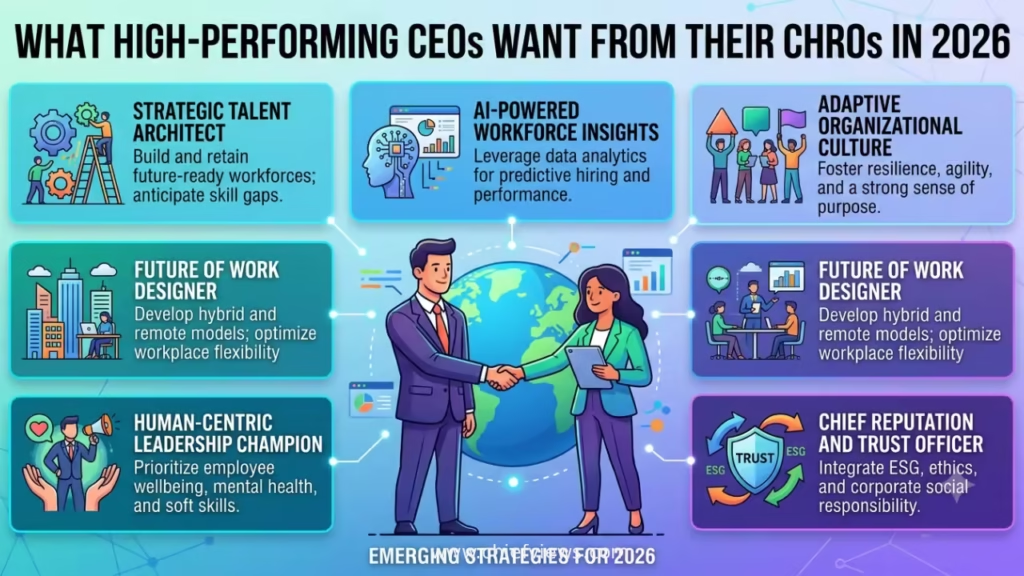
What high-performing CEOs want from their CHROs in 2026 starts with one clear shift: stop treating HR as a support function and start treating it as a core driver of enterprise performance. The bar has risen. CEOs at top-quartile companies now expect their chief people officers to co-architect AI-driven work redesign, strengthen leadership benches that actually deliver results, and link every major talent decision to revenue, productivity, and risk.
Here’s the quick view of what that looks like in practice:
- CHROs must lead (not just support) AI transformation of work and workforce capabilities.
- They need to deliver forward-looking metrics that show business impact, not activity logs.
- Strong, equal partnerships with the CTO now sit alongside the traditional CEO-CFO relationship.
- Operational excellence in core HR remains non-negotiable, but it is table stakes.
- Alignment with the CEO on strategy and succession is the difference between influence and irrelevance.
That combination separates the enterprise CHRO from the traditional one. Only about a quarter of CHROs currently operate at that level, according to recent analysis from Heidrick & Struggles.
What high-performing CEOs want from their CHROs in 2026: The enterprise shift
What high-performing CEOs want from their CHROs in 2026 High-performing CEOs no longer view talent as something that can be delegated. Strategy can be copied. Products can be matched. Capital is widely available. The lasting edge sits in the organization’s ability to build leaders, adapt work, and mobilize people around a clear direction. That is why the CHRO role has expanded.
CEOs are expanding the skill set they seek. Analysis of thousands of CHRO searches shows the average number of required capabilities rose from roughly 8.6 in 2016 to nearly 13 in 2026. The skills that matter most at high-TSR companies include AI and digital enablement, CEO advisory strength, succession planning that covers both internal and external talent, organizational design, workforce planning, and restructuring. Ethics and integrity remain foundational.
Span of control has also grown. In 2022 only 13 percent of CHROs held direct responsibility outside pure HR. That figure has climbed to 29 percent, with many now owning pieces of enterprise transformation, communications, or workplace strategy. Nearly half of Fortune 1000 CEOs have explicitly asked their CHRO to play a lead role in AI transformation.


The kicker? These expanded expectations have not come with bigger budgets. High-performing companies show no meaningful difference in HR spend or HR-to-employee ratios compared with lower performers. The difference sits in how the role is positioned and measured.
What high-performing CEOs want from their CHROs in 2026 around AI and technology partnerships
AI is forcing a rethink of what work gets done and how it gets done. Seventy-eight percent of CHROs say preparing the workforce for AI and technological change ranks among the most critical near-term issues. Only a quarter feel effective at it today.
That gap is exactly where CEOs are looking for leadership. The traditional CEO-CFO-CHRO triad is becoming a quartet that includes the senior technology leader. Enterprise CHROs are building relationships with CTOs that match or exceed the strength of their CFO relationships. They invest more time—roughly ten additional hours per month—collaborating on how AI, automation, and digital tools reshape roles and workflows. Ninety percent of enterprise CHROs report strong alignment with their CTO, compared with 73 percent of others.
In practical terms, this means the CHRO sits in the room when AI tools are selected, not after they are deployed. They help redesign workflows at the same time technology is introduced. They treat AI agents more like interns that still need clear boundaries and supervision rather than magic black boxes.
Measuring what comes next instead of what already happened
CEOs are tired of proxy metrics. Training hours completed, program participation rates, and engagement scores still appear, but they no longer carry the weight they once did. High-performing CEOs want evidence that talent decisions drive business outcomes.
Enterprise CHROs face more KPIs overall, and those KPIs tilt toward the future. They are more likely to be measured on the strength of the leadership bench rather than the number of training sessions delivered. They are more likely to be held accountable for whether the workforce is actually transforming to meet AI-enabled needs.
The same pattern shows up in the boardroom. Enterprise CHROs attend roughly the same number of board meetings as their peers. What changes is the content. They bring more material on strategic workforce planning, future skills needs, and leader effectiveness. They help the board evaluate enterprise risk and the odds of successful transformation instead of simply reporting historical HR numbers.
| Focus Area | Traditional CHRO Emphasis | Enterprise CHRO Emphasis |
|---|---|---|
| Core Metrics | HR cost efficiency, engagement scores, training volume | Leadership bench strength, workforce readiness for AI, productivity impact |
| Board Contribution | Historical HR reports and compliance | Forward-looking workforce risk, skills gaps, transformation probability |
| Key Partnerships | Primarily CEO and CFO | Equal-strength relationships with CEO, CFO, and CTO |
| AI Role | Supporting technology rollout | Co-architecting work redesign and capability building |
| Accountability Horizon | What happened last quarter | What the organization will need in 18–36 months |
Step-by-step action plan for CHROs who want to close the gap
If you are a CHRO or aspiring CHRO looking to meet these expectations, start here. This is the sequence I have seen work.
- Get crystal clear on the CEO’s definition of success for the next 24 months. Schedule a dedicated conversation that goes beyond the usual talent review. Ask what business outcomes the CEO is measured on and where talent is the constraint.
- Audit your current metrics against business outcomes. Identify which of your KPIs are activity measures and which actually predict or explain revenue, productivity, or risk reduction. Replace or reframe at least two proxy metrics within the next two quarters.
- Strengthen the CTO relationship deliberately. Block recurring time. Co-own at least one AI-related work redesign project. Make the partnership visible to the CEO.
- Build a living strategic workforce plan that ties future skills to specific business bets. Update it quarterly. Bring the forward view to the board rather than waiting for an annual talent discussion.
- Raise the quality of succession conversations. Move beyond “ready now / ready soon” labels. Assess leaders against the capabilities the strategy will require, not just the roles that exist today.
- Protect operational excellence. None of the strategic work matters if core HR processes break. Keep the foundation solid while you expand the aperture.
Common mistakes and how to fix them
What high-performing CEOs want from their CHROs in 2026 The most common failure mode is treating the expanded brief as a simple addition to the old job. CHROs who keep running traditional HR programs and bolt on AI language usually lose credibility fast.
Another frequent mistake is over-indexing on technology fluency while under-investing in business and financial acumen. CEOs do not need another technologist. They need a people leader who can translate technology into organizational capability and risk.
Many CHROs still wait for the CEO or board to define the talent implications of strategy. By the time the question is asked, the decision has often already been made. The fix is simple: insert yourself earlier. Bring the workforce lens into the conversation before options are narrowed.
Finally, some leaders chase more budget as the solution. The data does not support that path. High-performing companies succeed by positioning the role differently, not by spending more.
Key Takeaways
- High-performing CEOs want CHROs who operate as enterprise leaders, not functional specialists.
- AI transformation of work is now a core CHRO accountability for nearly half of Fortune 1000 CEOs.
- Metrics must shift from activity and engagement proxies to evidence of business impact and future readiness.
- The CHRO-CTO partnership has become as important as the traditional CHRO-CFO relationship.
- Expanded expectations have not been matched by expanded budgets; positioning and capability matter more than headcount or spend.
- Only about 25 percent of CHROs currently meet the full enterprise criteria of operational strength, strategic capability, and CEO alignment.
- Forward-looking board contributions on workforce risk and leadership effectiveness separate the best from the rest.
- Succession and leadership development remain central, but they must be tied directly to the capabilities the strategy requires.
What high-performing CEOs want from their CHROs in 2026 The organizations that win over the next several years will be the ones that treat leadership quality and workforce adaptability as the scarce resources they have become. CEOs already understand this. The CHROs who respond by expanding their aperture, tightening their metrics, and deepening their technology partnerships will become indispensable. Those who stay inside the traditional HR box will find their influence shrinking even as the demands on the role grow.
The next step is straightforward. Schedule the conversation with your CEO that clarifies expectations for the next 24 months, then map your current capabilities and metrics against that brief. Close the gaps that matter most. The window for making that shift is open right now.
FAQs
What high-performing CEOs want from their CHROs in 2026 regarding AI specifically?
They want the CHRO to lead the people and work redesign side of AI transformation rather than treat it as a technology project that HR simply supports after the fact.
How has the skill profile changed for what high-performing CEOs want from their CHROs in 2026?
The average number of skills sought in CHRO searches has risen significantly, with heavier weighting on AI enablement, CEO partnership, succession across internal and external talent, organizational design, and workforce planning.
Is more budget required to deliver what high-performing CEOs want from their CHROs in 2026?
No. Research shows high-performing companies do not spend meaningfully more on HR. They succeed by positioning the CHRO differently and holding the role accountable for enterprise outcomes.

