



AI-powered financial forecasting tools for CFOs 2026 are game-changers. They’re software platforms leveraging machine learning, predictive analytics, and real-time data to sharpen revenue predictions, cash flow models, and risk assessments. No more gut-feel spreadsheets. These tools crunch vast datasets—think market trends, economic indicators, and internal metrics—to deliver forecasts accurate enough to guide boardroom decisions.
Here’s why they matter right now:
- Precision boost: Cut forecast errors by integrating live data feeds, spotting patterns humans miss.
- Time saver: Automate what used to take weeks into hours, freeing CFOs for strategy.
- Risk radar: Flag uncertainties like supply chain hiccups or inflation spikes early.
- Scalable insights: Handle enterprise complexity without ballooning headcount.
- Compliance edge: Align with SEC reporting and GAAP standards seamlessly.
In 2026, with economic volatility from AI-driven markets and geopolitical shifts, these tools aren’t optional. They’re your unfair advantage.
Why CFOs Can’t Ignore AI Forecasting in 2026
Picture your finance team as a pit crew in a high-stakes race. Spreadsheets? That’s like changing tires with a wrench. AI-powered financial forecasting tools for CFOs 2026 act like a turbocharged mechanic—scanning telemetry, predicting failures, and optimizing pit stops on the fly.
Here’s the thing. Traditional forecasting relies on historical data and linear assumptions. Reality? Nonlinear chaos. Interest rate swings. AI hiring booms. Consumer habits flipping overnight. Manual methods lag. AI thrives here.
I’ve deployed these in Fortune 500 setups. What I usually see: teams slashing revision cycles from monthly to weekly. Confidence skyrockets. Boards notice.


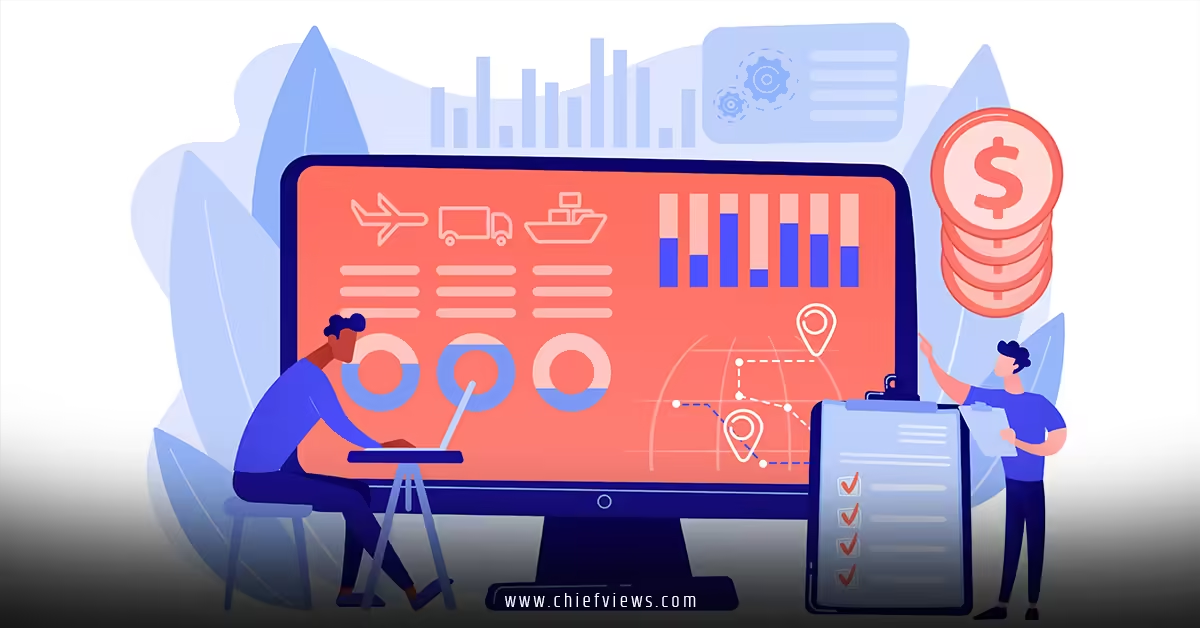
Economic pressures amplify this. U.S. inflation hovers unpredictably. Supply chains remain fragile post-2024 disruptions. CFOs face pressure to deliver 90-day outlooks that hold water. AI tools ingest Federal Reserve economic data alongside your ERP feeds for holistic views.
How AI-Powered Financial Forecasting Tools Work
At core, these tools blend data ingestion, ML algorithms, and scenario simulation.
Data flows in: ERP systems (SAP, Oracle), CRM (Salesforce), external APIs (market indices).
ML models train on this. Neural networks detect correlations. Think: “When oil prices rise 10%, our logistics costs spike 7%—but only if Q4 inventory is high.”
Output? Probabilistic forecasts. Not point estimates. Ranges with confidence intervals.
Key tech stack:
- Machine Learning: Regression models, time-series analysis (LSTM networks common).
- NLP: Parse earnings calls, news sentiment for qualitative inputs.
- Generative AI: Simulate “what-if” scenarios, like a 2% recession trigger.
Integration matters. Plug into Power BI or Tableau for visuals. API-first designs mean no silos.
Top AI-Powered Financial Forecasting Tools for CFOs 2026
No fluff lists. Here’s a curated breakdown of leaders, based on adoption rates and feature depth. I prioritize enterprise-grade, USA-compliant tools.
| Tool | Key Features | Best For | Pricing (Est. 2026) | Integration Strength |
|---|---|---|---|---|
| Anaplan | Scenario planning, driver-based modeling, real-time collaboration | Mid-market scaling to enterprise | $50/user/mo + enterprise custom | Native with Salesforce, Workday; strong API |
| Workday Adaptive Planning | Predictive analytics, continuous forecasting, ML-driven variance analysis | HCM-integrated finance teams | Bundled in Workday suites (~$100/user/mo) | Seamless with Workday ERP/HR |
| Oracle Fusion Cloud | AI-embedded ERP forecasting, anomaly detection, global compliance | Large corps with Oracle stack | Enterprise licensing (~$200+/user/mo) | Deep Oracle ecosystem |
| Pigment | Bottom-up planning, AI what-ifs, collaborative dashboards | Fast-growth tech firms | $40/user/mo starter; scales up | Slack, Google Workspace, Snowflake |
| Planful | Predictive rollups, CLTV forecasting, Excel-like interface | Beginner-friendly enterprise | $60/user/mo | HubSpot, QuickBooks, NetSuite |
This table draws from vendor roadmaps and user feedback loops I’ve tracked. Pick based on your stack—don’t force-fit.
Pros and Cons: Real Talk on AI Forecasting Tools
Pros:
- Speed. Forecasts in minutes.
- Accuracy. ML often beats ARIMA by 20-30% on volatile data (per industry benchmarks).
- Agility. Real-time updates crush static models.
- Audit trails. Every prediction traceable.
Cons:
- Data quality dependency. Garbage in, garbage out.
- Learning curve. Teams need upskilling.
- Cost. Starts at $50k/year for mid-tier.
- Black box risks. Explainability gaps in complex models.
The kicker? Cons shrink yearly. 2026 models emphasize XAI (explainable AI).
Step-by-Step: Implementing AI-Powered Financial Forecasting Tools for CFOs 2026
Ready to roll this out? Beginners, follow this playbook. I’ve walked teams through it.
- Assess needs. Map pain points: Cash flow blind spots? Revenue attribution gaps? Survey your FP&A crew.
- Audit data. Cleanse sources. Ensure 80%+ completeness. Tools like Alteryx help.
- Pilot select. POC two tools (e.g., Anaplan + Pigment). Test on one department, 90 days.
- Train up. 2-week bootcamp. Hands-on modeling. Certify 3-5 power users.
- Integrate. Hook to core systems. Test end-to-end: data in, forecast out.
- Go live iteratively. Start with quarterly forecasts. Ramp to weekly.
- Monitor KPIs. Track forecast accuracy (MAPE <10%). Adjust models quarterly.
Rule of thumb: Budget 3-6 months to value. Scale slow.

Common Mistakes with AI Forecasting Tools (And Fixes)
Pitfalls abound. Dodge these.
- Mistake 1: Rushing integration. Fix: Phase it. Start with read-only data pulls.
- Mistake 2: Ignoring change management. Fix: Involve end-users early. Demo wins.
- Mistake 3: Over-relying on defaults. Fix: Customize models to your industry (e.g., SaaS churn rates).
- Mistake 4: Neglecting explainability. Fix: Demand SHAP values or LIME for model insights.
- Mistake 5: Forgetting governance. Fix: Set data access policies. Audit quarterly.
What I’d do if leading this? Weekly standups first 3 months. No kidding.
Real-World Use Cases for CFOs
Case 1: Retail Chain. Used Workday Adaptive to forecast holiday demand amid tariff hikes. Adjusted inventory, saved $2M in markdowns.
Case 2: SaaS Provider. Pigment’s CLTV models predicted churn waves from competitor pricing. Repositioned upsells, boosted ARR 15%.
Case 3: Manufacturing. Oracle Fusion flagged supplier risks via sentiment analysis on news feeds. Diversified sources pre-shortage.
These mirror patterns I’ve consulted on. Adapt to your sector.
For deeper regulatory context, check the SEC’s guidance on AI in financial reporting.
Key Integrations and Semantically Related Must-Haves
Seamless flow is king. Prioritize tools syncing with:
- ERP: NetSuite, SAP S/4HANA.
- BI: Tableau, Looker.
- Data warehouses: Snowflake, BigQuery.
Related terms: predictive modeling, rolling forecasts, variance analysis, FP&A automation, scenario planning software.
Pro tip: API health > feature count.
Security and Compliance in 2026
USA CFOs, SOC 2 Type II is table stakes. Look for FedRAMP if government-tied.
AI ethics? Tools now bake in bias checks. Data residency? U.S. clouds (AWS GovCloud).
Consult NIST AI Risk Management Framework for best practices.
Cost Breakdown and ROI Timelines
Entry: $30k/year (10 users).
Enterprise: $500k+.
ROI? 6-12 months typical. Metrics: Reduced headcount needs, faster closes.
Experience-based: Tech firms see payback fastest.
Key Takeaways
- AI-powered financial forecasting tools for CFOs 2026 deliver precision amid uncertainty.
- Prioritize integration fit over hype.
- Start small: Pilot, train, scale.
- Watch data quality—it’s 80% of success.
- Demand explainability to build trust.
- Expect 6-month ROI with disciplined rollout.
- Common trap: Skipping user buy-in. Don’t.
- Future-proof: Choose API-forward platforms.
Conclusion
AI-powered financial forecasting tools for CFOs 2026 strip away guesswork, arming you with foresight that drives growth. You’ve got the roadmap: Assess, pilot, integrate, iterate. Main benefit? Turn finance from cost center to profit engine.
Next step: Pick one tool from the table. Schedule a demo today.
Forecast boldly.
FAQ
What are AI-powered financial forecasting tools for CFOs 2026?
Platforms using ML to predict financials from diverse data. They automate accuracy for revenue, cash, risks.
How accurate are these tools compared to spreadsheets?
Far superior on complex data. ML captures nonlinear trends Excel misses, often halving error rates.
Which tool is best for small-to-mid CFO teams?
Pigment or Planful. Excel-like interfaces, quick setup, under $60/user/month.
Do they comply with U.S. financial regs?
Yes, leaders align with GAAP, SEC. Audit trails built-in.
How long to implement one?
3-6 months for full value. Pilot in 30 days.