





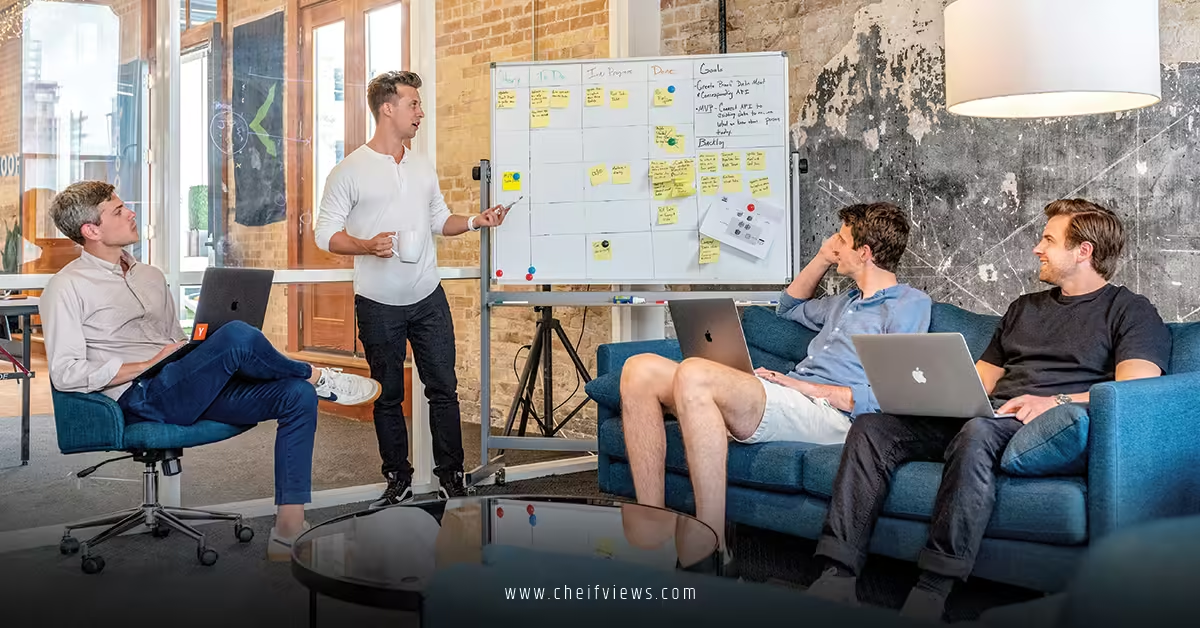
Building AI-ready marketing teams in 2026 means redesigning how people, tools, and workflows collide every single day. The old org chart—silos of content, paid, SEO, and analytics—cracks under pressure from agentic systems that execute faster than any human team.
Smart leaders treat AI as a force multiplier. Humans steer strategy and creativity. Machines handle the repetitive grind. Get this balance wrong and you waste budget on tools nobody uses. Nail it and your team ships campaigns that feel personal at scale while proving ROI in real time.
Why Building AI-Ready Marketing Teams Matters Right Now
Marketing speed has accelerated. Customer expectations keep rising. Budgets face tougher scrutiny. Teams that embed AI thoughtfully outperform those still manually approving every asset.
- Shift from task execution to strategic oversight
- Blend human judgment with AI automation
- Create hybrid roles that leverage both
- Focus on continuous upskilling over one-off training
- Measure success through business outcomes, not just activity metrics
This directly supports the evolving CMO role in AI-powered marketing 2026, where leaders orchestrate these teams instead of managing every campaign detail.
Core Skills Your Team Needs in 2026
Building AI-Ready Marketing Teams in 2026:Technical skills alone fall short. You need people who combine marketing intuition with AI fluency.
Prompt engineering tops the list. It turns vague requests into brand-aligned outputs. Data literacy follows—spotting biases before they hit campaigns. Critical thinking decides when to trust AI and when to override it.

Add change management. Many marketers fear replacement. Great teams reframe AI as their new junior analyst that never sleeps.
Practical mix of skills:
- AI workflow orchestration
- Ethical decision-making around personalization
- Cross-functional collaboration with tech and sales
- Experimentation mindset for rapid testing
Step-by-Step Guide to Building AI-Ready Marketing Teams
Here’s the exact sequence I’d follow if rebuilding a team from scratch.
- Assess current state — Audit tools, skills, and workflows. Identify repetitive tasks eating up hours.
- Define your AI vision — Align with business goals. Decide which areas get automation first (content, personalization, reporting).
- Redesign roles — Create hybrid positions. Example: Content Strategist + AI Orchestrator.
- Build data foundations — Clean, unified data is non-negotiable. AI fails without it.
- Roll out targeted training — Mix in-house workshops, role-specific modules, and quick-win projects.
- Pilot and iterate — Start with one high-impact workflow. Measure before scaling.
- Establish governance — Set guardrails for brand voice, ethics, and approval processes.
- Review quarterly — Adjust structure based on what actually moves metrics.
This isn’t theory. Teams following similar playbooks see faster output and happier people.
Recommended Team Structure for 2026
| Role Type | Traditional Focus | AI-Ready Evolution | Key Responsibilities |
|---|---|---|---|
| Marketing Operations | Tool management | AI workflow owner | Orchestrate agents, governance |
| Content Team | Writing & editing | Human + GenAI hybrid | Strategy, quality control, prompting |
| Performance Marketers | Campaign setup | Predictive optimization | Experiment design, exception handling |
| Analytics | Reporting | Real-time insight generators | Data storytelling, bias detection |
| Growth Specialists | Channel execution | Cross-channel AI conductors | Personalization at scale, testing |
Lean toward fewer, higher-impact roles. AI shrinks junior execution layers while elevating strategic work.
Common Pitfalls and Quick Fixes
Pitfall 1: Tool overload. Teams adopt ten AI platforms and use none effectively.
Fix: Centralize through marketing ops. Pick core tools that integrate cleanly. Prove ROI on each before adding more.
Pitfall 2: Training that’s too generic. Broad webinars create awareness but zero behavior change.
Fix: Run role-specific sprints. Pair learning with immediate projects. Celebrate early wins publicly.
Pitfall 3: Ignoring culture. Top-down mandates create resistance.
Fix: Involve the team in design. Frame AI as career enhancement, not threat. Share success stories internally.
Pitfall 4: No clear measurement. You can’t improve what you don’t track.
Fix: Tie AI adoption to KPIs like campaign velocity, cost per acquisition, and team capacity.
One analogy that sticks: Building an AI-ready team feels like upgrading from a rowing crew to a sailing team. The wind (AI) provides massive power. Your job as captain is knowing when to adjust sails, when to tack, and when to let the crew (humans) apply their unique skill at the right moment.
Rhetorical question: If your competitors have AI agents running A/B tests 24/7 while your team waits for Friday approvals, who wins the next quarter?
Training and Upskilling That Actually Works
Focus on applied learning. Theory alone dies fast.
- Short, weekly “AI hours” for experimentation
- Build a shared prompt library
- Partner with platforms offering marketing-specific certifications
- Create mentorship pairs between tech-savvy and domain experts
For deeper insights on leadership in this space, see resources from Gartner on AI maturity and Forrester’s marketing predictions.
Key Takeaways
- Building AI-ready marketing teams starts with clear vision tied to business results.
- Hybrid human-AI roles deliver the biggest gains.
- Data quality and governance form the foundation—skip them at your peril.
- Training must be practical, role-specific, and ongoing.
- Start small, prove value, then scale fast.
- Culture and change management determine success more than any single tool.
- Measurement keeps everyone accountable and motivated.
- This structure future-proofs your team and elevates the CMO role in AI-powered marketing 2026.
Building AI-Ready Marketing Teams in 2026:The teams winning in 2026 don’t just use AI. They orchestrate it. They free humans for what machines can’t touch: bold ideas, deep empathy, and sharp judgment.
Your next move? Run a skills audit this week. Pick one workflow to automate. Bring your team into the conversation early. Momentum starts there.
FAQs
What does an AI-ready marketing team structure look like in 2026?
It features fewer pure execution roles and more hybrid positions focused on strategy, AI orchestration, and quality oversight. Marketing ops often becomes central to managing agent workflows.
How do you train existing marketers to become AI-ready?
Combine hands-on projects with targeted learning. Focus on prompt engineering, data interpretation, and workflow design. Tie training directly to daily responsibilities for faster adoption.
How does building AI-ready marketing teams connect to the CMO role in AI-powered marketing 2026?
CMOs now act as conductors of these teams. They align AI capabilities with business strategy, redesign operating models, and ensure human creativity stays at the center while driving measurable growth.