




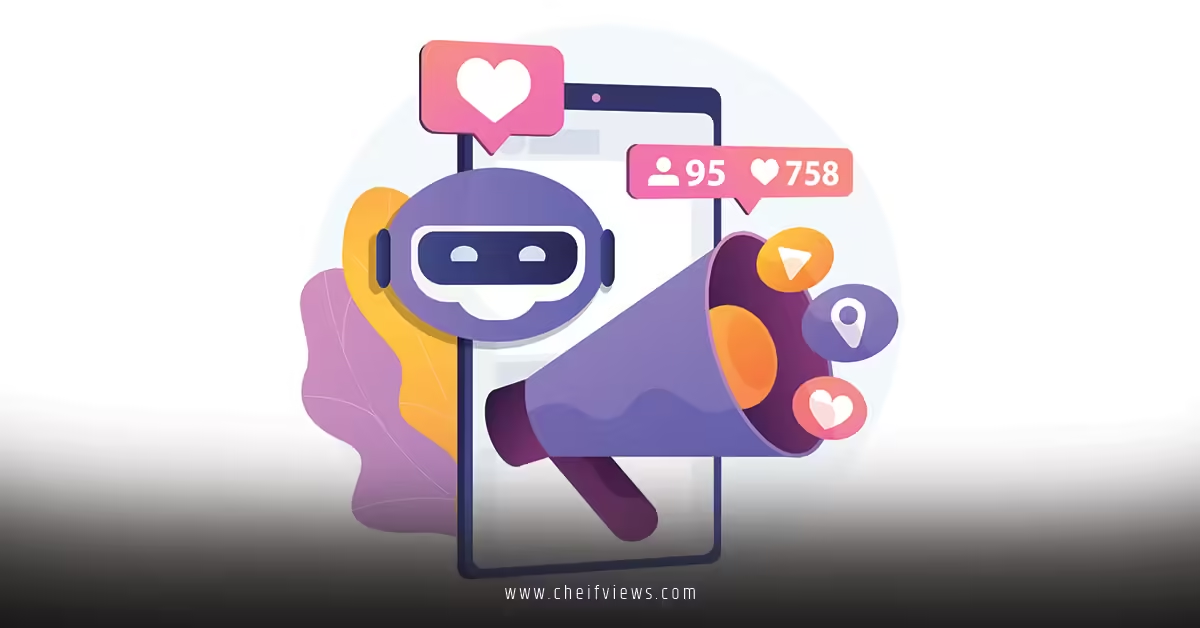
CMO role in AI-powered marketing 2026 looks nothing like it did even two years ago. The job has shifted from campaign overseer to systems architect. You now orchestrate human creativity with AI speed while proving every dollar moves the needle on revenue.
Here’s what it boils down to: survival demands blending strategy with tech fluency. Those who treat AI as a simple efficiency tool fall behind. Winners build adaptive marketing engines that learn and respond in real time.
What the CMO Role in AI-Powered Marketing 2026 Actually Means
- Strategic orchestrator: You align AI tools with business goals instead of chasing shiny features.
- Data guardian and ethics leader: Clean data plus responsible AI use builds trust and avoids costly mistakes.
- Talent transformer: You redesign teams so humans focus on judgment while AI handles repetition and scale.
- ROI enforcer: Every initiative needs clear measurement tied to growth metrics, not vanity stats.
- Innovation driver: You pilot agentic AI workflows that run autonomously yet stay under strategic control.
This matters because marketing budgets face scrutiny like never before. Companies that get it right see faster execution, sharper personalization, and measurable lifts in efficiency.
How AI Has Reshaped the CMO Seat
Forget the old world of quarterly planning cycles. In 2026, CMOs operate in near real-time environments. AI crunches customer signals instantly. Campaigns adjust on the fly.
The kicker? Over 80% of CMOs pilot or scale AI projects, yet few claim full transformation. Most sit in that messy middle—excited but still figuring out integration.


Agentic AI changes everything. These systems don’t just suggest. They execute workflows—from content variation testing to media optimization—with minimal hand-holding. You become the AI boss, setting parameters and guardrails while machines handle the grind.
Human roles evolve toward strategy, creative direction, and ethical oversight. Digital dexterity now ranks as a core skill alongside classic marketing smarts.
Key Skills Every CMO Needs in 2026
Technical knowledge alone won’t cut it. You need judgment to know when AI output shines and when it needs a human gut check.
- Prompt engineering mastery for consistent, brand-aligned results
- Data literacy to spot biases and connect insights to revenue
- Change management to help teams embrace new workflows without burnout
- Cross-functional leadership, especially with CIOs and CTOs who often co-own AI strategy
What usually happens is teams adopt tools fast but skip the operating model redesign. That’s where value leaks.
Step-by-Step Action Plan for Beginners and Intermediate Marketers
Start small. Scale smart. Here’s what I’d do if stepping into the role tomorrow:
- Audit your current stack – Map every tool and workflow. Identify repetitive tasks ripe for automation.
- Build a clean data foundation – Garbage data kills AI. Prioritize unification and governance first.
- Pilot one high-impact use case – Try AI-assisted content personalization or predictive lead scoring. Measure against baselines.
- Rethink team structure – Create hybrid roles where specialists oversee AI agents. Train on strategic prompting.
- Set up measurement frameworks – Tie everything to business outcomes like customer acquisition cost and lifetime value.
- Establish ethical guidelines – Document how you’ll handle transparency, bias, and customer consent.
- Review quarterly – Adjust based on what’s delivering ROI. Kill underperformers fast.
This isn’t theory. It’s the practical sequence that separates pilots from production systems.
| Area | Traditional CMO Focus (Pre-2024) | CMO Role in AI-Powered Marketing 2026 | Expected Impact |
|---|---|---|---|
| Strategy | Campaign planning | AI workflow orchestration | 3-5x faster iteration |
| Content Creation | In-house + agencies | Human + GenAI hybrid with agentic optimization | 6+ hours saved weekly per person |
| Analytics | Monthly reports | Real-time AI decisioning | 20-38% ROI improvement |
| Team Structure | Siloed specialists | Hybrid human-AI teams | Higher autonomy, less handoffs |
| Budget Allocation | Media + creative | AI tools + data infrastructure (28%+ to decisioning) | Faster proving of marketing value |
Common Mistakes and How to Fix Them
Many CMOs chase every new AI tool. The result? Tool sprawl and diluted focus.
Fix: Adopt a “one workflow at a time” rule. Prove value before expanding.
Another trap: Treating AI as a cost-cutter only. You slash headcount without reinvesting in strategy. Teams burn out. Creativity suffers.
Fix: Use efficiency gains to free humans for high-value work like deep customer insight and bold experimentation.
Over-reliance on black-box AI without explainability creates trust issues with leadership and customers.
Fix: Prioritize tools with transparent reasoning. Document decisions. Build “AI-free” review checkpoints for critical campaigns.
Ignoring Generative Engine Optimization (GEO) is another blind spot. Traditional SEO still matters, but appearing in AI summaries drives discovery now.
Real-World Wins and Watch-Outs
CMOs who embed AI into daily decisions redesign roles and unlock adaptive marketing. They move from reactive to predictive.
One fresh analogy: Think of your marketing operation like a jazz ensemble. AI provides the rhythm section—keeping perfect time and handling complex patterns. You, as CMO, conduct. You set the mood, interpret the room, and decide when to let a soloist (human or machine) take the spotlight. The magic happens in that interplay.
Rhetorical question: If your competitors run campaigns on autopilot while you still manually approve every asset, how long until they lap you?
Building AI-Ready Teams
Focus on upskilling existing talent before massive hires. Look for people who combine domain expertise with curiosity about tech.
What I’d do: Run internal “AI mastery” cohorts. Pair high-potentials with quick-win projects. Celebrate failures that teach something.
External partnerships help too. Collaborate with specialists when internal gaps exist.
For deeper reading on data foundations, check this Gartner report on composable marketing. On team transformation, see PwC’s CMO insights. And for practical implementation frameworks, Forrester’s AI predictions offer solid benchmarks.
Key Takeaways
- The CMO role in AI-powered marketing 2026 centers on orchestration over execution.
- Agentic AI and real-time decisioning separate leaders from laggards.
- Clean data and ethical guardrails form the non-negotiable foundation.
- Human judgment remains irreplaceable for strategy and creativity.
- Measurement must tie directly to business growth metrics.
- Operating model redesign beats tool adoption every time.
- Start with one focused pilot, then scale what works.
- Continuous learning and quarterly reviews keep you ahead.
Bottom line: AI doesn’t replace great CMOs. It amplifies them. Master this shift and you don’t just keep your seat at the table—you claim a bigger one.
Next step? Run that stack audit this week. Pick one workflow to automate. Measure results in 30 days. Momentum builds from there.
FAQs
How has the CMO role in AI-powered marketing 2026 changed from previous years?
It shifted from campaign manager to AI systems leader. You now focus more on orchestration, ethics, and ROI proof while AI handles execution speed and scale.
What technical skills matter most for success in the CMO role in AI-powered marketing 2026?
Data literacy, prompt engineering, and change management top the list. Understanding AI limitations helps you deploy it where it adds real value rather than hype.
Can smaller companies compete in the CMO role in AI-powered marketing 2026 without huge budgets?
Absolutely. Start with accessible tools for personalization and automation. Focus on high-ROI use cases like customer segmentation. Many SMBs see strong returns from targeted AI adoption without enterprise-level spend.