



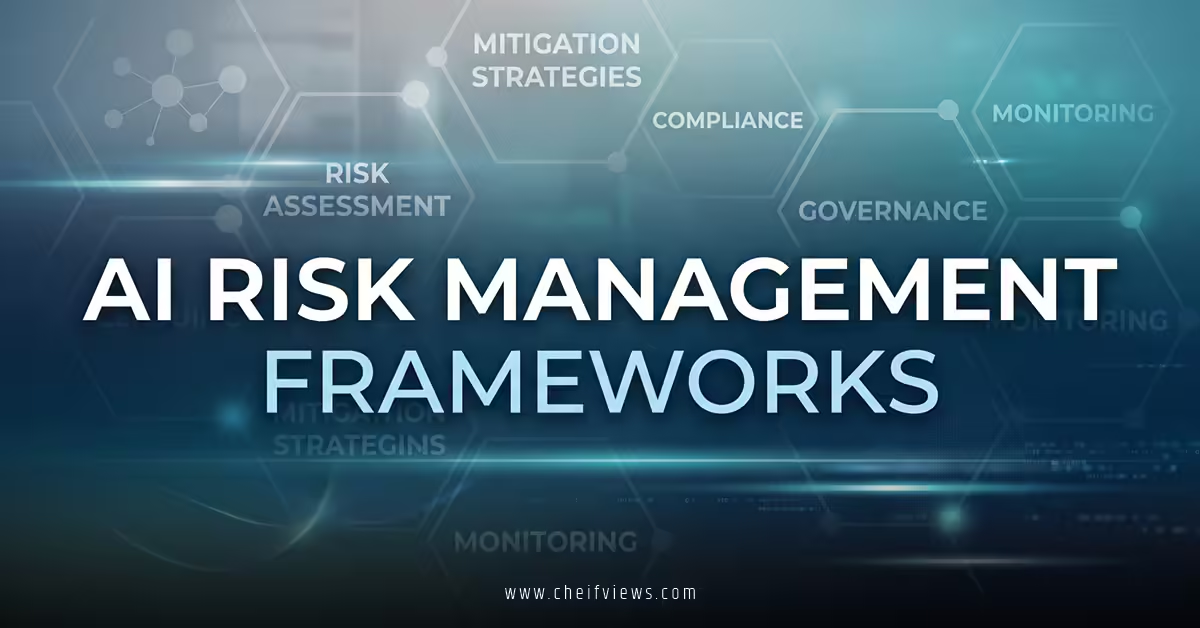
AI risk management frameworks 2026 give organizations the structure to deploy powerful AI without courting disaster. You push innovation hard. But you do it with eyes wide open to the new risks that come with agentic systems, generative models, and autonomous agents.
The landscape sharpened this year. Regulations tightened. Attack surfaces expanded. Companies that treat risk management as an afterthought pay the price in breaches, fines, and lost trust. Get it right, and these frameworks become your unfair advantage.
Why these frameworks matter in 2026:
- AI moved from pilots to production at scale.
- EU AI Act high-risk obligations hit full force in August.
- NIST profiles expanded for critical infrastructure and generative AI.
- Shadow AI and supply chain vulnerabilities remain top headaches.
Key highlights at a glance:
- NIST AI RMF remains the go-to voluntary playbook for most US organizations.
- ISO/IEC 42001 offers certifiable management systems.
- EU AI Act enforces mandatory requirements with real teeth.
- Effective frameworks balance speed with accountability.
Core AI Risk Management Frameworks 2026
NIST AI Risk Management Framework (AI RMF) stands out as the most practical starting point for American teams. It organizes around four functions: Govern, Map, Measure, and Manage.
This isn’t theory. It delivers repeatable processes across the full AI lifecycle. In 2026, NIST added focus on critical infrastructure profiles and deeper guidance for agentic systems.
What I’d do if stepping into a new role? Map your current AI inventory against the Govern function first. Establish accountability, culture, and policies before touching models.
It pairs beautifully with existing cybersecurity practices. Many teams run it alongside the NIST Cybersecurity Framework for seamless coverage.



ISO/IEC 42001 takes a different angle. This international standard delivers a certifiable AI Management System. Think PDCA cycle (Plan-Do-Check-Act) tailored specifically for AI.
Organizations chasing global operations or formal certification lean here. It complements NIST nicely — use one for guidance, the other for audited proof.
EU AI Act changes the game for anyone operating in or selling into Europe. High-risk systems face strict obligations starting August 2026. Risk management isn’t optional. It’s mandatory, documented, and continuous throughout the lifecycle.
Fines reach 7% of global revenue. That’s real skin in the game.
Comparison of Major AI Risk Management Frameworks 2026
| Framework | Type | Scope | Key Strength | Best For | Enforcement |
|---|---|---|---|---|---|
| NIST AI RMF | Voluntary | Global/US focus | Flexible, lifecycle-focused | Most enterprises | None (guidance) |
| ISO/IEC 42001 | Certifiable | International | Auditable management system | Global ops, compliance-heavy | Certification |
| EU AI Act | Regulatory | EU market | Risk-tiered obligations | High-risk systems in Europe | Heavy fines |
| IEEE 7000 Series | Ethical standards | Technical/Design | Value-based engineering | Ethical AI design teams | Voluntary |
| Sector Profiles (NIST) | Voluntary | Critical Infrastructure | Tailored trustworthiness | Energy, transport, utilities | None |
This table reflects real-world adoption patterns reported across industry analyses in 2026.

How These Frameworks Support Balancing Innovation with Cybersecurity in AI Adoption 2026
Smart teams don’t treat risk management as a brake pedal. They use it as a high-performance stabilizer.
When you embed Govern, Map, Measure, and Manage into your development cycles, you move faster with confidence. You catch prompt injection risks early. You secure data pipelines before deployment. You build explainability that supports both innovation and audits.
The result? Fewer fire drills. Stronger stakeholder trust. Actual competitive edge.
Practical integration tip: Link your AI risk processes directly to zero-trust architecture and existing security operations. One unified view beats fragmented efforts every time.
Step-by-Step Action Plan for Implementing AI Risk Management Frameworks 2026
Beginners and intermediate teams, start here. No fluff.
- Inventory ruthlessly. Catalog every AI tool, model, data source, and third-party dependency. Shadow AI will surprise you.
- Choose your foundation. Most US-based organizations begin with NIST AI RMF. Layer ISO 42001 if certification matters. Map EU AI Act obligations if relevant.
- Establish governance. Assign clear owners. Create cross-functional oversight. Define risk appetite for different AI use cases.
- Map risks. Identify potential impacts on safety, security, fairness, privacy, and operations. Prioritize by likelihood and severity.
- Measure and test. Run adversarial testing, bias checks, performance monitoring. Document everything.
- Manage continuously. Implement controls, monitor in production, review incidents, and feed lessons back into the cycle.
- Iterate quarterly. Treat your framework like living software. Update as new models, threats, and regulations emerge.
What usually happens? Teams skip thorough mapping and jump to tools. That creates blind spots that bite later.
Common Mistakes and How to Fix Them
Mistake 1: Treating frameworks as one-time checkboxes.
Fix: Build continuous processes. Risk management lives across the entire lifecycle, not just at launch.
Mistake 2: Going it alone in IT or security.
Fix: Involve legal, compliance, business leaders, and executives early. AI risk is enterprise risk.
Mistake 3: Ignoring smaller models or internal tools.
Fix: Apply proportionate controls based on actual risk tier, not just hype around frontier models.
Mistake 4: Over-documenting without action.
Fix: Focus on actionable insights and measurable controls first. Documentation supports, it doesn’t replace real work.
Advanced Moves for Mature Organizations
Leaders go beyond basics. They create tailored profiles for their industry. They integrate AI risk scoring into procurement. They run red team exercises that simulate both external attackers and internal misuse.
Some build automated governance layers that flag high-risk prompts or model behaviors in real time. Others publish transparency reports that turn compliance into market differentiation.
For deeper implementation details on related strategies, see our guide on Balancing Innovation with Cybersecurity in AI Adoption 2026.
Key Takeaways
- AI risk management frameworks 2026 provide proven structures to scale safely.
- NIST AI RMF delivers flexible, practical guidance for most teams.
- Combine frameworks strategically — don’t force one size on everything.
- Continuous processes beat one-off assessments.
- Early integration with cybersecurity delivers the best results.
- Documentation and testing build defensible positions.
- Tailor controls to actual risk levels for efficiency.
- Strong governance enables bolder innovation, not less.
Nail your AI risk management now and 2026 becomes a year of confident acceleration instead of reactive chaos. Pick one framework this week, map your top three AI use cases against it, and close the biggest gap you find. Momentum compounds fast.
FAQs
Which AI risk management framework should US companies prioritize in 2026?
Most start with the NIST AI RMF for its practicality and alignment with existing cybersecurity programs. Layer others as needed for certification or international operations.
How does the EU AI Act impact AI risk management frameworks 2026?
It makes risk management mandatory and continuous for high-risk systems, with significant penalties. Many organizations align their NIST or ISO processes to meet these obligations efficiently.
Can small and mid-sized businesses use AI risk management frameworks 2026 effectively?
Yes. Begin with the free NIST resources and focus on high-impact use cases. Scale controls proportionally. You don’t need enterprise complexity to achieve meaningful risk reduction.