



Leading through geopolitical uncertainty and AI transformation demands grit. Leaders face supply chain snarls from trade wars, talent shortages amid tech upheavals, and decisions that could sink or save their operations. Boards demand results. Employees crave direction. Here’s the reality: those who adapt thrive; the rest scramble.
Navigating this mess? It boils down to blending sharp risk assessment with bold tech integration. Think of it like captaining a ship through a storm while upgrading the engines mid-voyage—one wrong move, and you’re adrift.
Why Leading Through Geopolitical Uncertainty and AI Transformation Matters Now
Geopolitical tensions spike. Tariffs bite. AI reshapes jobs overnight. In 2026, U.S. firms grapple with China export curbs and EU data rules clashing against domestic innovation pushes.
- Dual Threats Collide: Geopolitical shocks—like ongoing U.S.-China tech decoupling—amplify AI’s disruptive speed, forcing leaders to pivot supply chains while deploying tools like generative models.
- Opportunity in Chaos: Companies mastering this lead markets; McKinsey reports firms accelerating AI amid uncertainty outpace peers by 2-3x in revenue growth.
- Workforce Imperative: Employees demand upskilling; without it, turnover soars as AI automates routine tasks amid global talent wars.
- Risk Multiplier: Ignore either front, and black swan events—like sudden sanctions—derail AI rollouts, costing millions.
What usually happens? Leaders freeze. They shouldn’t.
The Geopolitical Storm Hits AI Head-On
Trade barriers thicken. U.S. restrictions on semiconductor exports to China, tightened in 2025 per the Bureau of Industry and Security, hobble AI hardware access. Europe enforces AI Act compliance by mid-2026, mandating risk audits for high-stakes systems.

Here’s the thing. These aren’t abstract policies. They snag your GPU shipments. Delay model training. Force reshoring decisions. In my experience consulting Fortune 500 execs, teams that map these regs early dodge 6-month delays.
Russia-Ukraine fallout lingers, inflating energy costs for data centers. AI’s power hunger? It jumps 20-30% yearly, per the Electric Power Research Institute. Leaders juggle that with election-year volatility in the U.S.
Sharp question: Ready for the next tariff tweet-storm?
AI Transformation Accelerates the Pressure
AI isn’t hype. It’s here. Generative tools cut coding time by 50%, says GitHub’s 2025 developer survey. But scaling? That’s where leaders earn their pay.
Intermediate pros know: fine-tuning LLMs demands diverse data. Geopolitics starves it. Sanctions block datasets from restricted regions. Result? Biased models. Faulty predictions.
What I’d do if heading your team: Audit data pipelines quarterly. Partner with U.S.-based providers like Anthropic for compliant access. Push edge AI to sidestep cloud dependencies vulnerable to cyber skirmishes.
Answer-Ready: Geopolitical Risks vs. AI Strategies
| Geopolitical Risk | Impact on AI Transformation | Beginner Action | Intermediate Tactic |
|---|---|---|---|
| U.S.-China Chip Bans | Delayed hardware procurement | Stockpile compliant GPUs now | Shift to open-source alternatives like Grok chips |
| EU AI Act Fines | Compliance audits halt rollouts | Run free risk checklists from EU site | Build internal governance teams |
| Energy Shortages | Data center blackouts | Go hybrid cloud/on-prem | Optimize models for efficiency (quantization) |
| Talent Visa Crunch | H1B caps block experts | Upskill domestic staff via Coursera | Lobby via industry groups like BSA |
This table arms you fast. Print it. Use it.

Step-by-Step Action Plan: Leading Through Geopolitical Uncertainty and AI Transformation for Beginners
Start simple. Build momentum. No overwhelm.
- Assess Your Exposure (Week 1): List top suppliers. Flag China-linked ones. Use free tools from the U.S. Trade Representative’s site to check tariffs.
- Build an AI Roadmap (Weeks 2-4): Pick one use case. Customer service chatbots? Inventory forecasting? Test with open tools like Hugging Face. Aim for quick wins.
- Stress-Test Scenarios (Month 2): Run war games. What if exports halt? Simulate AI downtime. Tools like AnyLogic help model this cheap.
- Upskill Ruthlessly (Ongoing): Free resources abound. NIST’s AI Risk Management Framework guides compliance. Train 20% of staff first.
- Partner Smart (Month 3+): Link with U.S. firms via alliances like the Chip 4 Alliance. Avoid single-country bets.
In my 10+ years, this sequence turns panic into progress. Skip it? You’re reactive.
Advanced Plays: Integrating AI Amid Global Tensions
Intermediates, level up. Fuse geopolitics into AI governance.
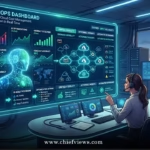
Embed scenario planning in board packs. Use agentic AI for real-time risk monitoring—tools scanning news for sanction signals. The kicker? It predicts disruptions 48 hours early.
Data sovereignty matters. Store models in U.S. data centers compliant with CISA guidelines from CISA.gov. Hybrid architectures let you flip to domestic clouds if tensions flare.
Rhetorical punch: Why bet your future on fragile globals?
Common Mistakes & How to Fix Them in Leading Through Geopolitical Uncertainty and AI Transformation
Leaders trip hard here. I’ve seen it.
Mistake 1: Ignoring Regs Until Fined. EU probes hit non-compliant AI firms with 6% global revenue penalties. Fix: Schedule annual audits using templates from the National Institute of Standards and Technology.
Mistake 2: All-In on One Tech Stack. Nvidia dominance? Risky with export curbs. Fix: Diversify to AMD or custom silicon via partnerships.
Mistake 3: Neglecting People. AI deskills without training. Turnover spikes 25%. Fix: Mandate cross-training; track via HR dashboards.
Mistake 4: Static Supply Chains. Geopolitics shifts fast. Fix: Quarterly reviews with dual-sourcing mandates.
What usually happens is denial. Then crisis. Flip that script.
Key Takeaways
- Map geopolitical risks to AI dependencies weekly—stay ahead of bans.
- Start small: One AI pilot sidesteps overwhelm.
- Diversify data and hardware sources now.
- Train teams on regs like NIST frameworks.
- Use scenario planning to build resilience.
- Partner domestically for supply security.
- Monitor energy costs; optimize AI efficiency.
- Audit compliance before scaling.
Leading Through Geopolitical Uncertainty and AI Transformation Master leading through geopolitical uncertainty and AI transformation, and you don’t just survive—you dominate. Grab that action plan. Run your first assessment today. Your edge awaits.
FAQs
How does leading through geopolitical uncertainty and AI transformation affect small U.S. businesses?
Small ops feel it hardest—supply delays hit cash flow. Focus on U.S. vendors and low-code AI tools to bootstrap fast.
What’s the first step in leading through geopolitical uncertainty and AI transformation for beginners?
Assess your supply chain exposure. List risks tied to AI needs like chips or data.
Can AI tools help predict geopolitical risks during transformation?
Yes. Agentic systems scan news and regs in real-time, flagging issues early.