




CMO AI strategies 2026 flip the script from flashy pilots to hard-nosed revenue impact. No more experimenting for the sake of it. Top CMOs treat AI as a core operating system that powers personalization, automation, attribution, and decision-making at scale. The winners connect every AI initiative straight to pipeline velocity and business growth.
What it looks like right now:
- Agentic AI handling end-to-end workflows from content to campaign optimization.
- Predictive analytics forecasting customer behavior before they even know it.
- Generative tools cranking out assets while humans steer strategy and brand voice.
- Unified data platforms closing the loop between marketing, sales, and finance.
The reality check? 70% of CMOs call AI a top priority, but only about 30% feel truly ready to scale it. That gap creates massive opportunity for those who move with purpose.
Why CMO AI Strategies 2026 Separate Leaders from Survivors
Budgets stay tight. Expectations explode. Boards demand proof that AI spend delivers measurable returns, not just cooler dashboards.
Here’s the thing: AI alone doesn’t drive growth. Smart alignment does. The strongest CMO AI strategies 2026 treat technology as the accelerator for aligning marketing with revenue growth as CMO 2026 — shared KPIs, full-funnel attribution, and cross-team accountability.
Without that foundation, you burn cash on tools that look impressive but move zero needles. With it, you compound wins fast.
Gartner notes CMOs allocating 15.3% of budgets to AI on average, with the ready ones pushing higher and seeing better outcomes.

Core CMO AI Strategies 2026 That Actually Deliver
Focus here. Skip the hype.
1. Agentic AI for Autonomous Workflows
Move past simple chatbots. Deploy agents that run campaigns, optimize bids, nurture leads, and flag risks in real time. Early adopters report dramatic gains in speed and efficiency.
2. Hyper-Personalization at Scale
AI crunches unified customer data for experiences that feel human, not creepy. Think dynamic content, predictive journeys, and offers timed perfectly. This isn’t nice-to-have — it’s table stakes.
3. Generative Engine Optimization (GEO)
Optimize for AI search summaries and agents, not just traditional rankings. Structure content for citation, authority, and machine readability.
4. Predictive Revenue Intelligence
Use AI for lead scoring, churn prediction, and next-best-action recommendations. Tie it directly to sales pipelines for closed-loop visibility.
5. Creative and Content Acceleration with Guardrails
Generative AI slashes production time while humans own strategy, ethics, and brand integrity. Test relentlessly. Scale winners.
What I’d do if stepping into a new role tomorrow: Audit the current data foundation first. Then pick 2-3 high-impact use cases with clear revenue ties. Pilot fast, measure harder, and expand.
Step-by-Step Action Plan for CMO AI Strategies 2026
Beginners and intermediates, keep it practical:
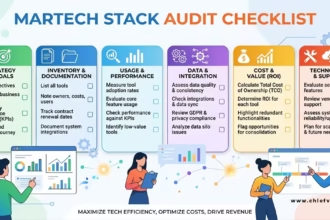
- Assess maturity. Map your current tech stack, data quality, and team skills. Identify the biggest revenue leaks AI can plug.
- Build or fix the data backbone. Clean, unify, and govern customer data across systems. No strong data = weak AI.
- Choose integrated platforms. Prioritize tools that connect marketing automation, CRM, analytics, and AI layers. Avoid more silos.
- Define governance and ethics. Set rules for transparency, bias mitigation, and brand safety. Involve legal and compliance early.
- Upskill the team. Train on prompting, interpretation, and oversight. Create “master prompter” culture with permission to experiment.
- Pilot with revenue in mind. Tie every test to metrics like influenced revenue, CAC payback, or pipeline contribution.
- Review and iterate monthly. Use real-time dashboards. Kill underperformers. Double down on what works.
The kicker is execution speed. Teams that review weekly and reallocate fast win bigger.
Comparison: Traditional vs. AI-First CMO Approach 2026
| Area | Traditional Approach | AI-First CMO Strategies 2026 | Revenue Impact |
|---|---|---|---|
| Content Creation | Manual, slow cycles | Generative with human oversight | 40% faster production |
| Personalization | Segment-based | Real-time, predictive | Higher conversion rates |
| Attribution | Last-click or basic | Multi-touch, AI-driven | Better ROI visibility |
| Campaign Optimization | Periodic reviews | Agentic, continuous | Faster scaling of winners |
| Team Focus | Execution heavy | Strategy & creativity | Higher productivity |
| Measurement | Vanity + lagging metrics | Revenue-linked, predictive | Board-level credibility |
This isn’t theory. It’s the new baseline.

Common Pitfalls and Quick Fixes
Pitfall 1: Chasing shiny tools without strategy.
Fix: Start with business problems, then match AI solutions. Always ask “How does this move revenue?”
Pitfall 2: Ignoring data quality.
Fix: Invest upfront in unification and governance. Garbage data produces expensive garbage outputs.
Pitfall 3: Over-automating creativity.
Fix: Keep humans in the loop for storytelling, empathy, and final approval. AI augments — it doesn’t replace taste.
Pitfall 4: No cross-functional alignment.
Fix: Link AI efforts to aligning marketing with revenue growth as CMO 2026. Joint KPIs with sales and finance make everything click.
Pitfall 5: Measuring activity, not outcomes.
Fix: Track influenced pipeline, win rates, and LTV impact from day one.
Tools and Resources Worth Watching
Platforms like Salesforce Einstein, Adobe Sensei, HubSpot AI, and emerging agentic systems lead the pack. Test what fits your stack.
For deeper frameworks, see Gartner’s CMO resources and Forrester Predictions.
Check Adobe’s AI and Digital Trends for practical customer journey insights.
Key Takeaways for CMO AI Strategies 2026
- Anchor every AI move to revenue outcomes and business alignment.
- Prioritize data foundations before stacking tools.
- Blend agentic automation with human strategy and creativity.
- Build GEO capabilities for visibility in AI-driven discovery.
- Upskill teams relentlessly and establish clear governance.
- Pilot small, measure fast, scale what delivers ROI.
- Treat AI as a system for alignment, not a standalone project.
- Review progress with revenue leaders monthly.
Bottom line: CMO AI strategies 2026 turn marketing from a support function into a predictive growth engine. Master this and you don’t just keep up — you set the pace while proving undeniable value.
Next step: Run a quick AI maturity audit with your team this week. Pick one revenue-blocking problem and test an AI solution against it. Momentum starts with that first decisive move.
FAQs
What makes CMO AI strategies 2026 different from previous years?
The focus shifts from experimentation and generative content to agentic systems, revenue accountability, and integration with overall growth engines like aligning marketing with revenue growth as CMO 2026.
How much budget should CMOs allocate to AI in 2026?
Top performers allocate around 15-21% of marketing budgets, with stronger readiness correlating to higher spend and better returns. Start where you can prove quick impact.
Can smaller teams implement effective CMO AI strategies 2026?
Yes. Focus on high-ROI use cases, integrated platforms, and strong data practices first. Principles scale down — prioritize ruthlessly and partner smartly.