




CEO leadership skills for AI transformation and talent development 2026 separate winners from watchers. CEOs who master these skills don’t just adopt AI—they redesign how their organizations think, work, and grow. They turn talent into a force multiplier while scaling technology that actually moves the needle on revenue and efficiency.
- Vision with execution: Translate AI hype into concrete business outcomes tied to P&L impact.
- Talent orchestration: Build, buy, borrow, or bot skills while keeping humans at the center.
- Adaptability under pressure: Lead rapid change without losing culture or trust.
- Governance that enables: Create guardrails that speed up, not slow down, innovation.
- Personal fluency: Understand AI deeply enough to ask sharp questions and make bold calls.
These aren’t nice-to-haves. In 2026, they determine who captures real ROI as AI agents move from pilots to core operations.
Why CEO Leadership Skills for AI Transformation and Talent Development 2026 Matter Now
AI investment keeps climbing—projected to hit around 1.7% of organizational revenue. Yet many leaders still wrestle with scaling beyond experiments. The gap isn’t technology. It’s leadership.
CEOs who embed AI across end-to-end workflows see higher productivity and retention. Those who treat it as an IT project fall behind. Talent development sits at the heart of this. You can’t scale AI without people who know how to work alongside it—and leaders who redesign roles accordingly.
Here’s the thing: AI handles routine work. Humans bring judgment, creativity, and accountability. CEOs who bridge that gap win.
What would I do if I were stepping into a CEO role in mid-2026? I’d start by auditing my own fluency, then map every major workflow for AI augmentation. No sacred cows.

Core CEO Leadership Skills for AI Transformation and Talent Development 2026
Strategic AI Thinking and Business Alignment
Forget generic pilots. Top CEOs diagnose exactly where AI creates unfair advantage. They tie initiatives to measurable outcomes—revenue lift, cost reduction, faster cycles.
They ask: Which processes can we redesign from scratch with AI at the core? Not “where can we slap on a chatbot?”
This skill demands comfort with uncertainty. Markets shift fast. Customer expectations evolve faster.
Human-AI Collaboration and Talent Strategy
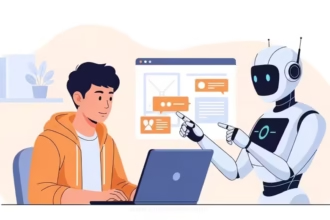
Leaders now operate a “build-buy-borrow-bot” model. Upskill current teams. Hire specialists. Partner for niche expertise. Deploy AI agents as digital colleagues.
The kicker? Treating AI agents like new hires—onboard them with context, goals, and feedback loops. Organizations doing this report stronger productivity and retention.
| Skill Area | Traditional Approach | 2026 AI-First Approach | Expected Impact |
|---|---|---|---|
| Talent Acquisition | Degree-focused hiring | Skills + AI fluency focus | Faster filling of critical roles, better cultural fit |
| Learning & Development | Annual training programs | Always-on, AI-personalized pathways | 2-3x higher skill adoption rates |
| Role Design | Static job descriptions | Dynamic, human-AI hybrid teams | Productivity gains of 30-80% in targeted workflows |
| Performance Management | Output metrics only | Human judgment + AI insights | Improved retention and innovation |
| Governance | Compliance checkbox | Business-enabling framework | Faster scaling with lower risk |

Change Leadership and Culture Building
Eighty percent of CEOs expect AI to overhaul operations. Yet employee change fatigue runs high.
Effective leaders communicate relentlessly. They celebrate early wins, address fears head-on, and model curiosity. They redesign incentives so people get rewarded for AI collaboration, not just individual output.
Rhetorical question: If your best people feel threatened by AI, how long before they walk?
Governance, Ethics, and Risk Navigation
Strong CEOs shift governance from red tape to ROI accelerator. They embed responsible AI practices early—bias checks, transparency, data readiness—without killing momentum.
They own the narrative on trust. In an era of deepfakes and regulatory scrutiny, this becomes a competitive edge.
Personal AI Fluency
You don’t need to code. You need to understand capabilities, limitations, and costs. Practice daily. Challenge your teams with specific use cases. Leaders who do this make sharper investment decisions and earn credibility.
Step-by-Step Action Plan for Beginners
- Assess your baseline (Week 1-2): Take an honest AI literacy audit. Interview five department heads on current pain points and AI readiness.
- Build your inner circle (Month 1): Assemble a cross-functional AI steering group—tech, HR, finance, operations. Make talent development a standing agenda item.
- Pick high-impact pilots (Months 1-3): Choose 2-3 workflows with clear ROI potential. Focus on augmentation, not replacement.
- Launch talent programs (Months 2-6): Roll out personalized learning paths. Partner with platforms for AI essentials training. Track adoption weekly.
- Measure and iterate (Ongoing): Set KPIs tied to business outcomes. Review monthly. Kill what doesn’t work fast.
- Scale what wins: Redesign full processes around successful pilots. Update roles, incentives, and org structure.
Common Mistakes & How to Fix Them
- Treating AI as a tech project only. Fix: Own it personally as CEO. Link it to strategy in every town hall.
- Underinvesting in talent development. Fix: Allocate budget and time proportionally. Make skills a board-level discussion.
- Over-focusing on cost cutting. Fix: Balance efficiency with growth plays. AI shines brightest in innovation and customer experience.
- Poor change communication. Fix: Be transparent about impacts. Involve employees in redesign.
- Waiting for perfect data. Fix: Start with what you have and improve iteratively. Momentum beats perfection.
CEO Leadership Skills for AI Transformation and Talent Development 2026 in Practice
Look at organizations embedding AI across functions. They report higher EBIT impact when they redesign workflows end-to-end.
Leaders succeed by connecting strategy to skills, fostering internal mobility, and creating shared skills taxonomies.
Explore the World Economic Forum‘s blueprint for workforce transformation in the AI age for deeper ecosystem examples. Or check Deloitte’s latest human capital trends for orchestration strategies.
Key Takeaways
- CEO leadership skills for AI transformation and talent development 2026 center on vision, fluency, and people-first execution.
- Talent isn’t a support function—it’s your primary differentiator alongside AI.
- Start small but think system-wide. Redesign work, not just add tools.
- Governance enables speed when done right.
- Personal practice builds credibility faster than any consultant.
- Measure relentlessly against business outcomes.
- Balance efficiency gains with human creativity and growth.
- Act now—2026 rewards decisive, adaptive leaders.
The CEOs who thrive won’t be the ones with the biggest budgets. They’ll be the ones who build organizations that learn faster, adapt smarter, and keep humans excited about the future of work.
Ready to level up? Audit one major workflow this week and map the talent implications. Small moves compound when leadership points the way.
FAQs
How do CEO leadership skills for AI transformation and talent development 2026 differ from general digital transformation leadership?
AI moves faster and impacts knowledge work directly. It requires deeper personal fluency, agent orchestration, and constant role redesign—skills beyond traditional tech adoption.
What talent development approaches work best under CEO leadership for AI in 2026?
Personalized, always-on learning combined with clear career pathways in hybrid human-AI teams. Focus on hybrid skills: critical thinking, creativity, and AI collaboration.
Can mid-sized companies compete on CEO leadership skills for AI transformation and talent development 2026?
Absolutely. Focus beats scale. Prioritize 2-3 high-value use cases, aggressive upskilling, and agile governance. Many nimble firms outpace lumbering giants through speed and focus.