






Cash flow forecasting best practices 2026 demand more than spreadsheets and monthly guesses. With volatile rates, supply chain hiccups, and uneven demand still testing businesses, accurate projections separate companies that thrive from those barely hanging on.
This isn’t about crystal balls. It’s about building systems that give you clear sightlines into cash reality — week by week, month by month. Especially when tying back to broader CFO priorities during economic uncertainty 2026, strong forecasting becomes your early warning system and strategic weapon.
- Rolling forecasts beat static ones in fast-moving conditions.
- AI tools now deliver 30-50% better accuracy on short-term predictions.
- Scenario planning turns “what if” into actionable plays.
- Real-time data integration replaces stale reports.
- Regular variance analysis sharpens future models.
Get this right, and you sleep better knowing you can handle surprises without panic.
Why Cash Flow Forecasting Best Practices 2026 Matter More Now
Economic bumps don’t announce themselves. One quarter you’re cruising. Next, customer payments stretch while costs climb.
In my experience, what usually happens is teams rely on last year’s patterns until reality bites. The smart move? Treat forecasting as a living process, not a quarterly chore. This directly supports key CFO priorities during economic uncertainty 2026 like liquidity protection and agile decision-making.
Here’s the thing: A good forecast doesn’t predict the future perfectly. It prepares you for multiple futures. Think of it like having a GPS with live traffic updates instead of an old paper map.
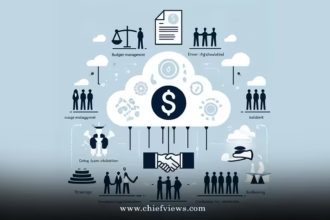


Core Cash Flow Forecasting Best Practices 2026
Adopt Rolling Forecasts
Ditch the fixed annual view. Rolling 13-week forecasts give you a moving window that updates constantly.
Finance leaders update these weekly or bi-weekly. This approach catches shifts early — whether it’s a big client slowing payments or unexpected supplier price hikes.
Leverage AI and Automation
AI-powered tools analyze historical patterns, customer behavior, and external signals to boost accuracy. Many teams now hit 85-95% accuracy on near-term forecasts.
Start small. Integrate with your ERP and banking data for automatic pulls. Let the system flag anomalies while you focus on judgment calls.
Build Multiple Scenarios
Don’t bet on one outcome. Create base, optimistic, and pessimistic versions. Tie them to clear triggers like interest rate changes or sector slowdowns.
This practice aligns tightly with CFO priorities during economic uncertainty 2026, helping you pre-approve contingency moves.
| Forecasting Element | Traditional Method | 2026 Best Practice | Accuracy/Impact Gain |
|---|---|---|---|
| Time Horizon | Static 12-month | Rolling 13-week + longer views | Faster response to changes |
| Data Source | Manual entry | Automated ERP/bank integration | Reduced errors by 40%+ |
| Method | Single model | Direct + indirect + AI ensemble | 30-50% better short-term precision |
| Review Cadence | Monthly/Quarterly | Weekly variance analysis | Continuous improvement |
| Scenario Planning | One base case | Multiple with triggers | Better risk preparedness |
This table highlights the practical shift happening right now.
Focus on Drivers and Assumptions
Break cash flow into clear drivers: customer payment timing, supplier terms, payroll cycles, capex plans. Document every assumption. Review them monthly.
Track leading indicators like order pipelines and freight costs. These give you earlier signals than lagging financials.

Step-by-Step Action Plan for Cash Flow Forecasting Best Practices 2026
- Gather Clean Data (Week 1)
Audit your AR, AP, and bank feeds. Fix inconsistencies before modeling. - Choose Your Tools (Weeks 1-2)
Evaluate solutions with strong integrations. Start with a 13-week rolling template if you’re keeping it simple. - Build Your First Model (Month 1)
Use direct method for short-term (actual invoices) and indirect for longer views. Layer in scenarios. - Set Review Cadence
Weekly cash huddles. Monthly deep dives on variances. Adjust assumptions fast. - Integrate AI Where It Fits
Pilot one area like AR predictions. Scale once you see the lift. - Stress Test and Communicate
Run worst-case models. Share insights with ops and sales teams for buy-in.
Follow these steps and you’ll move from guessing to guiding.
Common Mistakes & How to Fix Them
Mistake 1: Overly optimistic assumptions.
Fix: Ground inflows in historical collection patterns, not invoice dates. Build buffers.
Mistake 2: Ignoring seasonality and one-offs.
Fix: Layer in known events — tax payments, bonuses, inventory builds. Review quarterly patterns.
Mistake 3: Siloed data.
Fix: Automate pulls from multiple sources. Break down department walls for input.
Mistake 4: Set-it-and-forget-it forecasts.
Fix: Mandate regular variance reviews. Treat deviations as learning opportunities, not failures.
Advanced Tips for Cash Flow Forecasting Best Practices 2026
Incorporate customer-level predictions instead of portfolio averages. A single slow-paying client can wreck your model if hidden in averages.
Test new tools with real historical data first. Demand explainable AI — you need to understand why the forecast changed.
For more on tying this to bigger picture strategy, revisit approaches in CFO priorities during economic uncertainty 2026.
Check J.P. Morgan’s cash forecasting guide for midsize business insights. Explore Kyriba resources on AI applications. And review Numeric’s complete forecasting framework for FP&A teams.
Key Takeaways
- Rolling forecasts provide the agility needed in 2026’s environment.
- AI boosts accuracy dramatically when paired with human oversight.
- Multiple scenarios prepare you for real-world volatility.
- Clean, automated data beats manual effort every time.
- Regular variance analysis turns forecasts into learning machines.
- Driver-based models offer deeper business insights.
- Integration across teams makes forecasting truly actionable.
- Conservative assumptions protect against nasty surprises.
Cash flow forecasting best practices 2026 come down to discipline plus smart tools. Nail this, and you give your organization breathing room when others feel squeezed.
Your next step? Pull together last quarter’s actuals and build a simple 13-week rolling forecast this week. Compare it against reality in two weeks. Start small, iterate fast.
FAQs
How do cash flow forecasting best practices 2026 differ from previous years?
They lean heavier on automation, AI, and rolling models. Static yearly forecasts no longer cut it amid ongoing volatility.
What role does AI play in cash flow forecasting best practices 2026?
AI handles data crunching and pattern recognition for higher accuracy. Finance leaders still provide strategic context and final judgment.
Can small businesses implement advanced cash flow forecasting best practices 2026?
Yes. Start with free templates and cloud tools. Focus on the 13-week rolling approach first — it scales beautifully without big budgets.