






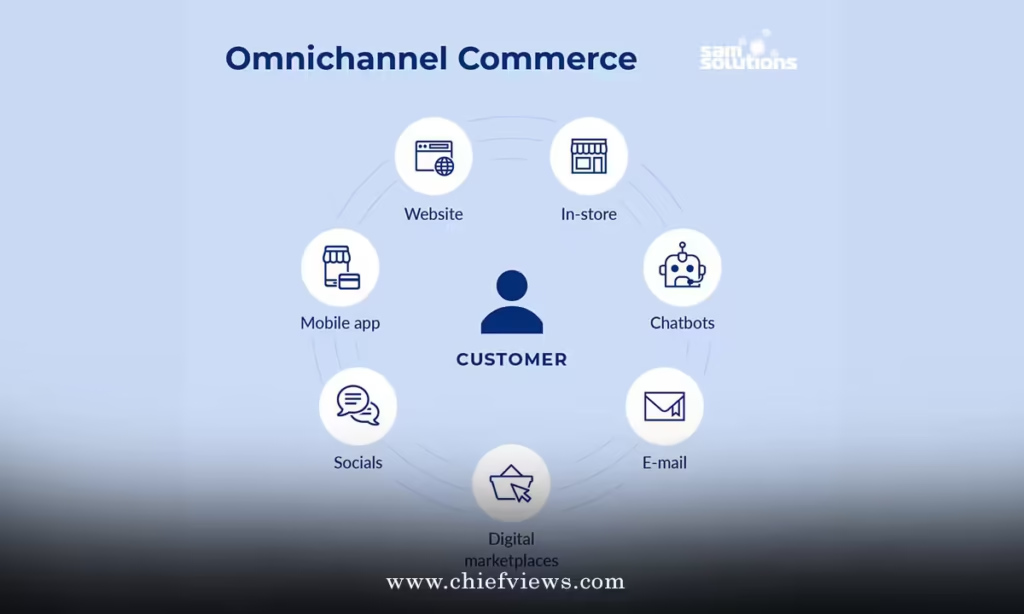
CXO strategies for omnichannel customer experience design are what we use when customers keep moving between your website, app, email, store, chat, phone, and social channels, and they expect the experience to feel like one conversation. If you run a business, you already know the pain point: a customer starts on Instagram, asks a question on live chat, then has to repeat everything when they call support. That is where trust slips.
The good news is that you do not need a huge team or a giant budget to improve this. You need a clear plan, a shared view of the customer, and a few smart habits that keep every channel working together. In this article, we’re going to be taking a look at CXO strategies for omnichannel customer experience design, and how you can build a smoother customer journey that improves loyalty and sales. If you would like to find out more, feel free to read on.
Pic – CC0 License
Start with one customer view
The first step in CXO strategies for omnichannel customer experience design is simple: stop treating each channel like it lives on its own. Your customer does not think in “departments.” They think in needs, timing, and convenience.
That means your sales, support, marketing, and operations teams need the same basic customer information. Who bought what? What issue was raised? Which offer did they open? What happened last time they reached out? When this is shared properly, the experience feels personal instead of repetitive.
A good place to begin is your CRM and service tools. If you want a practical benchmark for service expectations, the Salesforce State of the Connected Customer is useful reading. It shows how quickly customer expectations have risen across digital and human channels.



Design the journey, not just the channel
A lot of businesses build channels first and customer journeys later. That is backward. CXO strategies for omnichannel customer experience design work best when we map the full journey before we polish each touchpoint.
Ask a few basic questions. Where do customers first hear about you? Where do they compare options? Where do they get stuck? Where do they need reassurance before buying? Where do they want fast help after the sale? Once you see the journey clearly, you can remove friction instead of guessing where the problem is.
This is especially important for beginner and intermediate businesses that grow quickly. A process that works fine for 50 customers a month can break badly at 500. Journey mapping helps you fix weak spots before they become expensive problems.
Make handoffs feel invisible
One of the biggest signs of strong CXO strategies for omnichannel customer experience design is a smooth handoff. The customer should not feel like they are starting over every time they move between teams or channels.
If someone asks a question on your website and then follows up by phone, the agent should already know the context. If they abandon a cart and later return through email, the message should still make sense. If they visit a store after browsing online, staff should be able to pick up the story without making the customer repeat everything.
This is where training matters as much as technology. Good systems help, but people still need clear rules for logging notes, tagging issues, and passing the right information to the next person. The easiest way to lose trust is to make the customer do your internal coordination for you.

Use data to listen, not just report
Customer data is only useful if it helps you act. In CXO strategies for omnichannel customer experience design, we do not collect data to impress ourselves with dashboards. We collect it to spot patterns and improve decisions.
Look at response times, repeat contact rates, abandoned carts, review comments, and channel switching behavior. If customers keep moving from chatbot to phone, the bot may be failing. If many people ask the same question after checkout, your product page or confirmation email may be unclear. If one region behaves differently from another, local habits may be shaping the journey.
For businesses in the USA, UK, Australia, Singapore, and Dubai, local expectations can vary more than many owners expect. Mobile usage, delivery speed, preferred contact methods, and even service tone can differ by market. Use data to adapt, not assume.
Train employees to carry the brand voice
The customer experience is not only about systems. It is also about how your people speak, solve problems, and follow through. That is why CXO strategies for omnichannel customer experience design must include training, not just software.
Every employee who touches the customer should understand the brand promise. If your brand is fast and friendly, then email replies, chat messages, and in-store conversations should all sound that way. If your brand is premium and calm, your service should feel consistent too. Mixed signals confuse customers and weaken trust.
You do not need a scripted robot tone. You need a common standard. Give your team examples of good responses, clear escalation rules, and enough freedom to solve simple problems on the spot. A well-trained employee often does more for customer loyalty than another tool subscription ever will.
Build for mobile first
Most customers will meet your business on a phone before they meet you anywhere else. That is why CXO strategies for omnichannel customer experience design need to start with mobile, not end there.
If your site is hard to read on a small screen, your forms are too long, or your support buttons are hidden, people will leave. The same goes for slow-loading pages, awkward checkout steps, and chat tools that do not work properly on mobile. The smoother the mobile experience, the less effort your customer has to spend.
A good reference point is the Nielsen Norman Group for practical usability insights. Their guidance is useful if you want to understand how real people interact with digital experiences, not just how teams hope they will.
Measure the right things
If you want CXO strategies for omnichannel customer experience design to stick, you need to measure the experience, not just the output. Revenue matters, of course, but it does not tell you where the friction sits.
Track a mix of simple measures:
- First response time
- Repeat contact rate
- Conversion rate by channel
- Customer satisfaction after support
- Cart abandonment
- Complaint themes
- Return visits or repeat purchases
You do not need a dozen dashboards to begin with. Start small, review the numbers regularly, and look for one or two patterns you can fix each month. Small improvements add up fast when they are repeated across every channel.
Keep the experience consistent across markets
If you sell across different countries, consistency and local fit both matter. CXO strategies for omnichannel customer experience design should protect the core brand while still adjusting for local expectations.
For example, customers in Singapore may expect speed, clarity, and efficient service. In Dubai, relationship tone and premium service cues may matter more. In the UK, subtlety and helpful detail can matter. In the USA and Australia, customers often expect convenience and quick issue resolution. Your job is not to copy-paste the same script everywhere. It is to keep the experience clear, useful, and trustworthy in each market.
The HubSpot customer experience resources can also help if you want practical ideas on service, communication, and customer retention.
We hope that you have found this article enlightening in some way, because the main lesson is straightforward: CXO strategies for omnichannel customer experience design work best when you treat the customer journey as one connected experience, not a set of separate tasks. If you can share information better, remove friction, train your team well, and keep your message consistent, you will give customers a reason to come back.