


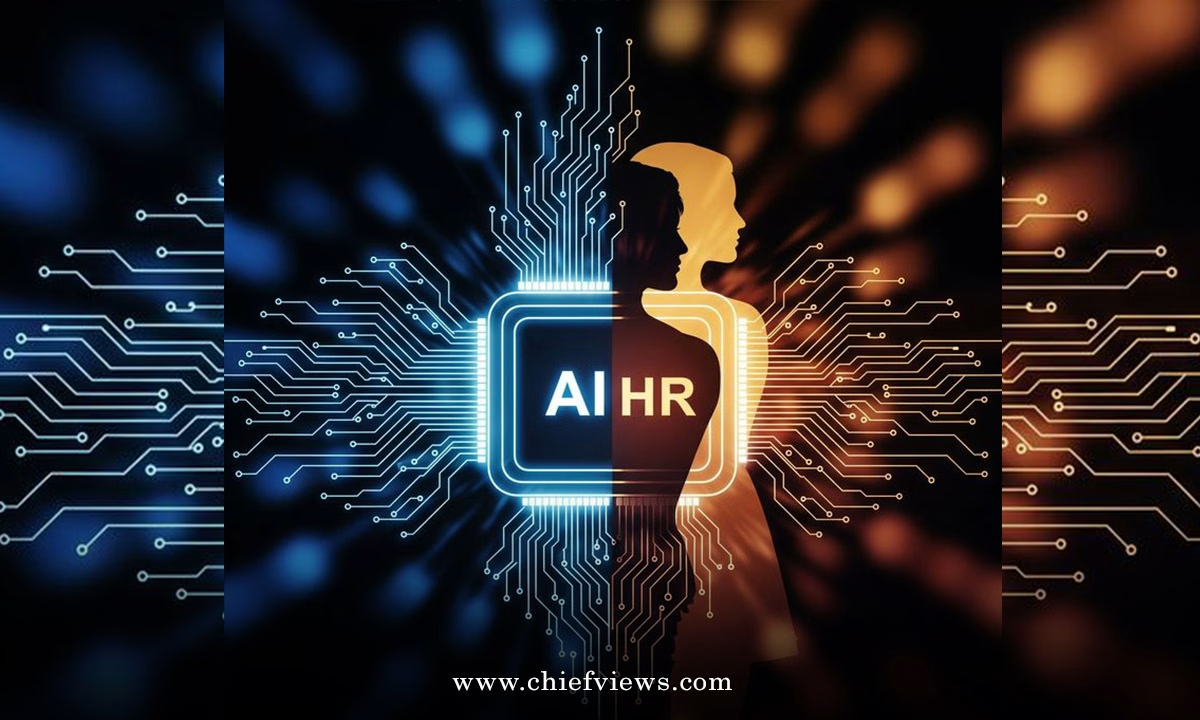
An effective HR AI Governance Framework gives HR teams a clear way to approve, monitor, and control AI use across hiring, performance, learning, workforce planning, and employee support. It matters because AI in HR can improve speed and consistency, but without guardrails it can also create bias, privacy risks, weak accountability, and a trust problem that spreads fast.[1][8][14]
- What it is: a set of policies, roles, reviews, and controls for AI used in HR.[1][14]
- Why it matters: it helps HR use AI fairly, transparently, and with human oversight where it counts.[1][13][14]
- What it protects: employees, candidates, managers, and the organization’s reputation.[8][14]
- What it improves: decision quality, auditability, and confidence in AI-enabled HR work.[1][18]
- What leaders need: a framework that is specific, repeatable, and easy to enforce.[1][10][14]
The kicker is simple: AI governance is not a paperwork exercise. It is how HR keeps control while AI gets smarter.
HR AI Governance Framework: what it should include
A strong HR AI Governance Framework usually has five core parts: inventory, ownership, policy, oversight, and review. Findem’s HR governance guide recommends starting with an inventory of every AI tool or workflow, then defining accountability, creating or updating policy, building a cross-functional committee, and running bias, privacy, and security reviews.[1] HR Acuity similarly defines AI governance policy as the internal document that explains how an organization approves, monitors, and holds people accountable for AI use.[8]
1. AI inventory
You cannot govern what you cannot see. List every AI-enabled tool in HR, including recruiting platforms, talent analytics, chatbots, performance tools, and embedded AI features inside larger systems.[1][14]
2. Clear ownership
Assign an executive sponsor, a program lead, data owners, and compliance roles. Several frameworks recommend a RACI-style structure so decisions do not float between HR, Legal, IT, and Compliance.[1][7][14]
3. Usage policy
Define acceptable use, prohibited use, vendor requirements, escalation paths, and human-oversight rules. This is where the organization states what AI can do, what it cannot do, and who signs off.[1][8][14]

4. Oversight and review
Build review points for bias, privacy, security, explainability, and impact on employees. NIST’s AI Risk Management Framework emphasizes governance, mapping, measurement, and management of AI risk, which maps cleanly to HR use cases.[19]
5. Ongoing monitoring
Review incidents, re-test high-risk systems, and update policy as tools change. Governance is a loop, not a launch event.[1][7][14]
Answer-ready table: HR AI governance components at a glance
| Framework element | What it does | Why it matters | Who owns it |
|---|---|---|---|
| AI inventory | Tracks all AI tools and AI-enabled workflows | Prevents shadow AI and hidden risk | HR + IT + Procurement |
| Policy | Sets approved, restricted, and prohibited uses | Creates consistent decision rules | HR + Legal + Compliance |
| Risk review | Checks bias, privacy, security, and explainability | Reduces harm before deployment | HR + Legal + Security + Data Privacy |
| Human oversight | Requires people to review high-impact decisions | Protects employees from blind automation | Business leaders + HR |
| Audit and monitoring | Tests outcomes and monitors changes over time | Keeps the framework current and defensible | Governance committee |
How HR AI governance supports trust and culture
This is where the framework connects to the broader business question of how CHRO can balance AI adoption with human centered culture. A governance model is not just about avoiding legal trouble. It is also how HR signals that speed will not come at the expense of fairness, dignity, or transparency.
SHRM has called for workplace AI governance and highlighted the need for transparency, human oversight, and appeal rights in high-risk use cases that materially affect employment.[13] That matters because employees do not judge AI by its technical elegance. They judge it by whether it feels fair.
A useful rule: if an AI process touches hiring, promotion, compensation, discipline, or layoffs, governance should be stricter. The more the system affects someone’s career, the less comfortable HR should be letting the model drive the outcome.
Step-by-step: how to build an HR AI Governance Framework
Step 1: Map current AI use
Inventory every AI tool, every embedded AI feature, and every workflow where AI already influences HR work.[1][14] Include vendors, internal builds, and pilot tools that are not fully rolled out yet.
Step 2: Classify risk by use case
Separate low-risk use cases from medium- and high-risk ones. Thinking Inc.’s CHRO-focused guide recommends tiering AI applications so general productivity tools get lighter rules while people-impacting systems get documented governance and human oversight at every decision point.[10]
Step 3: Assign decision rights
Define who approves tools, who reviews exceptions, who signs off on risk, and who owns audits.[1][8] If the org cannot answer “who says yes?” in one sentence, the framework is too vague.
Step 4: Write the policy
Keep it plain. Cover acceptable use, prohibited use, data handling, vendor due diligence, review standards, and escalation paths.[1][8][14] Avoid legal fog that nobody can actually use.
Step 5: Put a governance committee in place
Bring together HR, Legal, IT, Compliance, Security, DEI, and procurement when relevant.[1][7][14] This group should review new tools, incidents, audit findings, and policy updates on a fixed cadence.
Step 6: Require human oversight for high-impact decisions
Hiring, performance ratings, promotions, compensation, discipline, and workforce reduction planning should never be left to AI alone.[10][14] AI can inform the decision. People must own it.
Step 7: Test for bias, privacy, and security
Run baseline and ongoing audits. Review vendor methodology, data provenance, access controls, retention, and mitigations.[1][14] If a vendor will not explain how the model works at a level your team can understand, that is a red flag.
Step 8: Train the people using it
Teach HR staff, managers, and recruiters how the tools work, where they fail, and when to escalate concerns.[1][7] Governance fails fast when users treat AI like authority instead of assistance.
Step 9: Communicate with employees
Tell employees when AI is used, what it influences, what data it uses, and how they can ask questions or request human review.[8][14] Silence breeds suspicion. Plain language builds confidence.
Step 10: Review and improve
Refresh the framework on a set cadence. Update the policy when tools change, when laws shift, or when audit results show new risk.[1][10][14]
Common mistakes HR teams make
1. Treating governance as a legal-only task
That backfires. HR AI governance needs HR, Legal, IT, Security, Compliance, and business leaders in the room.[1][7][14]
2. Starting with the tool instead of the problem
Bad order. First define the HR problem, then decide whether AI is actually the right answer.[1][10]
3. Ignoring embedded AI
Many teams only track standalone AI tools and miss the AI already baked into platforms.[14]
4. Overlooking employee communication
If people do not know how AI is being used, trust erodes quickly.[8][14]
5. Skipping human oversight in high-risk workflows
This is the fastest way to create a governance failure. For employment decisions with real consequences, people must stay accountable.[10][13][14]
HR AI Governance Framework vs. general AI policy
An AI policy tells people what is allowed. A governance framework tells the organization how that policy gets enforced, reviewed, and improved. HR Acuity’s definition of AI governance policy covers approval, monitoring, and accountability, while broader HR governance guidance adds inventory, risk assessment, vendor scrutiny, and employee notice.[8][14]
Think of it this way: policy is the rulebook. Governance is the operating system.
Why this matters for CHROs in 2026
A CHRO does not just need AI tools. They need a way to keep AI aligned with the people strategy. That is exactly where how CHRO can balance AI adoption with human centered culture becomes more than a keyword phrase. It becomes the operating principle behind trust, adoption, and performance.
The organizations that get this right will move faster without looking reckless. The ones that skip governance will eventually pay for it—in rework, reputation damage, or employee pushback.
Key Takeaways
- HR AI Governance Frameworks define how AI is approved, monitored, and controlled in HR.[1][8]
- Inventory first. You cannot govern hidden tools or embedded AI features.[1][14]
- Cross-functional ownership is non-negotiable for strong oversight.[1][7][14]
- High-impact decisions need human review. AI should support, not replace, accountability.[10][13][14]
- Bias and privacy checks should happen before and after deployment.[1][14][19]
- Employee transparency is a trust issue, not just a compliance issue.[8][13][14]
- Governance must be ongoing. AI changes, vendors change, risks change.[1][10]
- The best frameworks protect both speed and trust.
A solid HR AI governance framework gives HR the structure to adopt AI without losing control of the employee experience. Start with the inventory, set the rules, assign owners, and make human oversight the default where careers are on the line.
FAQs
What is an HR AI Governance Framework?
It is the system of policies, roles, controls, and review processes that governs how AI is used in HR across hiring, performance, learning, and workforce decisions.[1][8][14]
Why does HR need AI governance now?
Because AI is already influencing people decisions, and without governance HR risks bias, privacy issues, weak accountability, and loss of employee trust.[13][14][19]
How does an HR AI Governance Framework connect to how CHRO can balance AI adoption with human centered culture?
It gives the CHRO a practical way to adopt AI while keeping transparency, fairness, and human oversight at the center of the employee experience.[10][13][14]