




AI transformation leadership strategies for CEOs start with one hard truth: technology alone never moves the needle. In my experience working with executive teams, the companies that actually extract value treat AI as a leadership test, not a pilot program.
Here’s the quick overview:
- AI transformation leadership strategies for CEOs mean owning the agenda, not delegating it to the CIO or a shiny new Chief AI Officer.
- Success hinges on clear accountability, business-outcome metrics, and redesigning work—not stacking more tools.
- Most organizations remain stuck in disconnected experiments; the leaders who scale treat AI as a core operating shift.
- Time allocation matters—CEOs who dedicate focused attention see faster adoption and measurable results.
- The real differentiator is culture, incentives, and decision rights, not model sophistication.
Boards and investors in the USA now separate the serious players from the dabblers. What usually happens is this: a wave of pilots creates buzz, then progress stalls because no one owns the full outcome.
Why Most AI Efforts Stall at the Top
The gap between adoption and impact remains wide. McKinsey’s recent work shows that while nearly nine in ten organizations report regular AI use in at least one function, only a small share attribute meaningful EBIT impact. High performers remain rare.
Bain research highlights a four-stage path most companies travel: understand the shift, run scattered tests, evolve the business, then lead the transformation. The majority get stuck in stage two.
IBM data from 2026 shows 76 percent of organizations now have a Chief AI Officer—up sharply from the prior year. That role helps, yet it does not replace CEO ownership. Companies with stronger leadership structures simply scale more initiatives.



The kicker is simple. AI rewards curiosity and clear decision rights more than traditional command-and-control.
Core AI Transformation Leadership Strategies for CEOs
Treat the effort like a capital allocation decision, not a science project.
Anchor every initiative to purpose and customer impact. Ask: How does this advance our mission? Most teams still default to cost-cutting stories. That approach rarely creates durable advantage.
Own the agenda personally. Bain notes that CEOs spending 15 to 25 percent of their time on AI improve adoption rates and business results. That does not mean writing code. It means setting direction, protecting experimentation space, and holding P&L leaders accountable for outcomes.
Build an AI-capable C-suite. McKinsey finds that a top team that understands AI is the single most significant driver of success. Upskill business leaders so they can integrate technology with operations and change management.
Shift from siloed systems to platforms. Treat technology platforms with the same rigor as strategy or succession planning.
Redesign decision rights early. Fragmented ownership kills momentum. Assign single owners for the handful of enterprise decisions that slow everything else.
Step-by-Step Action Plan for Beginners and Intermediate Leaders
If I were stepping into a new CEO role tomorrow with an uneven AI track record, here is exactly what I would do in the first 90 days.
- Clarify the dominant theme. Pick efficiency, growth, risk, or customer experience. Name two or three enterprise metrics AI must move in the next 12–18 months. Write them down and share them publicly inside the company.
- Map current pilots against those metrics. Kill or pause anything that cannot show a clear line to the chosen outcomes. Most organizations carry too many experiments.
- Assign clear owners. Pair every major initiative with a business-unit leader who owns the P&L impact, not just a technology sponsor. Tie a meaningful portion of compensation to shared results.
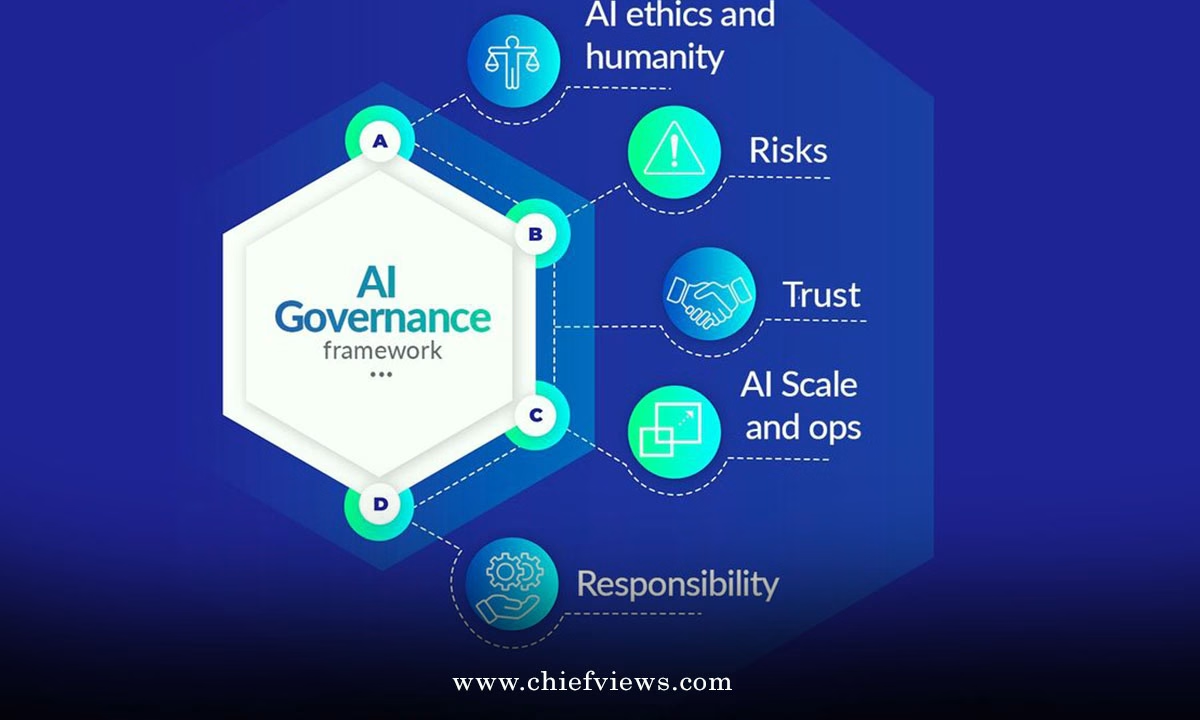
- Establish a dynamic governance model. Traditional stage-gate processes strangle speed. Move to continuous monitoring, clear escalation paths, and accountability pushed closer to the work.
- Protect a small set of high-visibility experiments. Give them air cover, measure weekly, and celebrate early measurable wins. Use those wins to fund the next wave.
- Launch targeted fluency programs for the top two layers of leadership. Focus on judgment, orchestration of human-AI work, and ethical guardrails rather than prompt engineering.
- Bring the board along with real decisions, not status updates. Secure explicit authorization for ambition, funding, and risk appetite.
This sequence creates visible progress while building the muscle for larger redesign.
Common Mistakes & How to Fix Them
What usually happens looks predictable.
| Mistake | What It Looks Like | How to Fix It |
|---|---|---|
| No single outcome owner | Everyone “owns AI”; no one is accountable for results | Assign one senior business leader per major value stream with explicit authority and metrics |
| Stuck in pilot purgatory | Dozens of proofs-of-concept, almost nothing scaled | Force a kill/scale decision every 90 days based on predefined value thresholds |
| Misaligned incentives | Functional leaders measured only on their silo | Link at least 30% of C-suite variable pay to shared AI-driven outcomes |
| Starting with flashy use cases | Marketing or sales demos that never integrate | Begin with high-frequency, well-defined back-office or operational processes where ROI is easy to track |
| Treating governance as a brake | Review layers that slow everything after the fact | Design lightweight, continuous controls that enable speed and safety together |
These patterns appear repeatedly across industries. Fix ownership and measurement first; the technology problems become manageable.

Building the Right Operating Model
Four common structures show up. The CEO-led transformation office works well when speed and visibility matter most. A dedicated leader reports directly to the CEO and holds cross-functional authority. Other models distribute ownership more broadly once the organization has stronger baseline fluency.
Choose based on your starting maturity and how centralized decision-making already is. The structure matters less than the clarity of accountability inside it.
Agentic systems raise the stakes further. Deploying an agent is relatively easy. Deciding its authority, the human hand-off points, and the trust model is the real leadership work. Start with focused problems where decisions repeatedly stall or experienced people spend time on administrative load.
Measuring What Actually Matters
Track behavior change and business outcomes, not model accuracy or number of tools deployed. Look for redesigned workflows, faster decision cycles, and shifts in where human judgment is applied.
High performers sequence investments so early wins fund later capability building. They become cash accretive relatively quickly while pursuing larger structural changes.
Key Takeaways
- AI transformation leadership strategies for CEOs succeed when the CEO owns the agenda and spends focused time on it.
- Clear single-point accountability for outcomes beats diffuse “everyone owns AI” approaches.
- Most value appears only after organizations move past isolated pilots into redesigned work.
- Upskilling business leaders on AI integration creates more leverage than pure technology training.
- Incentives and decision rights must shift before large-scale results appear.
- Boards need real decision involvement, not passive updates.
- Start with purpose-aligned problems and measurable metrics rather than technology capabilities.
- Culture and trust determine whether people actually use the systems leaders deploy.
The leaders who treat this as a multi-year capability build rather than a series of projects create durable advantage. The next practical step is straightforward: pick the two or three metrics that matter most to your strategy, audit every current AI effort against them this week, and assign clear owners with authority to act.
FAQs
What makes AI transformation leadership strategies for CEOs different from earlier digital efforts?
Earlier waves often stayed inside the technology function. AI demands business-unit ownership, redesigned decision rights, and new definitions of quality and judgment because humans and systems now share the work.
How much time should a CEO realistically spend on AI transformation leadership strategies for CEOs?
Bain’s observations suggest 15–25 percent of focused time correlates with stronger adoption and results. That time goes to direction-setting, accountability, and protecting experiments—not hands-on technical work.
Do AI transformation leadership strategies for CEOs require hiring a Chief AI Officer?
Many organizations now do so, and the role can accelerate progress. Yet the CEO still needs to own the overall agenda and ensure business leaders remain accountable for outcomes. The structure supports the strategy; it does not replace it.