

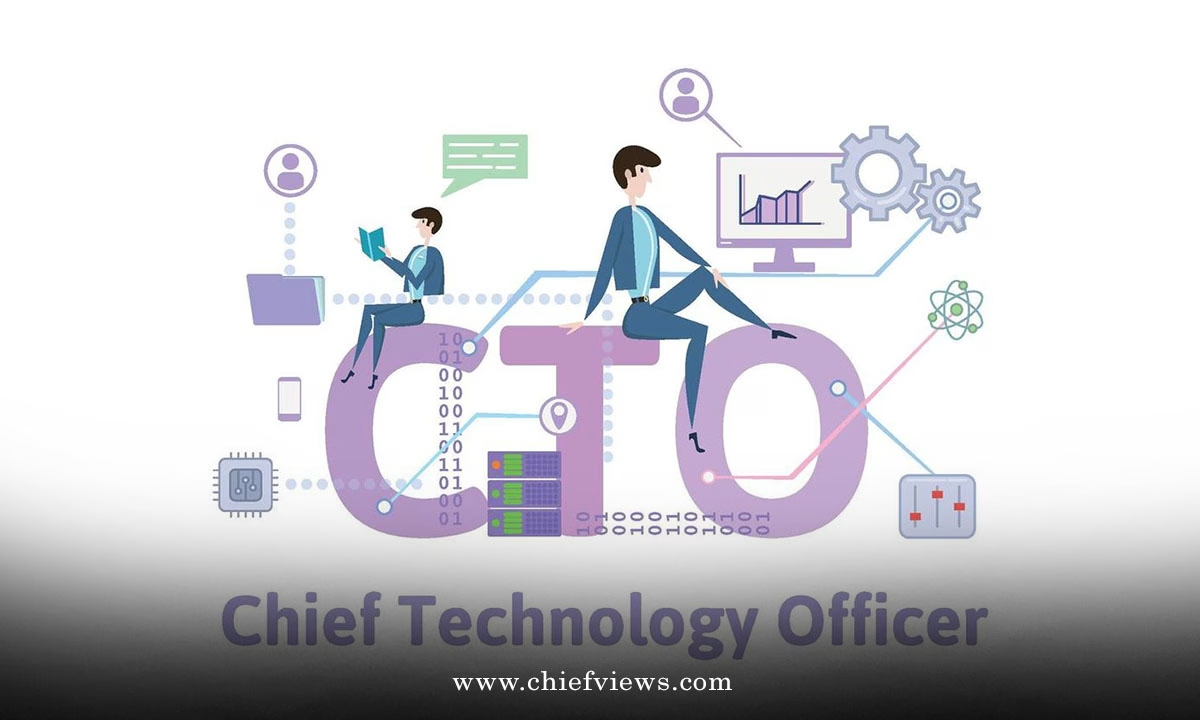
CTO skills needed in 2026 start with one hard truth: pure technical depth no longer gets you the seat at the table. You still need it. But the leaders who thrive treat technology as a lever for measurable business outcomes, not a collection of shiny tools.
Here’s the quick hit for anyone scanning:
- AI fluency means spotting real value and governing risk, not chasing demos.
- Cybersecurity and risk ownership now sit at board level.
- Business translation skills turn architecture decisions into P&L language.
- People leadership and change management keep hybrid human-AI teams productive.
- Systems thinking and data strategy decide whether AI investments compound or stall.
Master these and you move from order-taker to enterprise driver. Miss them and the role gets narrower fast.
Why CTO Skills Needed in 2026 Look Different
The job has shifted. Boards expect CTOs to own technology risk the way CFOs own financial risk. AI agents are moving from pilots into production workflows. Multi-cloud environments are the norm. Talent markets reward people who can upskill existing teams faster than they can hire new specialists.
In my experience, the CTOs who struggle most are the ones still optimizing for elegant code or the latest framework. The ones who last treat every technical choice as a business bet. They ask “Where does this create durable advantage?” before “How cool is the tech?”
What usually happens is simple. A company pours budget into generative tools. Six months later the dashboard looks busy but revenue and margin stay flat. The gap almost always traces back to missing strategic skills, not missing models.

Core CTO Skills Needed in 2026
AI Strategy Beyond the Hype
You do not need to train models yourself. You do need to know when AI creates measurable value and when it creates noise. That means identifying use cases that cut cycle time, improve customer outcomes, or unlock new revenue—and killing the rest early.
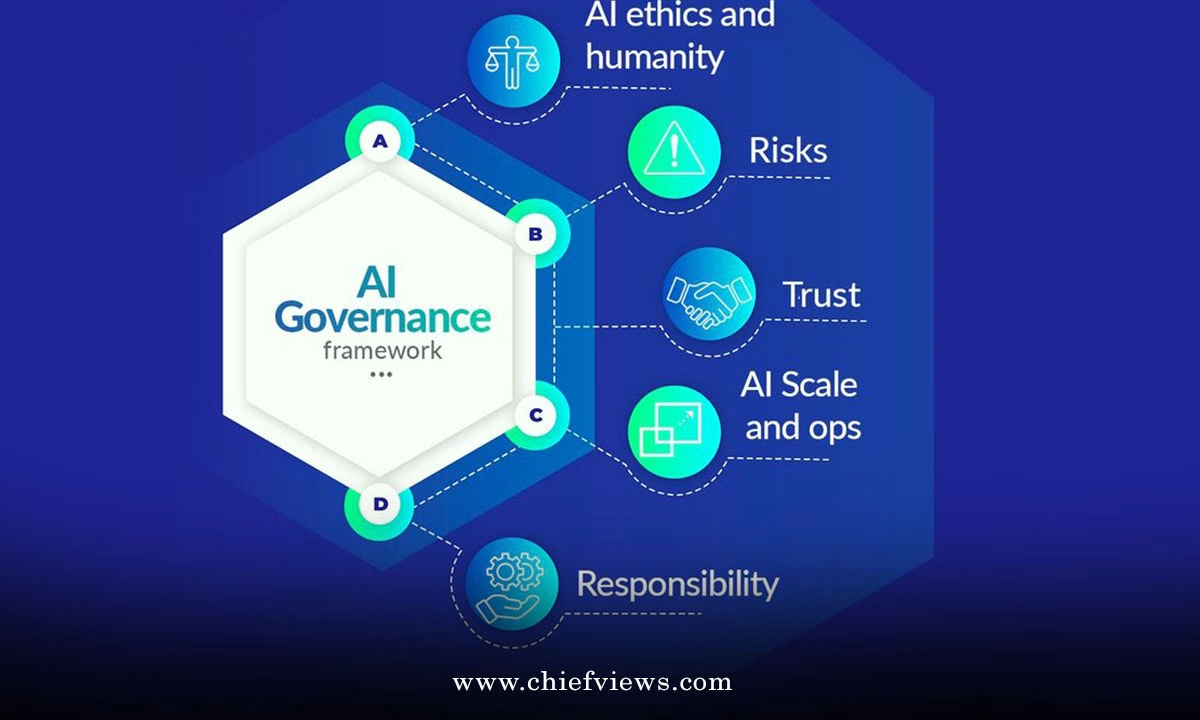
Agentic systems change the game. Traditional software development life cycles give way to agent orchestration. The CTOs who adapt treat AI as an operating layer, not a side project. They build governance so teams trust the outputs and auditors can follow the decisions.
If I were stepping into a new role tomorrow, I’d start by mapping three high-ROI workflows, assign clear owners for data quality and model risk, and set a 90-day value checkpoint. No value, no more budget.
Cybersecurity and Enterprise Risk Ownership
Cyber is no longer an IT problem. It is a board problem. Modern CTOs own the strategy, the metrics, and the narrative. That includes zero-trust architecture, secure AI pipelines, and the ability to translate breach probability into dollars and downtime.
The kicker is speed. Threats move faster than annual risk assessments. Continuous monitoring and clear escalation paths matter more than perfect policy binders.
Business Acumen and Strategic Translation
Can you read a P&L and explain how an architecture decision hits each line? Can you sit with the CFO and discuss unit economics of a platform investment? Most technical leaders still treat this as optional. It is not.
Strong CTOs become the bridge. They turn “we need better latency” into “this cuts customer churn by X and protects Y revenue.” They speak the language of multi-year roadmaps, technical due diligence for fundraising or M&A, and vendor consolidation that actually improves margins.
People Leadership in Hybrid Human-AI Teams
You will spend more time on org design, culture, and upskilling than on any single technical decision. Psychological safety still predicts team performance. So does the ability to help people work alongside autonomous agents without feeling replaced.
Hiring pure coding specialists is less useful than it used to be. Look for systems thinkers who can define problems clearly and orchestrate solutions. Then build internal pathways so your existing engineers level up on AI tooling, data literacy, and product judgment.
Systems Thinking and Data as a Strategic Asset
AI amplifies whatever system you already have. Clean data, clear workflows, and aligned incentives produce leverage. Messy data and siloed teams produce expensive failure.
Treat data quality and platform foundations as first-class work. The organizations that win treat platform teams as product teams with measurable outcomes, not cost centers.
Quick Comparison: Traditional CTO Focus vs. 2026 Reality
| Skill Area | Traditional Emphasis | 2026 Expectation | Business Impact |
|---|---|---|---|
| AI | Experimentation & pilots | Value realization + governance | Faster ROI, lower risk |
| Security | Perimeter defense | Board-level risk ownership + AI security | Reduced breach cost, trust |
| Leadership | Managing engineers | Hybrid human-AI teams + culture | Higher retention, faster delivery |
| Strategy | Tech roadmap | Multi-year business-aligned bets | Better capital allocation |
| Communication | Status updates | Board & C-suite translation | Larger budgets, longer tenure |

Step-by-Step Action Plan for Beginners and Intermediate Leaders
- Audit your current stack against business outcomes. Pick your top three revenue or cost drivers. Map every major tech decision to them. If the link is fuzzy, fix the language first.
- Build AI literacy at the leadership level. Run short, practical sessions for the C-suite. Focus on capabilities, limits, and risk. You own the narrative.
- Own one end-to-end risk domain. Start with data security or AI governance. Document the current state, the residual risk, and a 90-day improvement plan. Present it to the board in plain English.
- Redesign one team for hybrid work. Introduce AI agents into a contained workflow. Measure time saved and quality. Use the results to coach the broader organization.
- Practice financial fluency weekly. Spend one hour reviewing the company’s financial statements or unit economics. Connect one technical metric to a financial one. Repeat until it feels natural.
- Create an upskilling loop. Identify the three skills your team needs most (data literacy, agent orchestration, secure design). Run internal workshops or pair senior people with learners. Track progress quarterly.
What I’d do if I were intermediate and aiming higher: treat the next six months as a deliberate experiment. Pick one high-visibility initiative that forces you to practice all five core skills above. Document the outcomes. That portfolio becomes your proof.
Common Mistakes & How to Fix Them
Mistake 1: Chasing every new AI tool.
Fix: Require a clear value hypothesis and a kill criteria before any pilot expands.
Mistake 2: Staying too deep in the weeds.
Fix: Schedule architecture reviews, then step back. Trust your principals. Your job is direction and risk, not the last code review.
Mistake 3: Treating security as someone else’s problem.
Fix: Make risk metrics part of your regular board pack. Own the story.
Mistake 4: Ignoring culture until people start leaving.
Fix: Measure psychological safety and learning velocity the same way you measure uptime. Act on the data.
Mistake 5: Speaking only technical language upstairs.
Fix: Rehearse every board update with a non-technical colleague first. If they can’t repeat the key point, rewrite it.
Key Takeaways
- CTO skills needed in 2026 center on AI value creation, risk ownership, and business translation more than pure coding depth.
- Cybersecurity has become a board-level responsibility that CTOs must lead.
- Systems thinking and clean data foundations determine whether AI investments pay off.
- People leadership now includes coaching hybrid human-AI teams.
- Financial fluency turns technical credibility into sustained influence.
- Upskilling internal talent beats endless external hiring in most markets.
- Clear communication with non-technical executives is a career accelerator.
- Start with one high-visibility initiative that forces practice across multiple skills.
The CTOs who will still be thriving in three years are the ones who treat technology as a force multiplier for the business, not an end in itself. They stay curious, they stay honest about risk, and they keep building the human systems that make the technical systems work.
Pick one skill from the list above that feels weakest. Design a 30-day experiment around it this week. Measure the result. Then expand. That single habit compounds faster than any certification.
FAQs
What are the most important CTO skills needed in 2026 for someone coming from a pure engineering background?
Business translation, AI governance, and people leadership. Technical depth got you here. The other three keep you in the role and expand your influence.
How do CTO skills needed in 2026 differ between startups and large enterprises?
Startups still reward hands-on technical judgment and speed. Larger organizations demand more board-level risk ownership, multi-year roadmap discipline, and the ability to drive change across thousands of people. The core AI and systems skills remain the same; the scale of communication and governance changes.
Can I develop the key CTO skills needed in 2026 without leaving my current role?
Yes. Own a cross-functional initiative that forces you to speak business language, manage risk, and lead people through change. Document the outcomes. That internal proof is often more persuasive than an external title jump.