



AI Governance Framework for Technology Leaders :
Technology leaders can no longer treat AI as an experiment that sits outside normal controls. In 2026 an effective AI governance framework is the difference between scaling AI with confidence and watching risk, regulation and reputation catch up later.
The strongest frameworks blend three proven standards — NIST AI Risk Management Framework, ISO/IEC 42001 and the EU AI Act — then operationalise them so policies actually run in production rather than sitting in a shared drive. This is now a core part of the CTO skills needed in 2026.
Why AI governance moved from optional to essential
Three forces made the shift permanent. Regulatory exposure is real: the EU AI Act’s high-risk obligations are fully in force, with material fines. Shadow AI is widespread; most organisations still discover tools and agents after they are already in use. Agentic systems introduce new failure modes — autonomous decision chains, tool use and multi-agent coordination — that traditional IT controls never contemplated.
Boards are responding. Two-thirds of S&P 500 companies now have at least one non-executive director with AI skills. Data privacy and security remain the top concern today, but compliance, legal and execution risk are rising fast. Technology leaders who cannot show a clear governance model will find budget, hiring and board confidence harder to secure.


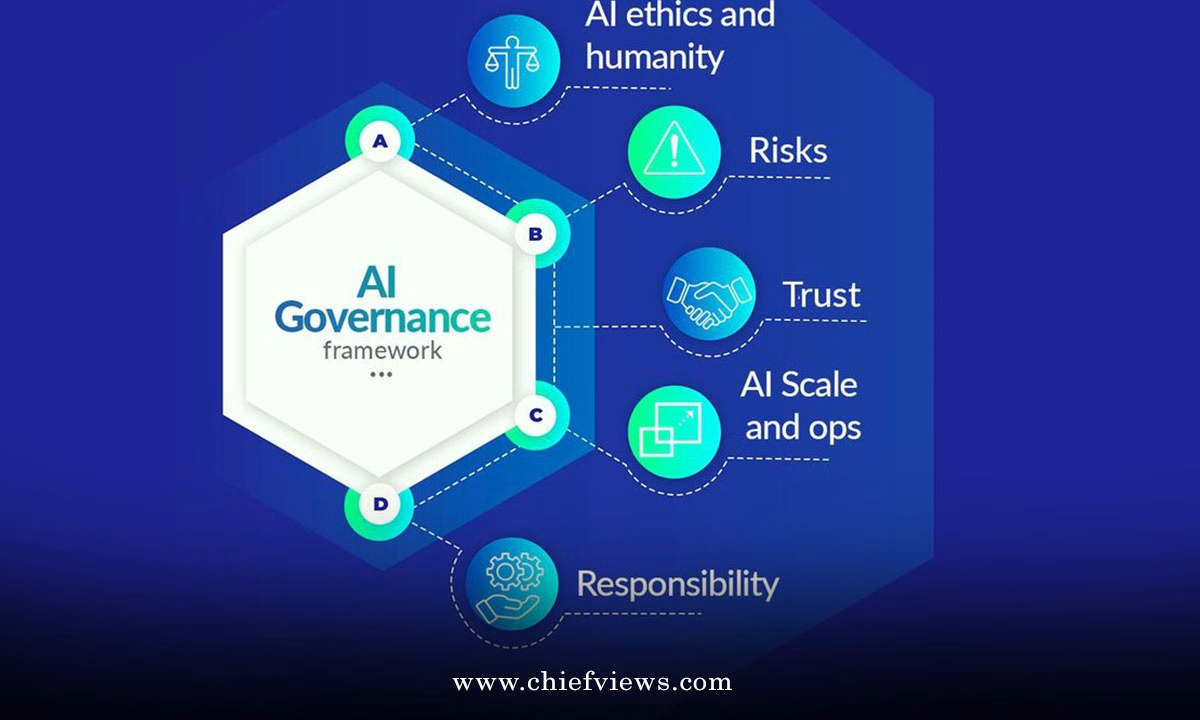
Core building blocks of a practical framework
Start with inventory. You cannot govern what you cannot see. Maintain a living catalogue of every AI system — models, agents, copilots, vendor tools and internal experiments — including the data they touch and the decisions they influence.
Map risk early. Use the NIST AI RMF functions (Govern, Map, Measure, Manage) as the operating rhythm. Classify systems by impact. High-risk use cases (hiring, credit, safety-critical operations, customer-facing decisions) need heavier controls. Low-risk productivity tools need lighter, faster processes.
Establish clear ownership. Create a cross-functional AI governance board that includes technology, legal, risk, data, security and business leaders. Assign a named accountable executive for each material AI system. Document decision rights so autonomy boundaries are explicit rather than assumed.
Translate policy into enforceable controls. Static PDF policies fail at scale. Convert rules into policy-as-code that runs inside CI/CD pipelines, model registries and agent orchestration platforms. Require human-in-the-loop checkpoints for high-stakes actions and maintain full audit trails of agent decisions.
Address agentic AI specifically. Singapore’s Model AI Governance Framework for Agentic AI (updated 2026) is currently the most practical public reference. Define agent boundaries, tool permissions, escalation paths and continuous monitoring. Treat agents more like junior employees with delegated authority than passive software.
Cover the supply chain. Track model provenance, training data lineage, third-party components and update processes. Require vendors to provide model cards, evaluation results and incident reporting commitments.
How the major frameworks fit together
- NIST AI RMF gives the risk methodology and vocabulary most US and global enterprises already understand.
- ISO/IEC 42001 turns governance into a certifiable management system that customers and auditors recognise.
- EU AI Act supplies the binding legal obligations and risk tiers if you operate in or sell into the EU.
Most mature programmes map to all three rather than picking one. The overlapping controls (risk assessment, documentation, human oversight, transparency) mean the work is not fully additive.

Implementation sequence that actually works
- Secure executive sponsorship and board visibility.
- Complete a rapid inventory and risk classification of existing AI.
- Stand up the cross-functional governance body with clear charters.
- Publish minimum viable policies and convert the critical ones into automated checks.
- Pilot on two or three high-visibility use cases, measure outcomes, then expand.
- Build continuous discovery so new shadow AI surfaces quickly.
- Report metrics the board cares about: coverage of inventory, number of high-risk systems with completed risk assessments, audit findings closed, and time-to-remediate.
Avoid the common trap of treating governance as a one-time project. The organisations making progress treat it as ongoing operational capability, the same way they treat cybersecurity or financial controls.
What technology leaders should measure
- Percentage of AI systems with documented ownership and risk classification
- Time from discovery of new AI tool to governance review
- Percentage of high-risk systems with completed impact assessments
- Audit trail completeness for agent actions
- Incident rate linked to AI systems versus baseline
These numbers turn abstract principles into management conversations.
An AI governance framework for technology leaders is not about slowing innovation. It is about creating the conditions in which AI can scale safely, legally and in ways the organisation can defend. The CTOs who master this discipline in 2026 will be the ones trusted to lead the next wave of technology investment.
FAQs
What are the three main frameworks technology leaders should use for AI governance in 2026?
Most effective programmes combine the NIST AI Risk Management Framework (for risk methodology), ISO/IEC 42001 (for a certifiable management system) and the EU AI Act (for binding legal obligations where applicable). They are complementary rather than alternatives.
Why has AI governance become a core CTO responsibility?
Shadow AI is widespread, agentic systems introduce new risks, and regulatory exposure is now real. Boards expect technology leaders to demonstrate clear ownership, continuous inventory and enforceable controls — skills that now sit at the centre of the CTO skills needed in 2026.
How should organisations handle agentic AI within an AI governance framework?
Define explicit boundaries, tool permissions, human escalation paths and continuous monitoring. Treat agents as systems with delegated authority rather than passive software, and use references such as Singapore’s Model AI Governance Framework for Agentic AI as a practical baseline.