










CXO strategies for human centered experience design begin with one non-negotiable: stop designing for the org chart and start designing for the person on the other side of the screen, the counter, or the phone.
Here’s the short version of what that means and why it pays off:
- It puts real human needs, emotions, and behaviors at the center of every journey, product, and process decision.
- It links experience work directly to retention, revenue, and cost, not just satisfaction scores.
- It forces cross-functional ownership so experience stops living in a silo.
- It treats AI as a tool that amplifies human judgment rather than a replacement for it.
- Done right, it creates measurable competitive advantage that compounds over years.
In my experience working with leadership teams across the U.S., the companies that treat this as a board-level discipline pull away from the pack. The ones that treat it as a marketing project stay stuck.
What usually happens is the C-suite declares “we’re customer-centric,” funds a few journey maps, then gets distracted by the next quarterly target. The gap between intention and execution is where the real work lives.
Why CXO strategies for human centered experience design matter more in 2026
Customer expectations moved faster than most organizations. One bad moment and people leave. Boards now demand proof that experience work drives financial outcomes.
McKinsey’s research on the business value of design showed that companies in the top quartile of design practices delivered 32 percentage points higher revenue growth and 56 percentage points higher total shareholder returns over five years compared with industry peers. That study still holds as a clear signal: design that starts with people produces outsized results.


More recent data from Watermark Consulting’s 2026 CX ROI Study, spanning 18 years of rankings, found that customer experience leaders generated a total return 415 points above the S&P 500 while laggards trailed by 374 points—a 7.8-times performance gap.
These are not soft numbers. They are shareholder value.
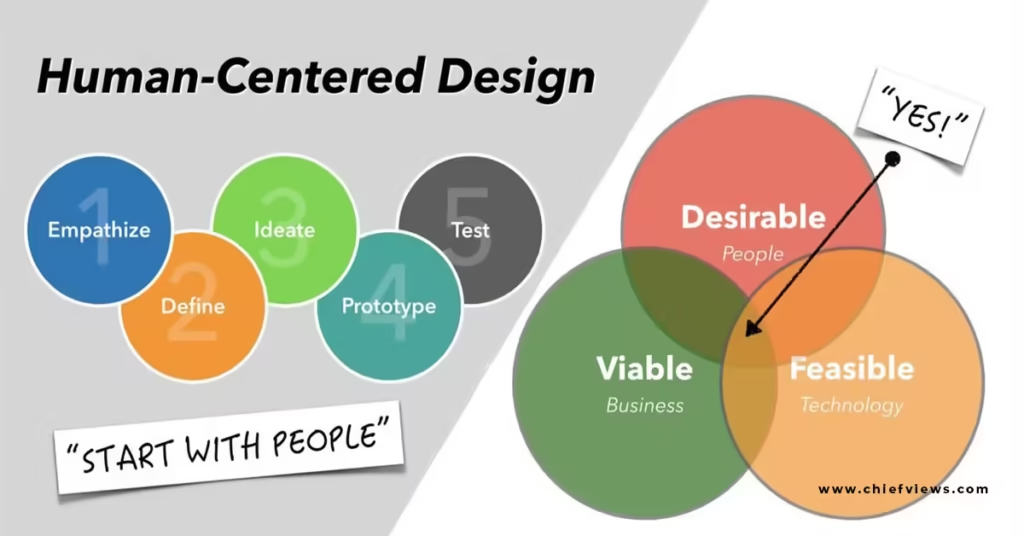
Human-centered experience design is the practical operating system that turns those numbers from aspiration into reality. It combines empathy research, rapid testing, and clear accountability so every major decision is stress-tested against real human behavior.
Core principles that separate the winners
Start with observation, not assumptions.
Spend time where the work or the customer interaction actually happens. Ride along with field teams. Sit with support agents. Watch a customer struggle through onboarding without jumping in to “help.”
Map outcomes, not channels.
Ask what the person is trying to accomplish—get paid, feel heard, resolve a claim, board a flight without friction—then redesign the steps around that outcome. Internal process maps are secondary.
Keep humans in the high-emotion moments.
AI handles speed and scale brilliantly. Judgment, empathy, and recovery still need people. Design the handoff so context travels with the customer.
Measure what moves the business.
Track effort scores, first-contact resolution quality, retention cohorts, and cost-to-serve alongside the usual NPS or CSAT. Translate every experience improvement into language the CFO already uses.
Step-by-step action plan for beginners and intermediate leaders
If I walked into a new CXO or experience leadership role tomorrow, here is the exact sequence I would run in the first 90 days.
- Pick one high-friction journey.
Choose the one that generates the most volume and the most complaints—refunds, claims, account setup, appointment scheduling. Measure current customer effort and resolution quality. That becomes your baseline. - Get the right people in the room.
Form a temporary cross-functional team with decision rights: product, operations, support, marketing, and someone from finance. Give them clear authority to change the process, not just recommend. - Go to the source.
Conduct 8–12 real interviews or shadow sessions. Build a simple empathy map that captures what people say, think, do, and feel. Nielsen Norman Group’s guidance on empathy mapping remains one of the cleanest ways to force the team past assumptions. - Prototype the fix in days, not months.
Sketch the improved flow. Test it with five real users. Iterate twice. Ship a pilot that covers 10–20% of volume. - Tie results to money.
Show the change in effort score, completion rate, and cost per transaction. Present the 90-day results to the full executive team with a clear recommendation for scale. - Lock in the operating rhythm.
Create a monthly journey review where the same cross-functional group looks at live data and decides the next experiment. Make it non-negotiable on the calendar.
Repeat for the next two highest-impact journeys. After three successful cycles you will have both proof and a culture that starts expecting this level of rigor.
Comparing traditional approaches versus human-centered CXO strategies for human centered experience design
| Dimension | Traditional Approach | Human-Centered CXO Approach | Typical Impact Window |
|---|---|---|---|
| Starting point | Internal process or channel | Customer job-to-be-done and emotional reality | Immediate reframing |
| Research depth | Surveys and dashboards | Observation, interviews, empathy maps | 2–4 weeks |
| Decision rights | Siloed by department | Cross-functional with clear ownership | 1–3 months |
| Role of AI | Volume reduction and automation | Friction removal plus human escalation for judgment | Pilot in 30–60 days |
| Success metrics | CSAT / NPS alone | Effort, retention cohorts, cost-to-serve, revenue impact | 90 days for pilot proof |
| Governance | Project-based or IT-led | Standing experience operating rhythm | Ongoing |
The difference is not subtle. One optimizes the machine. The other redesigns the system around people.
Common mistakes and how to fix them
Mistake 1: Treating human-centered work as a workshop series.
Teams leave the room energized, then return to the same incentives and org structure.
Fix: Tie every workshop output to a pilot with a named owner, budget, and 30-day checkpoint.
Mistake 2: Lack of real executive sponsorship.
Without a senior leader who will clear obstacles and protect the team, the work dies in the middle layers.
Fix: Secure one visible C-level champion who reviews results monthly and removes blockers in real time.
Mistake 3: Measuring only feelings.
Boards fund outcomes. Pure satisfaction scores get cut when budgets tighten.
Fix: Always pair experience metrics with retention, expansion, or cost data. Use frameworks like Forrester’s Total Economic Impact or simple cohort analysis.
Mistake 4: Ignoring the employee side of the experience.
You cannot deliver a human-centered customer experience with a burned-out frontline.
Fix: Run the same research methods on employee journeys. Reduce friction for the people who deliver the experience.
Mistake 5: Scaling too early.
Rolling out a half-baked redesign across the enterprise creates new problems faster than it solves old ones.
Fix: Prove value in one journey, document the playbook, then expand.
Building the case inside the C-suite
Talk money first.
Reference the McKinsey findings on design-driven growth and the Watermark 2026 performance gap. Then show your own pilot numbers.
Frame risk clearly.
The cost of doing nothing is visible in rising churn and higher cost-to-serve.
Make the ask specific.
Request budget and decision rights for one journey, not a multi-year transformation program. Success creates appetite for more.
Key Takeaways
- CXO strategies for human centered experience design start with real observation of people, not internal assumptions.
- Link every experience initiative to retention, revenue, or cost—boards fund outcomes, not feelings.
- Run tight 90-day pilots on high-friction journeys before scaling.
- Keep humans in the emotional and judgment-heavy moments; let AI handle scale and speed.
- Secure visible executive sponsorship and cross-functional decision rights or the work stalls.
- Measure effort, quality of resolution, and business impact alongside traditional satisfaction scores.
- Treat employee experience as part of the same system—friction for staff becomes friction for customers.
- Iterate publicly. Share wins and failures so the organization learns the rhythm.
The payoff is straightforward. Organizations that design around how people actually think, feel, and behave build loyalty that is hard to copy and results that show up in the numbers year after year.
Start with one journey this quarter. Map it honestly. Fix the biggest friction points. Prove the impact. Then expand. That single disciplined cycle does more for long-term advantage than any high-level strategy deck.
FAQs
What are the first practical CXO strategies for human centered experience design a new leader should implement?
Pick the highest-friction customer journey, run focused research with real users, prototype a fix, and measure business impact within 90 days. Secure one senior sponsor and give a small cross-functional team clear decision rights.
How do CXO strategies for human centered experience design differ from traditional CX programs?
Traditional programs often optimize channels and scores in isolation. Human-centered strategies begin with observed human behavior and emotion, redesign end-to-end outcomes, and explicitly connect experience changes to financial results.
Can smaller U.S. companies successfully apply CXO strategies for human centered experience design?
Yes. The principles scale down cleanly. Focus on one critical journey, use lightweight research methods, and measure the same business outcomes. The advantage often appears faster in leaner organizations because fewer layers stand between insight and action.

