





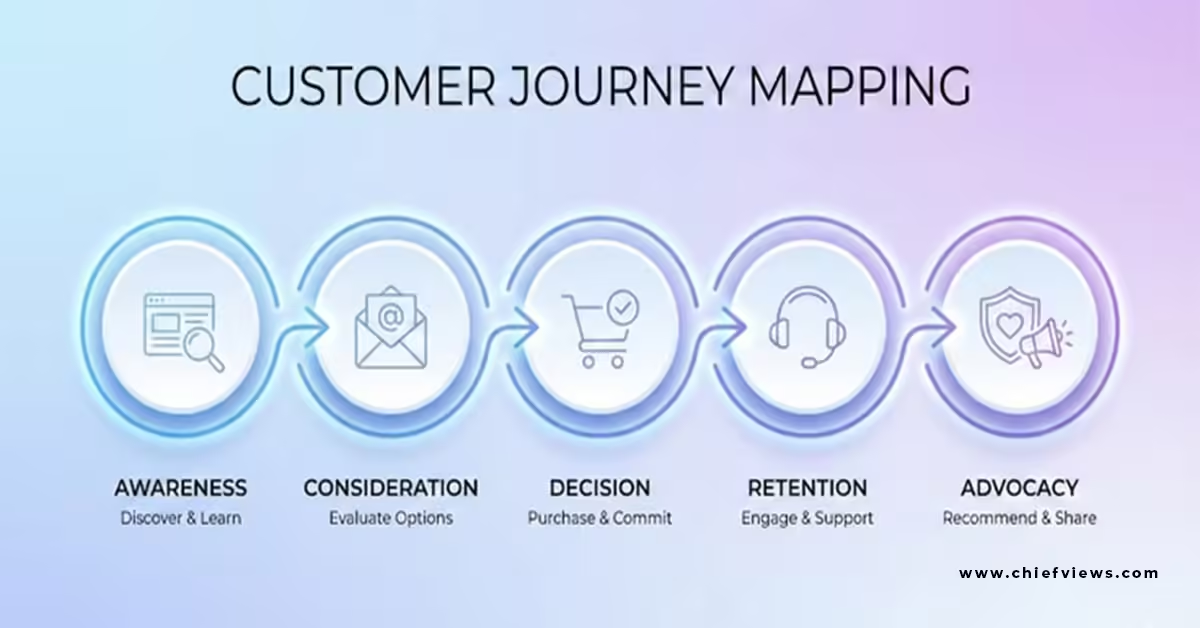
Customer Journey Mapping Best Practices for 2026 :
Most companies still treat journey maps like pretty wall art. They look impressive in workshops, get pinned in Miro, and then gather dust while the real friction keeps costing money.
Here’s the thing: a useful journey map in 2026 is a living financial tool, not a design artifact. It shows exactly where experience breaks, how much those breaks cost, and which fixes will move the numbers the board actually cares about.
Why journey mapping still fails most teams
Teams map every possible touchpoint. They create elaborate personas. They color-code emotions. Then nothing changes in the P&L.
The better approach is ruthless prioritization. Start with the journeys that already generate the highest volume of complaints, the most contacts, or the steepest drop-offs. Everything else can wait.


Core best practices that actually drive results
1. Begin with the money, not the sticky notes
Before any customer interviews or workshop, pull the financial data. What is the current conversion rate, cost-per-contact, 90-day retention, and average revenue in that journey? If you cannot attach a dollar figure to the pain, the map will never get funded.
2. Limit the scope aggressively
Map one critical journey end-to-end, not the entire customer lifecycle. Onboarding, support recovery, and post-purchase expansion usually deliver the fastest measurable impact. Trying to map everything at once is how projects die.
3. Combine qualitative insight with quantitative proof
Talk to real customers and frontline staff. Then validate every claimed friction point with operational data: time stamps, drop-off rates, repeat contact volumes, and survey scores tied to that specific stage. Emotion without evidence is just storytelling.
4. Assign clear ownership and success metrics
Every stage on the map needs a named owner and a measurable outcome. “Improve the account activation experience” is useless. “Reduce activation time from 4.2 days to under 48 hours and cut related support contacts by 25%” is actionable.
5. Keep the map alive
Static maps expire fast. Review the priority journey every 60–90 days. Update the data. Kill stages that no longer matter. Add new friction that appears after product or channel changes. A map that is not refreshed becomes fiction.
How journey mapping feeds ROI measurement
This is where the connection becomes powerful. Once you have a clean, prioritized map with baseline financials, you can run focused experiments and prove impact. The same discipline that produces a useful journey map is exactly what lets you follow the CXO guide to measuring customer experience ROI in 2026 and turn experience fixes into board-ready numbers.
Without that link, even the best map stays a cost center. With it, every improvement has a clear path to retention lift, cost reduction, or expansion revenue.
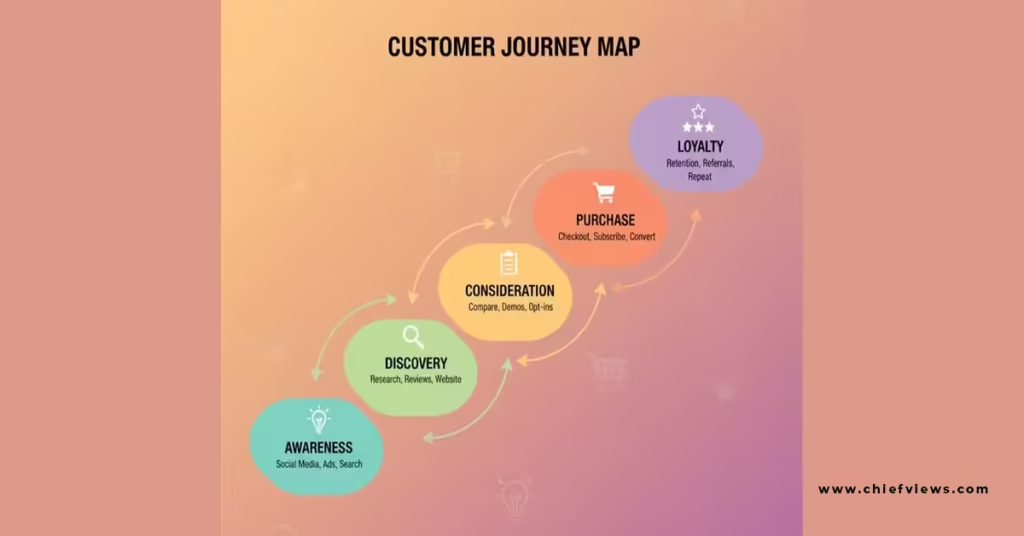
Quick-start checklist for your next mapping session
- Pull the last 12 months of performance data for the chosen journey
- Identify the three highest-cost or highest-drop-off stages
- Interview 8–12 recent customers who went through those stages
- Sit with frontline teams for half a day and watch the real process
- Write one hypothesis per major friction point with expected financial impact
- Set a 90-day measurement window and stick to it
Do this well and the map stops being a workshop deliverable. It becomes the operating system for experience investment decisions.
The teams that win in 2026 are not the ones with the most beautiful maps. They are the ones who can point to a specific stage, show the baseline cost, run a focused fix, and report the measured return. That is the only journey mapping that matters.
Key Takeaways / Conclusion
In 2026, effective customer journey mapping has moved far beyond static sticky-note workshops. The strongest maps are data-driven, AI-assisted, tightly scoped, and treated as living tools rather than one-time deliverables.
Success comes from combining behavioral data with real customer emotion, focusing on high-friction journeys first, and translating every insight into clear ownership and measurable action. Organizations that do this consistently improve satisfaction, reduce effort, and increase retention and revenue.
3 FAQs
1. What are the most important best practices for customer journey mapping in 2026?
Start with one high-volume, high-friction journey instead of trying to map everything. Use real customer data (behavioral analytics + qualitative research) rather than internal assumptions. Incorporate emotions and pain points at every stage. Leverage AI for faster synthesis and pattern detection. Treat the map as a living document that is regularly updated and linked to clear actions and metrics.
2. How has AI changed customer journey mapping in 2026?
AI now enables real-time data integration, automated theme detection from interviews and support transcripts, and dynamic journey visualization. AI-moderated voice interviews can scale qualitative research dramatically, while AI helps surface actual customer paths and friction points that teams often miss. However, human judgment is still essential for prioritization and decision-making.
3. What is the biggest mistake companies still make with journey maps?
Creating beautiful maps that never drive action. Maps fail when they lack a clear business objective, rely only on internal assumptions, try to cover too many journeys at once, or are never updated or owned by specific teams. The most effective maps are scoped tightly, validated with real customers, and tied directly to measurable improvements.