

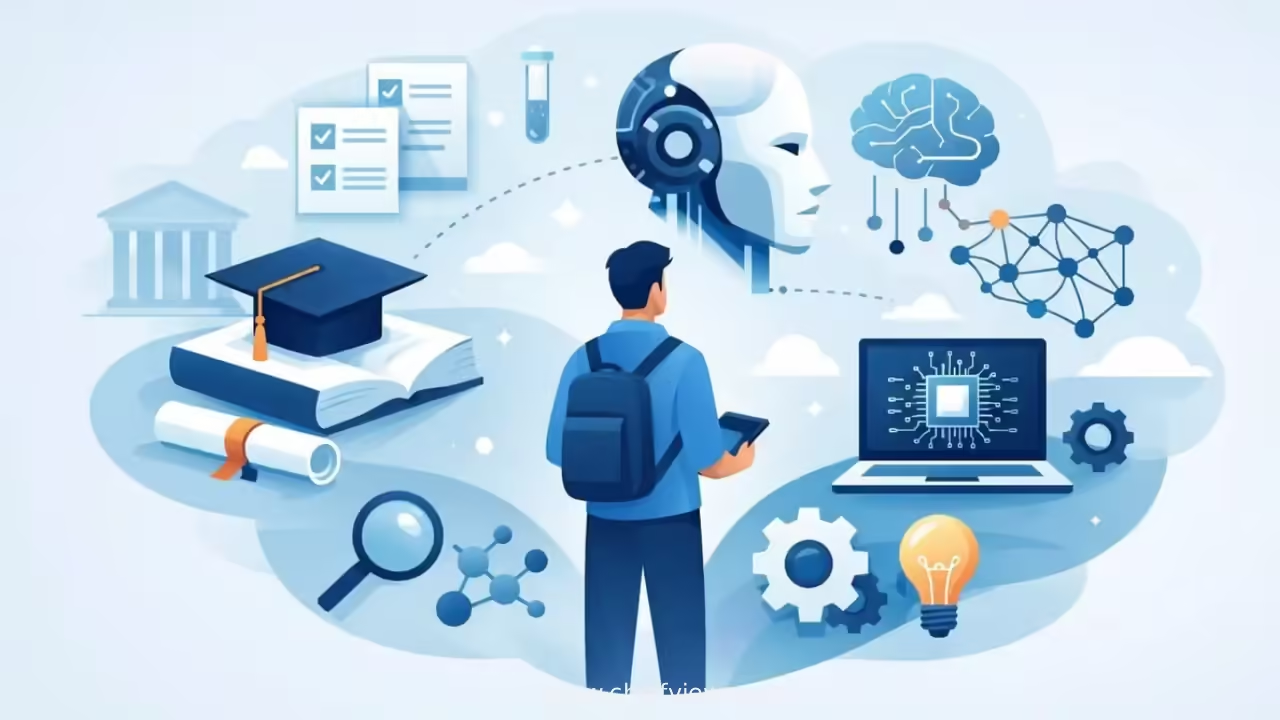
Continuous learning and AI workforce readiness starts with a simple truth: the tools keep shifting faster than most job descriptions can keep up. In 2026, that gap is no longer theoretical. AI agents already handle multistep work that used to belong to junior roles, and the organizations that treat skill-building as a one-and-done exercise are watching productivity stall while competitors pull ahead.
Here’s the quick overview of what continuous learning and AI workforce readiness actually means right now:
- It is the ongoing practice of updating both technical AI fluency and durable human skills so people can work productively alongside autonomous systems.
- It closes the readiness gap where most employees already use AI tools daily yet only about one in four feel fully equipped to drive results with them.
- It turns learning from occasional training events into daily workflow habits that keep entire teams adaptable.
- It protects career mobility and organizational value as AI redesigns tasks across nearly every industry in the United States.
- It prioritizes judgment, adaptability, and continuous skill recombination over static credentials.
The numbers back this up. McKinsey reports that demand for AI fluency skills has risen nearly fourteen-fold in three years. Skillsoft’s 2026 research shows 86 percent of individual contributors use AI at work, yet only 24 percent feel fully prepared. DeVry’s talent report found employers estimate 55 percent of their workforce will need significant upskilling within five years just to stay employable. Continuous learning and AI workforce readiness is how you stay on the right side of that curve.
Why Continuous Learning and AI Workforce Readiness Matters More in 2026
AI is no longer a side experiment. The World Economic Forum’s Future of Jobs analysis shows AI and information processing will affect 86 percent of businesses by 2030. That shift hits entry-level pathways hardest. When agents absorb the routine tasks that once taught juniors the ropes, the traditional skills ladder breaks. Deloitte calls this the “broken skills ladder,” and the data shows employment declines already showing up among workers aged 22-25 in highly exposed occupations.
Here’s the thing. Tool training alone does not fix it. You can teach someone the latest prompting techniques this quarter and watch those techniques age out by the next product cycle. What sticks is the ability to diagnose how AI changes a specific role, experiment with new workflows, and keep the human judgment layer sharp. McKinsey frames this as AI fluency: practical tool capability plus the human-centered habits of sound judgment, adaptability, collaboration, and continuous learning.
In my experience, the companies that treat continuous learning and AI workforce readiness as a structural priority—not a perk—see the difference in six to nine months. They redesign roles so people move from pure execution into problem-finding and orchestration. They stop chasing every new model release and instead build evergreen capabilities that travel with the technology.

Building Continuous Learning and AI Workforce Readiness: A Step-by-Step Action Plan for Beginners
Start small. Most people overcomplicate the first ninety days. Here’s the practical sequence I recommend to anyone who asks me how to get moving without burning out or waiting for perfect corporate programs.
- Map your actual work against AI exposure.
List the five to seven tasks you do every week. For each one, ask: Can an agent already do most of this? What judgment calls still require a human? This is not a theoretical exercise. Write it down. The output becomes your personal skills gap list. - Pick one high-leverage AI fluency skill and practice it in the flow of real work.
Do not start with a six-hour course on model architectures. Choose something immediate—prompting for research synthesis, using an agent to draft first-pass analysis, or building a simple multi-step workflow in a tool your team already has. Apply it to a live deliverable within seven days. Measure the time saved or quality gain. - Layer in one durable human skill that AI cannot replace.
Critical evaluation of AI output, clear communication of uncertainty, or coaching a colleague through a new workflow. These compound. Gartner notes that employees with strong change agility are 1.6 times more likely to perform well in the AI era. - Create a weekly learning loop that takes less than ninety minutes.
Thirty minutes reviewing one new technique or case study. Thirty minutes applying it. Thirty minutes documenting what worked and what did not. Share the note with one peer. This turns isolated experiments into shared organizational knowledge. - Seek visible application opportunities.
Volunteer for a pilot project, offer to redesign one recurring process with AI support, or present a short “what I learned this month” at a team meeting. Visibility turns personal practice into career capital.
If your employer offers no formal support, build the habit anyway. Coursera and similar platforms show U.S. enrollments in agentic workflows and AI security rising hundreds of percent year over year. The workers who treat continuous learning as non-negotiable keep moving even when organizational programs lag.
Practical Resources for Continuous Learning and AI Workforce Readiness
You do not need a massive budget. Focus on high-signal sources. The World Economic Forum’s Future of Jobs Report remains the clearest public map of which skills are rising fastest. McKinsey’s work on AI fluency as the next foundation of economic competitiveness gives concrete language for conversations with managers. For organizational design ideas, Jobs for the Future’s recent guidance on preparing for a human-agent future is grounded and usable.
Continuous Learning and AI Workforce Readiness: Common Mistakes and How to Fix Them
Mistake one: Treating AI training as a one-time event.
What usually happens is the company rolls out a two-hour workshop, checks the compliance box, and then wonders why adoption stays shallow. Fix it by embedding micro-practices into existing meetings and deliverables. One five-minute “AI tip of the week” at the start of stand-ups beats a forgotten LMS module every time.
Mistake two: Focusing only on technical skills while ignoring judgment.
People learn the buttons and still produce mediocre work because they accept the first AI draft without scrutiny. The fix is deliberate critique practice. Require every AI-assisted output to include a short note on what the human added or corrected.
Mistake three: Waiting for perfect tools or perfect strategy.
In my experience, the organizations that wait for the “right” platform lose a year of learning momentum. Start with the tools already in the stack. Iterate. The kicker is that imperfect practice compounds faster than perfect plans.
Mistake four: Measuring learning by hours completed instead of behavior changed.
Track whether people are redesigning their own workflows, not how many badges they collected. Skillsoft data shows most training still arrives after tools are already in use. Flip the sequence: train before rollout whenever possible, then reinforce in the work itself.
Comparing Approaches to Continuous Learning and AI Workforce Readiness
| Approach | Time Investment (per person/month) | Best For | Risk If Done Poorly | Expected Outcome in 6–12 Months |
|---|---|---|---|---|
| One-off workshops and LMS modules | 4–8 hours | Compliance tracking | Low retention, shallow adoption | Minimal behavior change |
| Role-specific micro-learning in workflow | 6–10 hours | Teams with live AI tools | Requires manager coaching | Faster task redesign, measurable time savings |
| Structured continuous learning loops + peer sharing | 8–12 hours | Organizations serious about AI fluency | Needs leadership modeling | Higher adaptability scores, internal mobility gains |
| Full internal AI academy + role redesign | 15+ hours + project time | Large enterprises scaling agents | High cost if not tied to real work | Sustained productivity lift and talent retention |
The middle two rows deliver the best return for most U.S. teams right now. Full academies make sense only after the daily habits are already working.
What I’d Do If I Were Starting From Scratch Today
I’d treat continuous learning and AI workforce readiness like physical fitness. You do not wait until you are out of shape to begin. You build a baseline routine that survives busy weeks. For an individual, that means the weekly loop described earlier plus one quarterly deep-dive into a rising skill such as multi-agent orchestration or responsible AI evaluation. For a manager, it means carving protected time on the calendar for the team and then modeling the behavior yourself. Leaders who never touch the tools send a louder message than any policy document.
The metaphor that sticks with me is this: AI is the new electricity of the workplace. Early factories that simply bolted motors onto old processes saw limited gains. The ones that redesigned the entire production line around electric power transformed their industries. Continuous learning is how you redesign the line while the power is still being switched on.
Key Takeaways
- Continuous learning and AI workforce readiness is the practical discipline of updating both AI fluency and human judgment skills as work itself changes.
- Only about one in four employees currently feel fully equipped even though most already use AI tools daily.
- Start with a personal task-to-AI map and one high-leverage skill applied to real work within a week.
- Embed learning in daily workflows rather than relying on occasional courses.
- Prioritize evergreen capabilities—change agility, critical evaluation, and collaboration—over chasing every new tool.
- Measure success by redesigned processes and applied judgment, not by training hours completed.
- Individuals can build momentum without waiting for perfect organizational programs; managers accelerate it by modeling and protecting the time.
- The organizations that treat this as structural infrastructure, not a side program, will capture the largest share of AI-driven value through 2030.
The payoff is straightforward. People who treat continuous learning and AI workforce readiness as a core professional habit stay employable, mobile, and valuable. Organizations that build it into how work gets done turn AI from a cost center into a compounding advantage. Pick one task this week. Map it. Apply one new approach. Document what changes. That single cycle is how readiness actually begins.
FAQs
How does continuous learning and AI workforce readiness differ from traditional upskilling programs?
Traditional programs are usually event-based and focused on a fixed curriculum. Continuous learning and AI workforce readiness treats skill development as an ongoing loop embedded in daily work, updating both technical fluency and human judgment as tools and roles evolve.
What is the fastest way for a beginner to start building continuous learning and AI workforce readiness?
Map five of your regular tasks against current AI capabilities, choose one high-impact skill, apply it to a real deliverable within seven days, and create a short weekly review habit. That sequence builds momentum faster than any multi-week course.
Why do so many organizations still struggle with continuous learning and AI workforce readiness in 2026?
Most still treat training as a compliance exercise that arrives after tools are rolled out. Without protected time, manager modeling, and measurement of actual behavior change, the learning never sticks into daily practice.