







How CHRO can shape enterprise transformation with AI 2026 starts with one hard truth: most companies still treat the people leader as a late-stage fixer rather than the architect of the system. That approach is already failing.
- CHROs who claim ownership of work redesign, skills architecture, and human-AI decision rights turn AI capacity into growth instead of just cost cuts.
- Organizations that leave the CHRO out of AI strategy definition (nearly half, per recent IBM data) lag on revenue uplift and innovation.
- The real lever is not more tools. It is redesigning roles, workflows, and culture so people and AI agents operate as one system.
- Beginners can start with a clear 90-day action plan focused on HR’s own AI use and cross-C-suite partnerships.
- Success in 2026 hinges on treating AI as an operating-model problem, not a technology rollout.
The kicker is simple. AI creates capacity. Only the CHRO decides whether that capacity becomes growth or gets wasted on friction, fear, and half-baked role changes.
Why the CHRO Seat Matters More Than Ever in 2026
In my experience working with leadership teams, the companies that pull ahead do not have the flashiest AI stack. They have a CHRO who sits in the strategy room before vendors get chosen.
Look at the numbers. IBM’s 2026 CHRO Study found that enterprises with the strongest “Thinking Organization” capabilities—those that deliberately blend human judgment with AI—deliver twice the revenue uplift, twice the workforce outcomes, and twice the innovation throughput of their peers. Yet 46 percent of organizations still leave the CHRO out when AI strategy gets defined.
That gap is the opportunity. Technology leaders own the platforms. Finance owns the ROI model. The CHRO owns the only part that actually determines whether the system works: how work gets redesigned, which decisions stay human, and whether people develop the judgment to override bad AI outputs.
Think of it like rebuilding a city’s traffic system while the cars keep moving. You can install smarter signals all day. Without someone redesigning the lanes, the intersections, and the driver training, you just get faster congestion. That someone is the CHRO.


How CHRO can shape enterprise transformation with AI 2026: The Core Levers
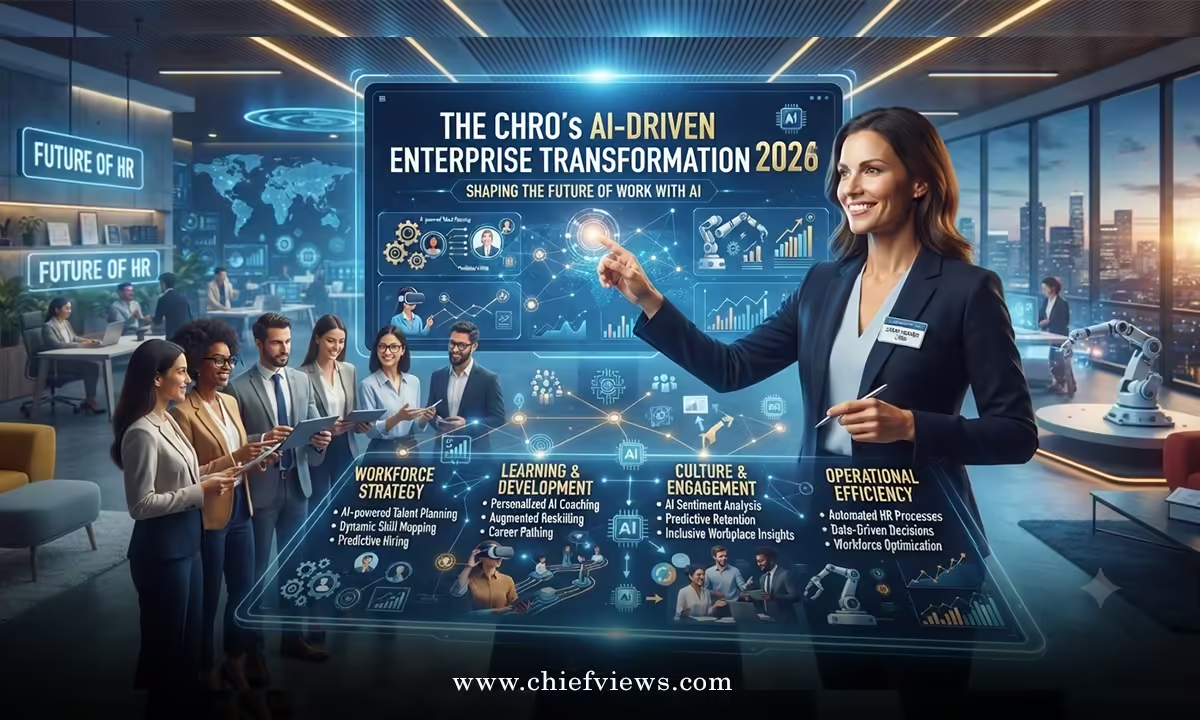
Four practical levers separate the CHROs who shape transformation from those who merely react to it.
First, own the definition of human-led work. Organizations that clearly classify workflows as human-led, AI-assisted, or AI-executed report 18 percent lower risk and 20 percent higher quality. The CHRO is the natural owner of that classification because it requires deep knowledge of roles, accountability, and culture.
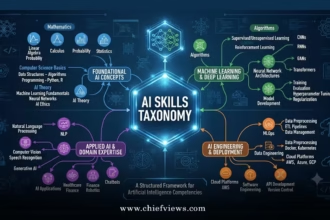
Second, build the skills architecture that maps human capabilities against AI capabilities. This is not another competency framework. It is a living taxonomy that shows where judgment, critical thinking, and ethical oversight create the most value—and where AI agents should take the routine load.
Third, force the CHRO-CIO partnership into real operating mechanisms. Shared ownership of AI ethics, skills-based talent systems, and human-AI performance management is no longer optional. Gartner has been clear on this for two years running.
Fourth, start inside HR. Seventy-two percent of organizations still make limited or no use of AI inside the HR function itself. CHROs who treat HR as the pilot plant for AI adoption build credibility and fluency that the rest of the enterprise can copy.
Step-by-Step Action Plan for Beginners and Intermediate Leaders
If I were walking into a new CHRO role tomorrow and needed to shape enterprise AI transformation in 2026, here is exactly what I would do in the first 90 days.
- Audit involvement. Sit down with the CEO, CIO, and CFO. Ask one question: “When AI strategy is set, am I in the room before tools are selected?” Document the answer. Close any gap within 30 days by proposing a standing joint agenda item.
- Map three pilot workflows. Pick one high-volume HR process (recruiting screening, for example), one business process with clear pain (customer onboarding), and one decision process that currently relies on pure human judgment. Classify each as human-led, AI-assisted, or AI-executed. Redesign the handoffs.
- Launch a skills intelligence pilot. Identify 50–100 critical roles. Map the human capabilities that remain essential once AI handles the rest. Build a simple taxonomy. Share it with business leaders. Use it to drive the next talent review cycle.
- Create internal AI fluency inside HR first. Require every HR business partner to complete a short, role-specific AI literacy path. Measure adoption by actual use in their daily work, not completion certificates.
- Establish shared governance with the CIO. Agree on five joint decision rights: AI ethics guardrails, skills taxonomy ownership, performance metrics for augmented roles, change management standards, and data access rules for workforce analytics.
- Reinvest the capacity. Track the hours or headcount freed by AI in the pilot areas. Explicitly allocate a portion to reskilling and innovation rather than pure cost takeout. Forty-two percent of CHROs already say this is their primary reinvestment path—join them.
This sequence builds credibility fast. You demonstrate value inside HR, create visible cross-functional wins, and position the people function as the system designer rather than the cleanup crew.
Common Mistakes & How to Fix Them
Mistake 1: Waiting for the technology roadmap before engaging.
Fix: Demand a seat at the strategy table now. Bring workforce data and role redesign scenarios. Technology without people design fails.
Mistake 2: Treating AI literacy as a one-time training event.
Fix: Build continuous, role-specific pathways. Focus managers first—half of CHROs in a recent Gallup roundtable still lack confidence that managers can guide AI use.
Mistake 3: Measuring success only by cost savings.
Fix: Track revenue uplift, innovation throughput, quality, and risk reduction. The IBM data shows the real differentiator is growth, not just efficiency.
Mistake 4: Leaving decision rights undefined.
Fix: Explicitly define which decisions stay human. Publish the list. Enforce it.
Mistake 5: Letting HR lag its own adoption.
Fix: Make HR the first scaled user of AI agents. Use that experience to teach the enterprise.
Practical Comparison: Traditional HR Approach vs. Transformation-Shaping CHRO
| Area | Traditional HR Approach | Transformation-Shaping CHRO Approach | Impact in 2026 |
|---|---|---|---|
| AI Strategy Involvement | Consulted after tools selected | Co-owns strategy definition from the start | Avoids the 46% exclusion trap |
| Work Redesign | Adds AI tools to existing roles | Redesigns workflows and decision rights | 18% risk reduction, 20% quality gain |
| Skills Focus | Generic upskilling programs | Living human-AI capability taxonomy | Faster redeployment, higher innovation |
| Partnership Model | Occasional CIO alignment | Shared ownership of ethics, performance, skills | Scaled adoption instead of pilot graveyard |
| Capacity Reinvestment | Pure cost takeout | Portion directed to reskilling and innovation | 2x revenue and workforce outcomes |
The table makes the contrast obvious. One path manages the human slice of an automated operation. The other architects the entire system.

how CHRO can shape enterprise transformation with AI 2026 in Practice: Culture and Governance
Culture is not soft. It is the operating system that determines whether people use the tools or work around them.
What usually happens is this: leaders announce the AI strategy, roll out training, then wonder why adoption stalls. The missing piece is redesigning incentives, performance metrics, and decision rights so that collaborating with AI agents becomes the path of least resistance—and highest reward.
Governance follows the same logic. The CHRO must co-own the ethical guardrails, bias monitoring, and human override protocols. Without that ownership, AI agents scale faster than the organization’s ability to manage their impact on people.
For a deeper look at how leading organizations are approaching this, review the full findings in the IBM 2026 CHRO Study on Designing the Thinking Organization. The World Economic Forum has also outlined the four interconnected roles CHROs must play—design architect, capability steward, adoption catalyst, and partnership builder—in its analysis of AI transformation and the human redesign of work. Gartner’s guidance on shared CHRO-CIO ownership remains essential reading for any leader building the operating mechanisms.
Key Takeaways
- Nearly half of organizations still exclude the CHRO from AI strategy definition—close that gap immediately.
- Enterprises that master human-AI work design achieve roughly twice the revenue and innovation outcomes.
- Start by redesigning three pilot workflows and classifying them as human-led, AI-assisted, or AI-executed.
- Build a living skills taxonomy that maps human judgment against AI capabilities.
- Force real shared ownership with the CIO on ethics, performance, and skills systems.
- Make HR the first scaled user of AI so the function can teach the rest of the enterprise.
- Reinvest a portion of AI-created capacity into reskilling and innovation rather than pure cost cuts.
- Measure success by growth metrics, not just efficiency.
The CHRO who treats AI as a pure technology problem will manage the shrinking human slice of the operation. The CHRO who claims the system design role will shape the enterprise that turns capacity into lasting advantage.
Your next step is concrete: schedule the joint strategy session with the CEO and CIO this month. Bring the workforce data and the three pilot redesign proposals. Own the conversation. That is how CHRO can shape enterprise transformation with AI 2026—starting now.
FAQs
How can a mid-sized company CHRO start shaping enterprise transformation with AI in 2026 without a large budget?
Begin with the highest-volume HR process and one business workflow. Use existing tools already licensed in the company. Focus on decision rights and role redesign rather than new software spend. The leverage comes from clarity of design, not capital outlay.
What is the single biggest risk if the CHRO stays on the sidelines of AI strategy?
The organization redesigns work without deep knowledge of roles, culture, and human judgment. The result is usually stalled adoption, eroded trust, and AI capacity that never converts into growth.
Does how CHRO can shape enterprise transformation with AI 2026 require new formal authority, or can influence alone work?
Influence gets you into the room. Sustained results require clear shared decision rights with the CIO and CEO on work design, skills architecture, and human-AI performance systems. Document those rights early.
