








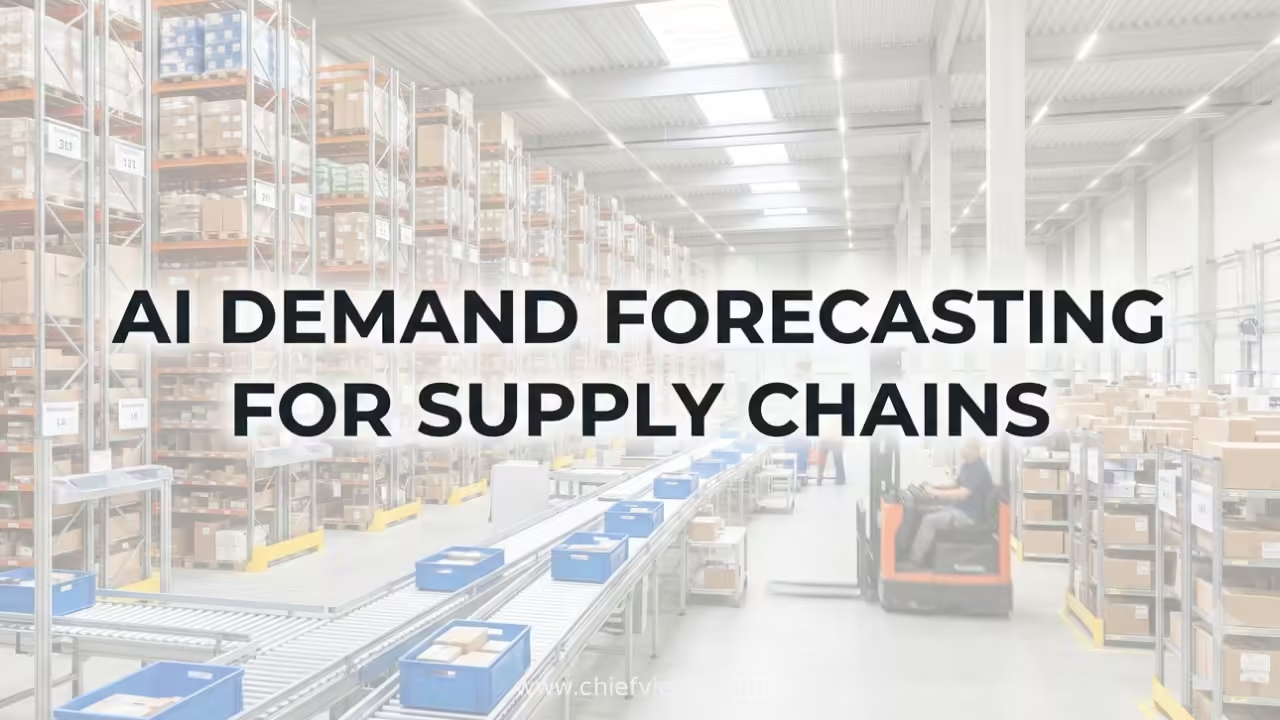
AI demand forecasting for supply chains has moved past the “nice-to-have model” stage. It now sits at the center of how operators cut excess inventory, protect service levels, and feed smarter downstream decisions. The best systems no longer spit out a single number every Monday. They continuously sense signals, update probabilities, and hand clean inputs to the next layer of automation.
Quick overview for the scanners:
- Modern AI forecasting blends historical sales with real-time signals—weather, promotions, social trends, competitor moves, and even macroeconomic indicators.
- Accuracy gains of 10–20 percent are common when the data foundation is solid; some operators report double-digit inventory reductions as a direct result.
- The real leverage appears when forecasts feed autonomous agents that adjust safety stock and replenishment without waiting for a planner’s approval.
- U.S. mid-market and enterprise teams are shifting from monthly statistical engines to daily or continuous probabilistic forecasts.
- Gartner projects that 70 percent of large organizations will adopt AI-based forecasting for demand prediction by 2030.
Here’s the thing most teams miss: a better forecast only creates value if someone—or something—acts on it fast. That is exactly where [Inventory and logistics optimization with AI agents](Inventory and logistics optimization with AI agents) becomes the natural next step. Forecast accuracy without execution speed is just a prettier spreadsheet.
Why AI demand forecasting for supply chains outperforms traditional methods
Statistical forecasting relied on history and a few causal factors. It worked reasonably well in stable markets. Volatility changed the rules. Promotions, short product life cycles, and external shocks now arrive faster than monthly planning cycles can absorb.
AI models detect complex, non-linear patterns across dozens of data streams at once. They handle sparse data for new products, adjust for seasonality in real time, and produce probabilistic ranges instead of single-point estimates. Planners get a clearer picture of risk, not just a mean forecast.
In my experience, the biggest practical shift is cadence. Weekly or monthly forecasts forced planners to live with lag. Continuous sensing lets the system update as new point-of-sale or order data lands. That single change reduces the lag between market reality and the plan.


Gartner notes that AI-based forecasting enables touchless processes that reduce the need for frequent manual overrides while improving consistency.
How AI demand forecasting for supply chains actually works
Most production systems combine several techniques:
- Machine-learning time-series models that learn patterns across thousands of SKUs.
- External signal ingestion—weather, events, social sentiment, competitor pricing.
- Hierarchical forecasting that reconciles store-level, regional, and national views.
- Probabilistic outputs that show confidence intervals rather than one “best guess.”
The strongest setups feed those forecasts directly into inventory policies. When confidence is high, safety stock can drop. When uncertainty spikes, buffers rise automatically. That hand-off is where inventory and logistics optimization with AI agents delivers the compounding effect—forecasts stop being recommendations and start driving autonomous adjustments within defined guardrails.
Traditional vs. AI-driven demand forecasting
| Factor | Traditional Statistical | AI-Driven Forecasting | Typical Outcome |
|---|---|---|---|
| Update frequency | Weekly or monthly | Daily or continuous | Lower forecast lag |
| Data inputs | History + limited causals | History + real-time external signals | Better handling of volatility |
| Output type | Single-point estimate | Probabilistic ranges | Clearer risk visibility |
| New product handling | Limited or manual | Learns from similar items + early signals | Faster ramp-up accuracy |
| Manual intervention | High | Lower once models stabilize | Planners focus on exceptions |
Step-by-step action plan for beginners
AI demand forecasting for supply chains Most teams that try to boil the ocean fail. Start narrow and expand.
- Pick the right scope. Choose a product category or region with clean historical data and measurable pain—high stockouts or excess inventory. Avoid the long-tail SKUs on day one.
- Clean the core data. Fix SKU hierarchies, location attributes, and promotion flags. AI amplifies data quality problems; it does not fix them.
- Select a platform that already integrates. Look for tools that connect to your ERP or planning system without heavy custom coding. Prefer vendors with proven production deployments over pure research models.
- Run a parallel pilot. Keep the old process running. Compare accuracy (WAPE or MAPE), bias, and downstream inventory metrics for 8–12 weeks.
- Define success metrics upfront. Track forecast accuracy, inventory turns, stockout rate, and planner hours. Avoid vanity metrics such as “model complexity.”
- Establish governance. Decide who owns model monitoring, when overrides are allowed, and how often models retrain. Document the rules.
- Connect the forecast to action. Once accuracy stabilizes, link the output to inventory policies or agent workflows. This is the step that turns forecasting into measurable working-capital improvement.
What I’d do if I were leading a mid-sized U.S. distributor: start with the top 20 percent of SKUs by revenue, run a 90-day pilot against the existing statistical baseline, and only then expand. The early wins fund the broader rollout.
Common mistakes and how to fix them
Mistake one: chasing perfect accuracy. No model hits 100 percent. Focus on directional improvement and reduced bias instead. Fix: set realistic targets—10–15 percent accuracy lift is meaningful and achievable for most categories.
Mistake two: ignoring the human override problem. Planners who distrust the model override constantly and erase the gains. Fix: make the model explainable. Show the top drivers for each forecast so planners can see the logic.
Mistake three: treating forecasting as a standalone project. Isolated models collect dust. Fix: design the hand-off to inventory and replenishment from day one. That is where [Inventory and logistics optimization with AI agents](Inventory and logistics optimization with AI agents) compounds the value.
Mistake four: under-investing in change management. Planners need to shift from “I build the forecast” to “I govern and improve the forecast.” Fix: involve them early in signal selection and exception design.
BCG has observed that companies moving to AI-first supply chain decision making can unlock working-capital reductions and EBITDA gains when forecasts and execution stay tightly linked.
Real-world results that hold up
AI demand forecasting for supply chains Published cases show consistent patterns. One automotive glass distributor improved SKU-level forecast accuracy by 15 percent and cut inventory 9.25 percent while raising service levels. Other operators report double-digit accuracy lifts translating into lower safety stock and fewer expedites. The common thread is clean data plus a clear path from forecast to action.
The analogy that fits: traditional forecasting is like checking the weather once a week and packing for the average day. AI demand forecasting checks conditions hourly, adjusts the packing list, and tells the logistics team what to load before the storm arrives.
Key Takeaways
- AI demand forecasting for supply chains delivers continuous, multi-signal predictions that traditional methods cannot match in volatile markets.
- Accuracy gains of 10–20 percent are realistic when data quality and governance are prioritized.
- Value multiplies only when forecasts feed inventory policies or autonomous agents.
- Start with a narrow, high-impact scope and parallel testing rather than a full-system replacement.
- Planners shift from forecast builders to exception managers and model governors.
- External signals and probabilistic outputs reduce the lag between market changes and operational response.
- Linking forecasting tightly to inventory and logistics optimization with AI agents turns prediction into measurable working-capital results.
- Measure downstream impact—inventory turns, stockouts, and planner productivity—not just MAPE.
AI demand forecasting for supply chains The practical next move is simple. Identify one category where stockouts or excess inventory hurt most. Clean the data for that slice. Run a parallel AI forecast for 90 days. Compare results against the current process. Then decide how far to push the connection into autonomous inventory adjustments. That sequence produces durable gains faster than any big-bang transformation plan.
FAQs
How much accuracy improvement can AI demand forecasting for supply chains realistically deliver?
Most production deployments see 10–20 percent gains in forecast accuracy when data is clean and models are properly tuned. Some categories show higher lifts; long-tail or highly promotional items often improve more modestly.
Does AI demand forecasting for supply chains require replacing the existing planning system?
No. Many platforms integrate with current ERP and APS tools through APIs or connectors. The forecast layer can sit on top and feed improved inputs without a rip-and-replace project.
How does AI demand forecasting connect to inventory and logistics optimization with AI agents?
The forecast provides the demand signal and confidence intervals that agents use to set safety stock, trigger replenishment, and rebalance inventory across locations—turning prediction into autonomous action within policy guardrails.

