







CTO strategies for managing AI driven digital transformation demand a hard shift from pilot theater to production systems that actually move the P&L. In my experience working with engineering and product leaders across mid-market and enterprise U.S. firms, the ones who win treat AI as a core operating system redesign—not a side project bolted onto legacy stacks. Get this wrong and you burn budget on demos that never scale. Get it right and you unlock measurable velocity, cost leverage, and decision speed.
Here’s the short version of what works:
- Start with business outcomes and measurable KPIs before any model selection.
- Rebuild data platforms and governance first; models come second.
- Redesign workflows around human-AI teams instead of automating broken processes.
- Fund and staff for continuous iteration, not one-and-done deployments.
- Measure value in EBITDA impact and cycle-time reduction, not model accuracy alone.
Why most AI efforts stall—and what CTOs actually control
The pattern is consistent. Teams spin up dozens of use cases. A few look promising in sandbox. Then data quality, unclear ownership, rising inference costs, and risk reviews kill momentum. Deloitte’s 2026 Global Technology Leadership Study shows more than 80% of tech leaders feel confident they can deploy and govern AI at scale, yet 75% admit their operating models need major changes in the next 12–18 months to capture value.
What usually happens is the CTO gets pulled into tool evaluations while the real blockers sit in process design, talent density, and funding models. In my experience, the highest-leverage move is to treat AI transformation as an enterprise operating-model problem with technology as the enabler.
Core CTO strategies for managing AI driven digital transformation
Focus beats breadth every time. Leading organizations concentrate on one to three business domains and reinvent them end-to-end rather than sprinkling AI across every department. McKinsey’s work with companies that delivered roughly 20% EBITDA uplift from tech and AI transformations shows the same discipline: clear value cases, substantial investment, and disciplined scaling.
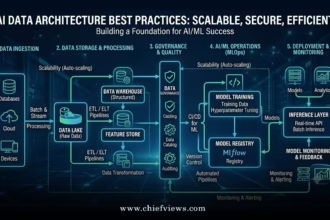


Platforms matter more than any single model. Models are increasingly interchangeable. Competitive edge comes from the ability to orchestrate long-running agent workflows, manage lifecycle, enforce guardrails at runtime, and keep humans in the loop where judgment still wins. IBM’s recent framing of the future CTO role lands here: balance human judgment with autonomous execution while embedding auditability into the systems themselves.
Governance cannot be an afterthought. Build it into the platform layer—policy as code, continuous monitoring of model drift and cost, clear escalation paths—so teams can move fast without creating new risk surfaces.
Talent density is non-negotiable. Upskill the people already closest to the work. Insourcing strategic AI engineering capability while using partners for surge capacity tends to outperform pure outsourcing. McKinsey’s guidance for technology leaders emphasizes tailored training by role and proficiency level because the impact of generative AI varies dramatically across software development, data engineering, and operations.
Step-by-step action plan for CTOs new to AI-scale transformation
If I were walking into a new CTO seat tomorrow with an AI mandate, this is the sequence I would run.
Week 1–2: Diagnose reality
Map current data quality, platform readiness, and existing AI experiments. Identify the three highest-value domains where AI can change cost structure or revenue velocity. Force every proposed use case through a simple filter: clear owner, measurable KPI, and path to production within two quarters.
Week 3–6: Fix the foundation
Stand up or harden the data architecture so structured and unstructured sources are accessible under consistent governance. Create a small centralized platform team that provides approved models, vector stores, and agent orchestration patterns as a service. This prevents every product team from reinventing security and cost controls.
Month 2–3: Redesign work, not just tools
Pick one high-impact workflow and rebuild it as a human-AI system. Define decision rights: where agents act autonomously, where humans approve, and how exceptions surface. Run the new process in parallel with the old one long enough to measure cycle time, error rates, and cost.
Month 4–6: Scale with discipline
Expand only the patterns that proved value. Match risk to capability—keep high-stakes processes at lower autonomy levels while allowing lower-risk domains to move faster. Shift funding from annual project budgets to product-style continuous funding tied to outcomes.
Ongoing: Embed measurement and iteration
Track both leading indicators (deployment frequency of AI-assisted features, percentage of workflows with agent support) and lagging ones (EBITDA contribution, cost per transaction). Review the portfolio quarterly and kill low performers without apology.
This sequence keeps beginners from drowning in model catalogs while still moving intermediate teams past the pilot plateau.
Comparison of approach maturity levels
| Maturity Stage | Typical Focus | Risk Profile | Expected Outcome Window | CTO Primary Job |
|---|---|---|---|---|
| Exploratory | Individual tools, demos | Low technical, high opportunity cost | 3–6 months of learning | Remove friction, set policy |
| Implemented | Isolated use cases in production | Medium (data & cost) | 6–12 months | Build platform services |
| Aligned | Workflow redesign + governance | Medium-high | 9–18 months | Orchestrate human-AI teams |
| Scaled | Cross-domain agent systems | High if poorly governed | 12–24 months | Embed AI into core operating model |
Most U.S. mid-market and enterprise organizations still sit between Implemented and Aligned. The jump to Scaled requires operating-model changes that pure technology projects rarely deliver.

Common mistakes and how to fix them
Mistake one: chasing every shiny use case. Fix it by forcing a hard prioritization filter and protecting the top three domains with dedicated resources.
Mistake two: treating AI like traditional IT projects with waterfall funding and change control. Fix it by moving to product funding models and continuous delivery of AI capabilities.
Mistake three: ignoring the people side. Seventy percent of scaling success is change management and skills, not algorithms. Fix it by investing early in role-specific upskilling and redesigning incentives so teams own the outcomes of the new human-AI workflows.
Mistake four: measuring success by model performance metrics alone. Fix it by tying every initiative to business KPIs from day one and reporting those numbers to the executive team.
Mistake five: bolting governance on after the first production incident. Fix it by baking policy, monitoring, and auditability into the platform layer before the first agent goes live.
Key Takeaways
- Anchor every initiative to a clear business outcome and KPI before selecting models or vendors.
- Invest in platforms and data readiness; models are the easy part.
- Redesign workflows around human-AI collaboration rather than automating existing broken processes.
- Match autonomy levels to risk—different domains can operate at different maturity stages simultaneously.
- Shift funding and talent models to support continuous iteration instead of one-time projects.
- Embed governance and cost controls into the runtime platform so teams can move fast safely.
- Measure value in financial and operational terms the rest of the C-suite actually cares about.
- Treat operating-model redesign as a core CTO responsibility, not a side conversation with HR or the COO.
The CTOs who treat AI driven digital transformation as a system redesign problem—not a technology shopping list—create durable advantage. The ones who stay stuck in pilot mode will keep explaining why the ROI never showed up.
Start this week by mapping your three highest-leverage domains and the current state of data and platform readiness. That single diagnostic usually surfaces the real constraints faster than any vendor roadmap.
FAQs
What are the highest-impact CTO strategies for managing AI driven digital transformation in the first six months?
Prioritize one to three business domains, harden data and platform foundations, redesign a single high-value workflow with clear human-AI decision rights, and establish outcome-based funding. Everything else is secondary until those pieces prove they can deliver measurable results.
How should CTOs balance speed and risk when scaling agentic AI?
Match autonomy to risk tolerance by domain. Keep regulated or high-stakes processes at lower autonomy with strong human oversight while allowing lower-risk operational areas to move faster. Embed monitoring, cost controls, and audit trails into the platform so speed does not create uncontrolled exposure.
Where do most organizations fail when implementing CTO strategies for managing AI driven digital transformation?
They fail at the operating-model layer—treating AI as a series of technology projects instead of redesigning how work, funding, talent, and governance actually function. Pilots succeed; production at scale requires the harder organizational changes.

