









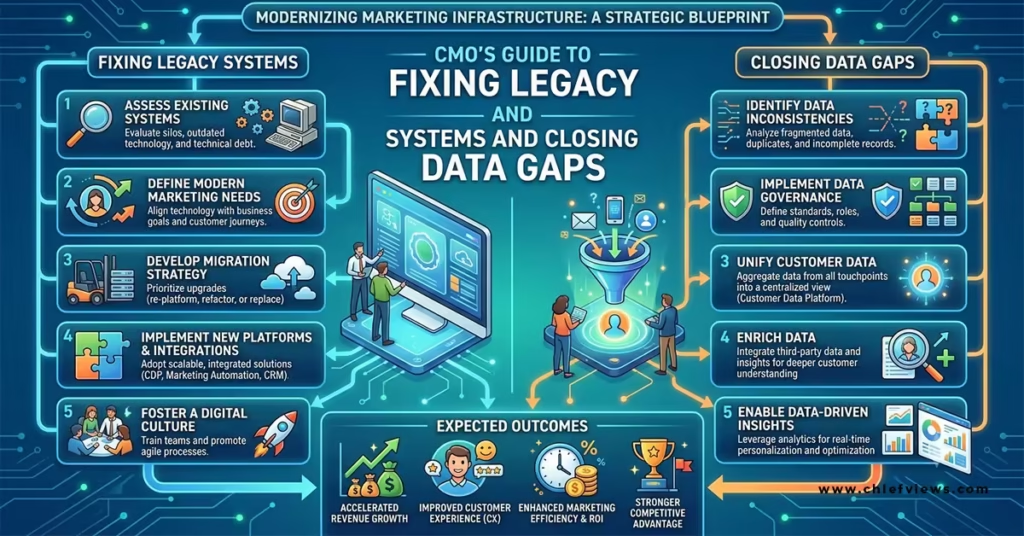
CMO guide to fixing legacy systems and closing data gaps is the practical playbook every marketing leader needs when outdated platforms and fragmented customer records start throttling growth. Here’s the quick overview:
- Legacy systems create data silos that block real-time personalization and AI activation.
- Closing those gaps starts with an honest audit, not a rip-and-replace project.
- Unified customer profiles and clean data contracts deliver faster ROI than new tool purchases.
- Phased integration and governance keep teams aligned and budgets under control.
- The payoff is measurable: better attribution, higher campaign relevance, and AI that actually works.
You’ve inherited a stack that looks like it was built by three different committees over a decade. CRM still runs on rules written in 2018. Marketing automation has five conflicting lead definitions. Analytics lives in its own universe. Sales complains the data is wrong. Finance questions every ROI slide. Sound familiar?
In my experience, the real problem is rarely the tools themselves. It’s the invisible gaps between them. Data arrives late, incomplete, or duplicated. Customer profiles never quite match. When you try to layer AI agents on top of that mess, the models hallucinate or simply refuse to scale. What usually happens is the team keeps buying point solutions hoping the next one will magically connect everything. It doesn’t.
The kicker is that most organizations already own the pieces they need. The missing ingredient is deliberate architecture and ruthless prioritization. Think of your martech stack like an old house with excellent bones but knob-and-tube wiring. You don’t tear the house down. You rewire the critical circuits first so the lights stay on while you modernize the rest.
Why legacy systems still own the data problem in 2026
Most enterprise marketing teams run somewhere between twenty and ninety tools. Many of those platforms were never designed to share clean, real-time data. Older CRM instances and marketing automation platforms store information in rigid schemas that resist modern APIs. The result is shattered rather than simply siloed data: the same customer exists under three different IDs with conflicting attributes.
Recent industry reporting shows the impact clearly. Only 21 percent of marketers say their CRM data is very well prepared to support AI, according to Validity’s State of CRM Data Management in 2026 report covered by CMSWire. At the same time, Salesforce research found 98 percent of marketers face barriers to personalization, with fragmented and poor-quality data as the primary bottleneck. These are not abstract problems. They show up as wasted ad spend, broken journeys, and AI pilots that never leave the sandbox.
CMOs who treat data readiness as an IT side project lose. The ones who own the problem as a marketing performance issue start winning. That ownership starts with a clear-eyed view of where the gaps actually sit.


CMO guide to fixing legacy systems and closing data gaps: the step-by-step action plan
Here’s exactly what I’d do if I walked into a new CMO seat tomorrow and found a decade of technical debt.
- Map the current state in two weeks, not two months. List every system that holds customer or campaign data. Note ownership, refresh frequency, key fields, and known sync failures. Focus on the revenue-critical flows first: lead capture, opportunity progression, purchase events, and support interactions. Skip the exhaustive inventory of every free trial tool someone signed up for three years ago.
- Define the canonical customer profile. Agree on a single set of required fields and definitions for identity, lifecycle stage, and key attributes. Document them as a data contract that every system must honor. This is non-negotiable. Without shared definitions, every downstream integration fails.
- Prioritize the highest-friction data gaps. Rank gaps by business impact: which missing or conflicting fields cost the most in wasted spend or lost pipeline? Typical early targets include inconsistent job titles, missing account hierarchies, and delayed purchase signals.
- Build a bridge, don’t burn the house. Connect critical sources to a modern data layer (cloud warehouse or CDP) using reverse ETL or iPaaS tools. Push clean, unified segments back into the systems teams already use. Keep the legacy platforms running as execution engines while the new foundation takes shape.
- Enforce data quality at the intake point. Stop dirty records before they enter the system of record. Add validation rules, required fields, and automated enrichment for the highest-volume sources. Use AI agents sparingly at first—start with title normalization or location enrichment—then expand.
- Measure and iterate every quarter. Track simple health metrics: percentage of complete profiles, sync latency, duplicate rates, and the share of campaigns running on unified data. Review the scorecard with sales and product partners so ownership stays shared.
This sequence keeps risk low and momentum high. Teams see early wins instead of waiting for a multi-year transformation that never finishes.
Practical comparison: phased modernization vs. full rip-and-replace
| Approach | Time to First Value | Typical Cost Range | Risk Level | Best For |
|---|---|---|---|---|
| Phased bridge (connect + clean + activate) | 8–16 weeks | Moderate (tools + limited consulting) | Low | Most mid-market and enterprise teams with existing stack investment |
| Full rip-and-replace | 12–24 months | High (licenses + migration + change management) | High | Rare cases where core platforms are truly end-of-life and unsupported |
| Status quo + more point tools | Immediate (but temporary) | Low short-term, high long-term | Medium-High | Teams avoiding hard decisions |
The table makes the choice obvious for most organizations. Phased work delivers usable data faster and preserves the institutional knowledge already embedded in current systems.
Common mistakes and how to fix them
Mistake one: treating data cleanup as a one-time project. What usually happens is a big scrub campaign followed by rapid re-contamination. Fix it by embedding validation into every intake process and assigning ongoing data stewardship to operations owners, not just IT.
Mistake two: buying a CDP or warehouse and expecting magic. Without clear identity resolution rules and field governance, the new platform simply becomes another silo. Start with the data contracts and canonical model before the platform selection discussion.
Mistake three: letting every team define its own lead stages and attribution logic. Conflicting definitions destroy trust. Force alignment on a short list of shared definitions and publish them where both marketing and sales can see them daily.
Mistake four: ignoring the human integration layer. Tools talk to each other through APIs, but people talk through Slack and spreadsheets. Create visible exception queues and clear ownership for records that fail validation. Without that, the process collapses back to manual workarounds.
CMO guide to fixing legacy systems and closing data gaps: governance that sticks
Governance sounds bureaucratic. Done right, it is the opposite. A lightweight data council with marketing, sales, and product representation can set the rules once and then enforce them through system configuration rather than endless meetings. Focus on three things only: required fields for revenue-critical records, consent and source tracking, and a simple escalation path when data breaks.
One useful external resource for thinking about the decisioning layer that sits between data and activation is the practical framework outlined by Destination CRM on closing the “missing middle” in martech stacks. Another solid reference is McKinsey’s work on master data management, which underscores why business sponsorship—not just technology funding—determines success. For the AI readiness angle, CMSWire’s coverage of context engineering and data preparedness provides current benchmarks.
Key Takeaways
- Start with an honest two-week map of revenue-critical data flows rather than a full stack inventory.
- Create a single canonical customer profile and enforce it through data contracts.
- Bridge legacy systems to a modern data layer instead of attempting a risky full replacement.
- Fix quality at the intake point so dirty records never become the system of record.
- Track a short list of health metrics every quarter and share them with sales partners.
- Treat data readiness as a marketing performance issue, not an IT side quest.
- Use AI agents for specific cleaning and enrichment tasks only after the foundation is trustworthy.
The organizations pulling ahead in 2026 are not the ones with the newest logos in their stack. They are the ones that treated data gaps as a competitive liability and closed them with disciplined, sequential work. Your next step is simple: pick the three highest-friction data flows in your current operation and run the two-week mapping exercise. Once you see the real gaps in black and white, the path to fixing them becomes obvious.
FAQs
How long does a CMO guide to fixing legacy systems and closing data gaps typically take to show results?
Most teams see usable improvements in data completeness and campaign relevance within one to two quarters when they follow a phased bridge approach rather than a full migration.
What is the biggest early win in a CMO guide to fixing legacy systems and closing data gaps?
Establishing a shared canonical profile and enforcing required fields on the highest-volume lead sources. That single change reduces downstream noise faster than any new platform purchase.
Does a CMO guide to fixing legacy systems and closing data gaps require replacing the entire martech stack?
No. The more effective path for the majority of organizations is connecting existing systems to a clean data foundation and gradually improving quality and governance while keeping proven execution tools in place.
