





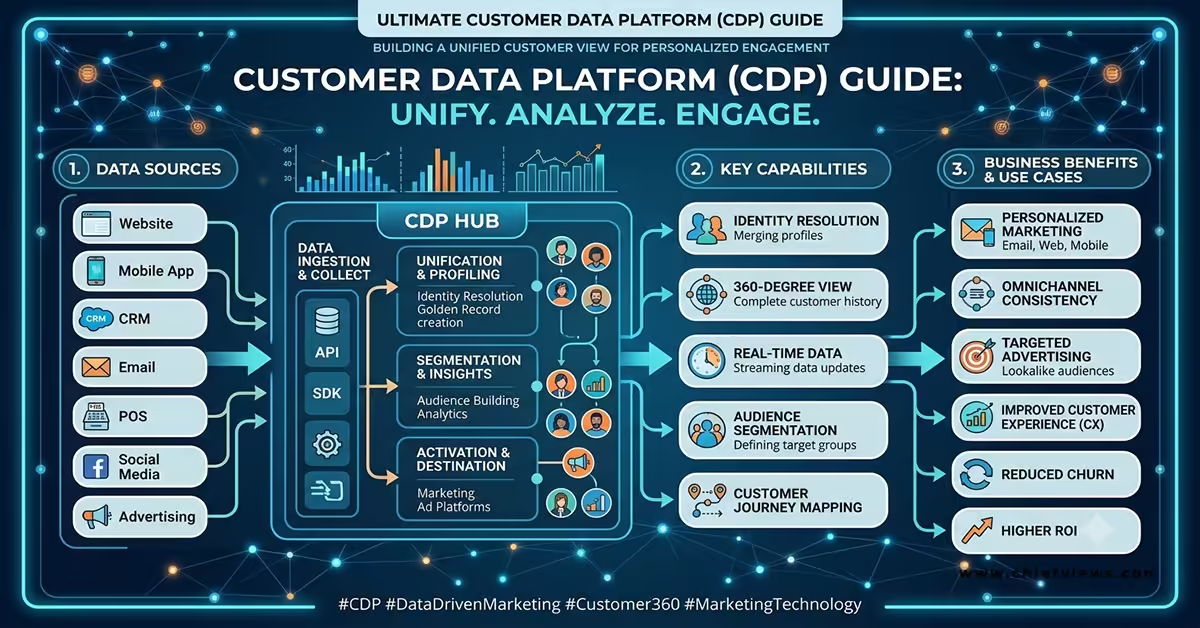
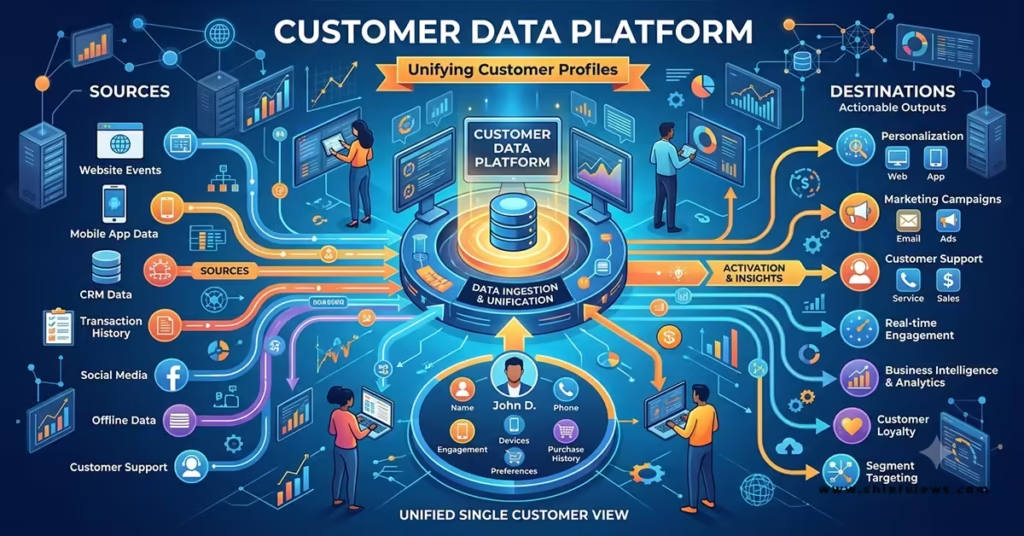
Customer data platform (CDP) guide starts with a clear definition: a CDP is software that collects customer data from every source you own, resolves it into a single persistent profile per person, and makes those profiles available in real time for marketing, personalization, analytics, and AI-driven actions.
- Collects first-party data from websites, apps, CRM, email, POS, support, and more.
- Uses identity resolution to stitch anonymous and known interactions into one profile.
- Stores profiles long-term and updates them continuously.
- Activates data across channels—email, ads, onsite experiences, service tools.
- Serves as the foundation for real-time personalization and AI agents.
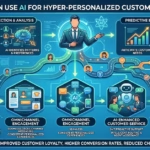
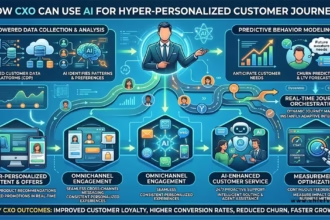
In 2026 the strongest CDPs also feed the systems that power advanced customer experiences. When CXOs look at how CXO can use AI for hyper personalized customer journeys, a solid CDP is usually the data backbone that makes those journeys accurate and scalable.
CDP vs CRM vs DMP: Quick Comparison
| Feature | CDP | CRM | DMP |
|---|---|---|---|
| Primary data | First-party (known + anonymous) | Known contacts & relationships | Mostly anonymous / third-party |
| Identity | Persistent person profiles | Manual or sales-driven records | Short-lived cookies/devices |
| Main users | Marketing, CX, analytics | Sales & service | Media & advertising |
| Core job | Unify data + activate | Manage relationships | Build ad audiences |
| Retention | Long-term | Long-term | Short-term |
| 2026 relevance | High (personalization + AI) | Stable | Declining with cookie loss |
A CDP does not replace your CRM. It complements it by giving marketing and experience teams a richer, behavior-based view of the same people.
How a CDP Actually Works
- Ingest – Pull data from every relevant source via connectors, APIs, or SDKs.
- Resolve identity – Match records that belong to the same person across devices and channels.
- Unify profiles – Build and continuously update a single, persistent customer profile.
- Understand & decide – Apply segmentation, predictive models, or AI to determine next-best actions.
- Activate – Push audiences or individual profile data to email platforms, ad systems, websites, apps, and service tools in real time.
- Learn – Feed engagement results back into the profiles so the system improves over time.
Modern platforms increasingly support “agentic” capabilities—AI agents that can query profiles and trigger actions with appropriate governance.
Common Use Cases
- Real-time personalization of website or app experiences
- Consistent cross-channel messaging (email + SMS + ads)
- Audience suppression (don’t show ads to recent buyers)
- Predictive churn or lifetime-value scoring
- Clean, consented data for AI-driven journey orchestration
- Single customer view for support and success teams
How to Evaluate and Choose a CDP
Start with outcomes, not features. Decide the specific problems you need to solve (better personalization, cleaner audiences, AI readiness, reduced data silos).
Key evaluation criteria in 2026:
- Strength of identity resolution
- Real-time performance and scale
- Number and quality of native connectors
- Governance, privacy, and consent management
- Ability to support AI agents and reverse ETL / warehouse-native approaches
- Total cost of ownership (licenses + implementation + ongoing maintenance)
Popular options include Twilio Segment, Salesforce Data Cloud (Data 360), Adobe Real-Time CDP, Tealium, Hightouch, mParticle, and others. Packaged CDPs handle more out of the box; composable/warehouse-native approaches give greater control if you already have a strong data warehouse.
Run a focused pilot with a handful of sources and one or two clear use cases before full commitment.
Common Mistakes to Avoid
Buying a CDP before clarifying use cases and data readiness. The platform cannot fix messy source data or unclear goals.
Treating the CDP as a pure analytics warehouse. Its power lies in activation and real-time availability.
Ignoring identity resolution quality. Poor matching produces fragmented or incorrect profiles.
Underestimating governance and privacy requirements. Consent, data residency, and auditability matter more every year.
Expecting instant ROI without process and people changes. Technology alone does not create personalized experiences.
Key Takeaways
- A CDP unifies first-party customer data into persistent, actionable profiles.
- It differs from CRM (relationship management) and DMP (anonymous ad audiences).
- Core value is real-time activation for personalization, marketing, and AI.
- Choose based on identity strength, connectors, governance, and fit with your architecture.
- Start with clear use cases and a limited pilot.
- A strong CDP becomes the data foundation for advanced AI-driven customer journeys.
- Success requires clean source data, clear ownership, and ongoing governance.
A well-implemented customer data platform turns scattered interactions into a coherent, usable view of each customer. That unified view is what lets teams—and increasingly AI systems—deliver relevant experiences at scale. Define the outcomes you need, evaluate platforms against those outcomes, and treat the CDP as infrastructure rather than a magic bullet. When the data foundation is solid, everything built on top of it works better.
FAQs
Do I need a CDP if I already have a CRM?
Yes, if you need to unify behavioral and multi-channel data beyond the known contacts and interactions managed in the CRM. The two tools work best together.
What is the difference between a packaged CDP and a composable CDP?
Packaged CDPs handle collection, storage, identity, and activation inside one system. Composable (often warehouse-native) approaches keep data in your warehouse and focus on activation and reverse ETL.
How long does it take to implement a CDP?
A focused pilot can show value in weeks to a few months. Full enterprise rollouts typically take longer depending on data sources, identity complexity, and governance requirements.

