









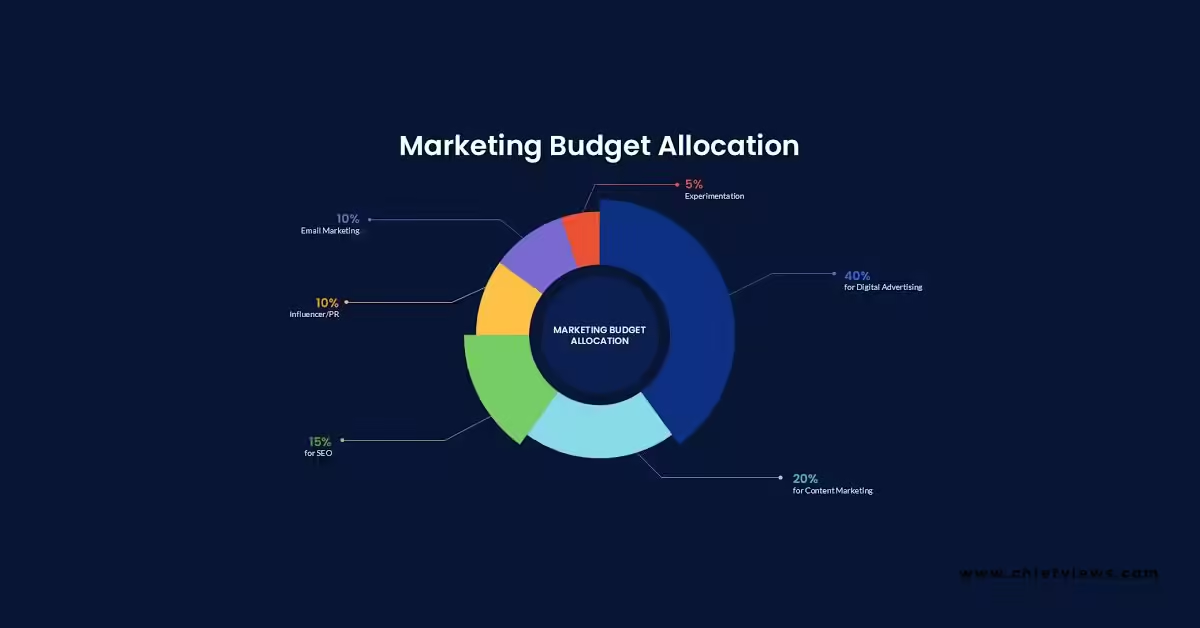
A marketing budget allocation framework is the difference between throwing darts and actually aiming. Most CMOs don’t lack data. They lack a repeatable system for turning that data into a spend split that holds up when the CFO asks “why this channel, why that number?”
Here’s the thing—budgets have gone flat while expectations keep climbing. That combo makes a real framework non-negotiable, not optional.
Quick summary before we go deep:
- What it is: A structured method for dividing marketing spend across channels, functions, and initiatives based on data, not habit.
- Why it matters now: Marketing budgets have flatlined at 7.7% of company revenue, according to Gartner’s 2025 CMO Spend Survey.
- The biggest shift: Paid media still dominates at 30.6% of budget, but martech and labor costs are under heavy scrutiny.
- Who needs this: Any marketing leader justifying spend decisions to finance, especially during flat or shrinking budgets.
- The payoff: A defensible, flexible allocation model that survives both board reviews and sudden market shifts.
What a Marketing Budget Allocation Framework Actually Does
A framework isn’t a spreadsheet with last year’s numbers copied forward. It’s a decision system. It tells you how much goes to brand versus performance, how much stays flexible, and how you’ll rebalance when something breaks.
In my experience, teams that skip this step end up reallocating by panic instead of logic. Something underperforms, and suddenly the whole plan gets rewritten in a Monday meeting nobody prepped for.
That’s exactly the gap that CMO strategies for clarity agility amid market disruption are built to close—a sound allocation framework is really just agility with a spreadsheet attached.



Core Buckets Every Framework Needs
Most working frameworks boil down to four buckets, regardless of company size:
- Paid media — search, social, programmatic, out-of-home.
- Martech and data — the platforms, CDPs, and analytics tools running everything else.
- Labor and agencies — internal headcount plus outside agency support.
- Brand and content — organic, SEO, creative production, PR.
Gartner’s 2025 survey puts real numbers behind this. Paid media takes 30.6% of marketing budgets, martech sits at 22.4%, labor at 21.9%, and agencies at 20.7%. That’s a useful benchmark, not a mandate—your mix depends on your industry, growth stage, and how much of your demand is inbound versus outbound.
Marketing Budget Allocation Framework: A Practical Model
Here’s a model you can actually apply, broken down by allocation philosophy.
| Allocation Model | How It Works | Best For |
|---|---|---|
| 70/20/10 Rule | 70% proven channels, 20% emerging growth bets, 10% experimentation | Mid-size companies balancing stability and growth |
| Revenue-Percentage Model | Fixed share of revenue (commonly 7–10%), split across channels by historical ROI | Established companies with predictable revenue patterns |
| Zero-Based Budgeting | Every line item justified from scratch each cycle, nothing carried over by default | Companies under cost pressure or post-restructuring |
| Agile/Rolling Allocation | Budget reviewed and adjusted monthly or quarterly instead of locked annually | Volatile markets, fast-moving categories, startups |
None of these are “correct” in isolation. What I’d do is blend them—use a revenue-percentage baseline for stability, then layer in a rolling review cadence so you’re not locked into decisions made nine months ago under completely different market conditions.
Step-by-Step: Building Your Allocation Framework
If you’re starting from scratch, here’s the sequence that actually works.
- Set your total budget as a percentage of revenue. Use Gartner’s 7.7% benchmark as a reference point, then adjust up or down based on your growth stage and category competitiveness.
- Separate brand spend from performance spend. Brand builds long-term demand. Performance captures demand that already exists. Blurring the two makes ROI reporting meaningless.
- Benchmark your channel mix against industry data. Compare your paid-to-owned-to-earned ratio against the 30.6% paid media, 22.4% martech, 21.9% labor split from current Gartner data, then explain any big deviations to finance before they ask.
- Build in a flexible reserve. Hold back 10–15% of total budget specifically for reallocation. Without this, every pivot requires raiding a committed line item, and that’s where good plans die.
- Assign owners to each bucket, not just totals. A number without an owner doesn’t get managed—it just gets spent.
- Set review checkpoints, not just year-end reports. Monthly or quarterly check-ins catch underperformance early, before it compounds into a budget crisis.
- Document the “why” behind each allocation. When the CFO questions a line item six months from now, you want a written rationale, not a shrug.
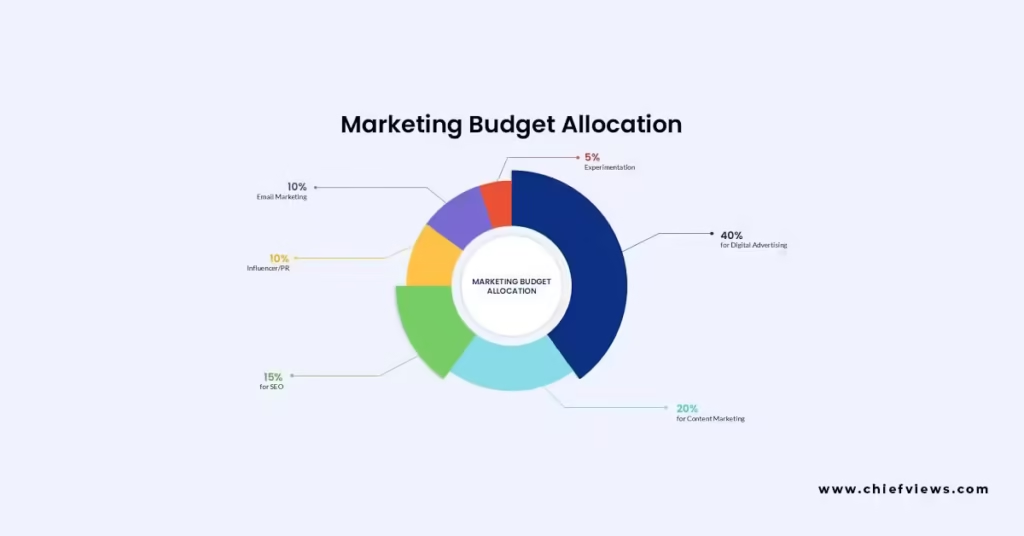
Common Mistakes & How to Fix Them
Mistake 1: Copying last year’s budget forward. Markets move. Last year’s winning channel might be this year’s waste. Fix it by re-justifying at least 20% of your budget from zero each cycle.
Mistake 2: No flexible reserve. Locking 100% of budget means you can’t respond to disruption without a painful reallocation fight. Fix it by protecting that 10–15% buffer no matter how tight things get.
Mistake 3: Overloading martech without workflow integration. Martech now eats 22.4% of the average budget, but tools sitting unused don’t generate ROI. Fix it by auditing tool usage before renewing any contract.
Mistake 4: Cutting labor without a transition plan. Gartner found 39% of CMOs are reducing labor costs, often through role consolidation. Fix it by mapping which functions absorb the workload before headcount disappears, not after.
Mistake 5: Treating allocation as a once-a-year decision. Annual-only budgeting is the enemy of agility. Fix it by adopting a rolling review model, the same muscle behind solid CMO strategies for clarity agility amid market disruption—because a budget that can’t move is a budget that breaks under pressure.
How Allocation Changes During Market Disruption
Here’s where this gets real-world practical. When a tariff hits, a competitor slashes prices, or a platform algorithm shifts overnight, your allocation framework gets tested immediately.
What usually happens in weaker organizations? Budget stays frozen because nobody has pre-authorized the flexibility to move it. Stronger teams already have the reserve carved out and a short approval chain ready to go.
Duke’s Fuqua School of Business, through The CMO Survey, found marketer optimism at its lowest point since 2020 —which tells you disruption-readiness isn’t theoretical anymore. It’s the baseline operating condition for 2026.
Key Takeaways
- A marketing budget allocation framework is a decision system, not a static spreadsheet—build it to flex, not just to report.
- Gartner’s 2025 benchmark splits budgets roughly 30.6% paid media, 22.4% martech, 21.9% labor, and 20.7% agencies.
- Keep 10–15% of total budget unallocated so you can respond to disruption without a committee fight.
- Separate brand investment from performance spend—blending the two muddies your ROI story.
- Review allocation quarterly or monthly, not just once a year.
- Document your rationale for every major allocation so finance conversations go faster, not slower.
- Labor cuts need a workflow transition plan, not just a smaller headcount number.
- Strong allocation frameworks and CMO strategies for clarity agility amid market disruption rely on the same core habit: deciding fast on good information.
Here’s the honest bottom line: a budget allocation framework only works if somebody actually owns rebalancing it. Build the structure, protect the flexible reserve, and review it like it’s alive—because it is. Markets don’t hold still long enough for a “set it and forget it” budget to survive the year.
If you’re building yours from scratch this quarter, start with step one: lock your revenue percentage, then carve out that flexible reserve before you touch channel splits. Everything else gets easier once that foundation’s in place.
FAQs
Q: What percentage of revenue should a marketing budget allocation framework target in 2026?
A: Gartner’s 2025 CMO Spend Survey puts the average at 7.7% of company revenue, though this varies heavily by industry and growth stage. Use it as a reference point, not a rule.
Q: How does a marketing budget allocation framework support agility during a market disruption?
A: By building in a flexible, unallocated reserve—typically 10–15% of total spend—you can reallocate fast without a drawn-out approval process, which is the core idea behind CMO strategies for clarity agility amid market disruption.
Q: Should startups use the same budget allocation framework as established companies?
A: Not exactly. Startups often lean toward an agile, rolling allocation model since they lack the historical data for a stable revenue-percentage approach, while established companies can rely more on benchmarked, consistent splits.

