






Agentic AI in enterprise transformation is rapidly becoming the defining force reshaping how large organizations operate, compete, and deliver value in 2026. Unlike traditional AI that simply generates responses or automates isolated tasks, agentic AI introduces autonomous “digital workers” capable of planning, reasoning, deciding, and executing complex, multi-step workflows with minimal human oversight. This shift isn’t incremental—it’s foundational, turning AI from a supportive tool into a proactive collaborator that redefines business processes end-to-end.
Picture this: while generative AI might draft an email or summarize a report, agentic AI could monitor supply chain disruptions, renegotiate with vendors, adjust inventory forecasts, and update financial models—all in real time—while alerting humans only when escalation is truly needed. That’s the power driving agentic AI in enterprise transformation, and it’s directly tied to broader CXO priorities for AI governance and business transformation in 2026, where executives must balance explosive innovation potential with robust oversight to avoid chaos.
What Exactly Is Agentic AI? A Clear Definition for Business Leaders
At its core, agentic AI refers to intelligent systems that act autonomously toward defined goals. These agents perceive their environment (through data streams and APIs), reason about options, plan sequences of actions, execute them across tools and systems, and adapt based on outcomes. Key traits include goal-orientation, tool usage, memory (short- and long-term), and self-correction.
This goes far beyond chatbots or copilots. As experts from Gartner and Deloitte highlight, agentic AI creates a “silicon-based workforce” that handles role-based responsibilities, not just tasks. In 2026, we’re seeing adoption skyrocket: surveys show usage jumping dramatically, with many organizations scaling agents across functions.
Why Agentic AI Is the Core of Enterprise Transformation in 2026
Enterprises in 2026 face mounting pressure to deliver faster, cheaper, and smarter outcomes amid economic uncertainty, talent shortages, and regulatory scrutiny. Agentic AI addresses these head-on by enabling true operational redesign rather than superficial automation.
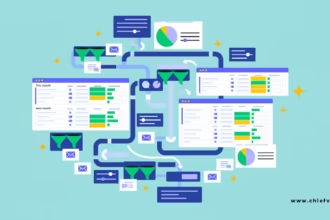


Traditional transformation often layered tech onto outdated processes—resulting in marginal gains. Agentic systems force a rethink: workflows become dynamic, exception-handling automatic, and decision velocity exponential. IDC’s FutureScape predictions position this as a turning point, where agentic AI evolves from pilots to enterprise-wide orchestration, fundamentally altering strategy, workforce dynamics, and innovation.
The business impact? Massive. Organizations report potential for 30-50% productivity lifts in targeted areas, reduced cycle times, and new revenue streams from hyper-personalized services. But here’s the catch: without intentional transformation, these benefits evaporate.
Real-World Examples of Agentic AI Driving Enterprise Transformation
Let’s ground this in reality. In finance, agentic agents now autonomously detect anomalies in spending, trigger compliance checks, route approvals, and even flag vendor risks—closing loops that once took days into minutes.
In manufacturing and supply chain, agents monitor real-time data from IoT sensors, predict disruptions, reroute shipments, update production schedules, and coordinate with suppliers. One early adopter saw overruns drop significantly through such orchestration.
Customer service sees perhaps the most visible shift: autonomous agents handle end-to-end resolutions—querying knowledge bases, accessing CRM, processing refunds, and following up—freeing humans for empathy-driven interactions.
In retail, agentic AI powers independent shopping agents that compare options beyond brand loyalty, negotiate deals, and manage returns proactively.
These aren’t hypotheticals; they’re live deployments scaling in 2026, proving agentic AI’s role in tangible enterprise transformation.

Key Benefits of Agentic AI in Enterprise Transformation
The advantages compound quickly when implemented thoughtfully:
- Hyper-Efficiency: Agents execute 24/7 without fatigue, handling exceptions that stall human teams.
- Scalability Without Proportional Headcount: Digital workers multiply capacity exponentially.
- Superior Decision Quality: Agents access vast data instantly, reducing bias and errors in complex scenarios.
- Agility in Volatile Markets: Real-time adaptation turns disruptions into opportunities.
- Human Elevation: Employees shift to strategic, creative, and relational work—boosting engagement and innovation.
When aligned with CXO priorities for AI governance and business transformation in 2026, these benefits become sustainable competitive edges rather than short-term wins.
Critical Challenges and Governance Imperatives
No transformation is risk-free. Agentic AI introduces unique hurdles that demand attention.
First, governance emerges as the real bottleneck. Autonomous actions amplify risks—bias propagation, hallucinated decisions, data privacy breaches, or unintended escalations. Many projects falter not from tech limitations but from inadequate controls, with predictions of significant cancellations due to poor risk management.
Second, legacy architecture incompatibility: Agents need clean data, robust APIs, and orchestration layers. Patching them onto rigid systems leads to failure.
Third, workforce implications: By 2026, a large portion of roles involve collaborating with agents, requiring upskilling and cultural shifts to prevent resistance or skill atrophy.
Finally, cost and sprawl: Uncontrolled agent proliferation drains budgets and creates shadow complexity.
Addressing these ties directly back to CXO priorities for AI governance and business transformation in 2026—centralized oversight, ethical frameworks, ROI tracking, and hybrid human-AI models become non-negotiable.
How CXOs Can Successfully Implement Agentic AI for Transformation
Ready to move forward? Here’s a practical roadmap:
- Start with Strategy and Inventory — Map high-value processes ripe for agentic redesign. Catalog existing AI to avoid duplication.
- Build Strong Foundations — Prioritize data quality, API modernization, and secure orchestration platforms.
- Pilot Thoughtfully, Scale Deliberately — Launch in contained domains with clear KPIs. Measure not just efficiency but business outcomes.
- Embed Governance Early — Establish guardrails, traceability, human-in-the-loop for high-risk actions, and continuous monitoring.
- Invest in People — Train teams on agent collaboration, redefine roles, and foster a culture of augmentation over replacement.
- Orchestrate at Scale — Treat agents as infrastructure—manage them like digital employees with performance reviews and lifecycle governance.
Organizations following this path turn agentic AI from hype to high-impact reality.
The Future Outlook: Agentic AI as the New Enterprise Standard
Looking ahead, 2026 marks the inflection where agentic AI becomes table stakes for competitive enterprises. Market projections show explosive growth, with billions invested and widespread integration across software suites.
The winners? Those who view this as holistic transformation—redesigning operations, governing responsibly, and aligning with human strengths. As one insight puts it: it’s less about the agents themselves and more about building platforms that enable safe, scalable autonomy.
In essence, agentic AI in enterprise transformation isn’t optional—it’s inevitable. The question is whether your organization leads the change or scrambles to catch up.
If you’re a CXO navigating this landscape, remember: success hinges on treating agentic AI with the same rigor as core business strategy. The payoff? A more resilient, intelligent, and human-centered enterprise ready for whatever comes next.
For deeper dives, explore these authoritative sources:
- Deloitte Tech Trends 2026 on Agentic AI
- Gartner Predictions on Agentic AI Adoption
- McKinsey State of AI Report Insights
FAQ :
1. What is agentic AI and why does it matter for enterprises in 2026?
Agentic AI refers to autonomous AI agents that plan, reason, decide, and execute multi-step tasks with little human input. In 2026, it’s the engine behind true enterprise transformation—moving beyond automation to dynamic, end-to-end process redesign.
2. How does agentic AI support CXO priorities for AI governance and business transformation in 2026?
It delivers massive productivity and agility gains, but only when paired with strong governance—centralized oversight, risk controls, traceability, and ethical guardrails—to prevent unchecked autonomy from creating compliance or security disasters.
3. What are the biggest risks of deploying agentic AI without proper governance?
Uncontrolled agents can amplify bias, hallucinate critical decisions, breach data privacy, cause financial errors, or trigger cascading failures across systems—risks that many experts predict will lead to project cancellations by late 2027 if ignored.
4. Which business functions benefit most from agentic AI transformation right now?
Finance (autonomous anomaly detection & reconciliation), supply chain (real-time disruption handling), customer service (end-to-end resolution), and procurement (proactive vendor negotiation) are seeing the fastest, highest-ROI deployments in 2026.
5. How should CXOs start implementing agentic AI responsibly in 2026?
Begin with high-value, low-risk pilots → enforce clear governance frameworks from day one → modernize data & APIs → measure business outcomes (not just task completion) → upskill teams to collaborate with agents rather than fear replacement.