




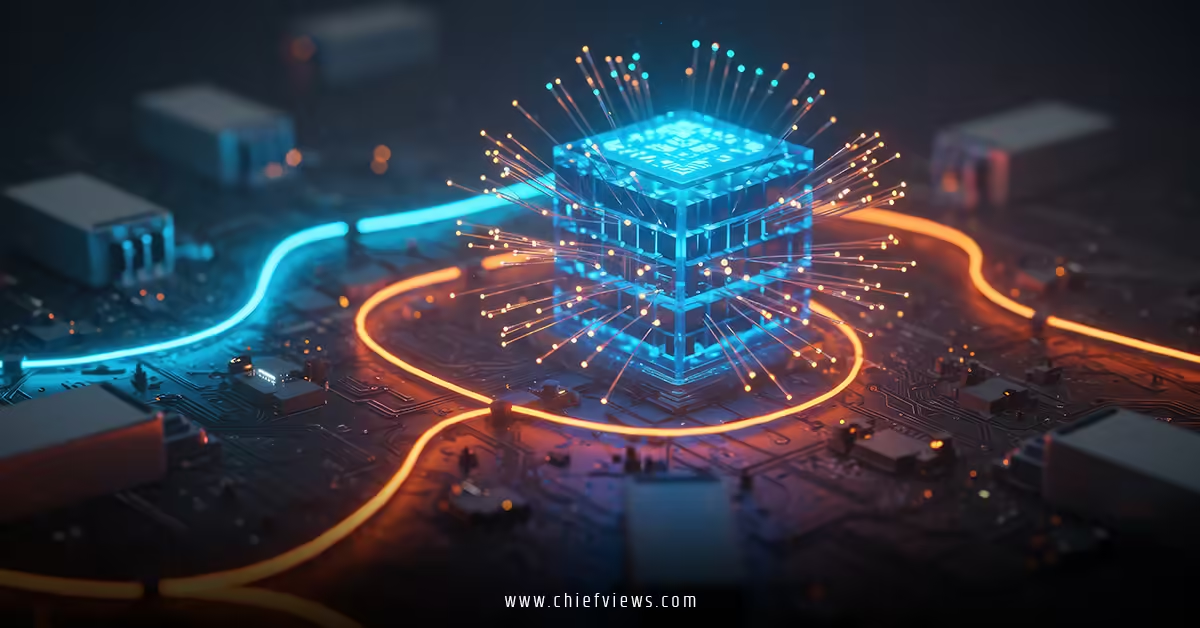
Post-quantum cryptography algorithms are the unsung heroes in the battle against quantum computers that could unravel our digital world’s encryption overnight. Imagine a vault door that’s picked in seconds by a futuristic lockpick— that’s what Shor’s algorithm does to RSA. But fear not; these cutting-edge algos, vetted by NIST, keep your data locked tight. As a CTO or security pro, diving into post-quantum cryptography algorithms isn’t optional anymore—it’s your ticket to staying ahead. Let’s unpack what they are, why they matter, and how to deploy them today.
What Are Post-Quantum Cryptography Algorithms? A Crash Course
At their core, post-quantum cryptography algorithms (PQCAs) are cryptographic primitives designed to withstand attacks from quantum computers. Unlike classical crypto relying on hard math problems like integer factorization (RSA) or elliptic curves (ECC), PQCAs lean on quantum-resistant math foundations—lattices, hashes, codes, and more.
Why “post-quantum”? Quantum rigs exploit superposition and entanglement to crack classical keys exponentially faster. Grover’s algorithm halves symmetric key strength, but Shor’s? It obliterates public-key systems. PQCAs flip the script, ensuring security even if every qubit goes online.
Rhetorical nudge: Ever wonder why your bank’s app feels “secure”? It’s classical crypto holding the line—for now. Enter post-quantum cryptography algorithms to future-proof it.
The Quantum Menace: Why Post-Quantum Cryptography Algorithms Are Urgent
Quantum supremacy isn’t sci-fi. IBM’s 1,000+ qubit chips and Google’s Sycamore scream progress. By 2030, cryptographically relevant quantum computers (CRQCs) could emerge, per expert consensus.

“Harvest now, decrypt later” looms large—adversaries snag encrypted traffic today for tomorrow’s crack. Sectors like finance lose trillions if unprepared. That’s where quantum-safe cybersecurity frameworks CTOs must implement by 2026 for enterprise compliance come in, powered by post-quantum cryptography algorithms.
Analogy time: Classical crypto is a chain; quantum is the plasma cutter. PQCAs? Reinforced titanium links.
NIST’s Chosen Ones: Top Post-Quantum Cryptography Algorithms Breakdown
NIST’s PQC standardization marathon (2016-2024) crowned winners. Here’s the A-team—battle-ready for prime time.
Lattice-Based Champs: CRYSTALS-Kyber and CRYSTALS-Dilithium
- Kyber (Key Encapsulation Mechanism – KEM): Module-LWE (Learning With Errors) based. Encapsulates shared secrets securely. Why love it? IND-CCA2 secure, compact keys (800-1500 bytes), lightning-fast. Drop-in for TLS key exchange.
- Dilithium (Digital Signatures): Same lattice family. EUF-CMA secure, balances speed and size. Signs 1MB docs in milliseconds—ideal for certs.
These shine in hybrids: Pair Kyber with ECDH for transition ease.
Hash-Based Heavyweights: SPHINCS+ and Beyond
SPHINCS+ uses stateless hash trees for signatures. Provably secure under random oracle model—no new math assumptions. Trade-off? Bigger signatures (10-50KB), but eternal security for long-lived keys like software updates.
Code-Based Stalwarts: Classic McEliece
Error-correcting codes underpin this 1970s relic, quantum-hardened. Massive public keys (200KB+), but decryption’s a breeze. Niche for high-security, low-volume use.
Multivariate and More: Emerging Contenders
Rainbow (multivariate) fell to attacks, but GeMSS lurks. NIST’s round 4 eyes isogenies like SQISign—ultra-short sigs for blockchain.
Table of Key PQCAs:
| Algorithm | Type | Key Size (bytes) | Sig Size (bytes) | Use Case |
|---|---|---|---|---|
| Kyber-768 | KEM | ~1200 | N/A | TLS Key Exchange |
| Dilithium-3 | Signature | ~2500 | ~2400 | Certificates |
| SPHINCS+-128f | Signature | ~32 | ~7800 | Firmware Signing |
| McEliece-6960 | KEM | ~200000 | N/A | High-Security Links |
These post-quantum cryptography algorithms form the backbone of resilient systems.
How Post-Quantum Cryptography Algorithms Work: Under the Hood (Simplified)
No PhD required. Lattices? Think high-dimensional grids where finding shortest vectors is hell—even for quantum. LWE: Noisy linear equations over rings.
Hashes? Merkle trees chain one-time signatures infinitely.
Metaphor: Classical factoring is unscrambling a Rubik’s cube blindfolded; quantum solves it. PQCAs make it a multidimensional maze.
Implementation? Libs like OpenQuantumSafe (OQS) or PQClean provide C libs. Integrate via BoringSSL forks.
Real-World Deployment: Implementing Post-Quantum Cryptography Algorithms Today
Start hybrid: Classical + PQC. Cloudflare’s TLS 1.3 experiments mix Kyber+X25519. AWS Key Management Service (KMS) supports Kyber.
Step-by-Step Rollout
- Inventory: Audit crypto with Mozilla’s Observatory or Cryptosense.
- Prototype: Test OQS-OpenSSL in staging.
- Migrate PKI: Issue PQC certs via Google Trust Services.
- Scale: Automate with Ansible playbooks.
- Validate: FIPS 140-3 certs incoming.
Performance hit? Kyber’s 2-3x slower than ECDH, but hardware accel (Intel’s AVX) closes gaps.
Challenges: Key bloat strains IoT. Fix: Compression schemes.
Performance, Trade-Offs, and Benchmarks of Post-Quantum Cryptography Algorithms
Speed tests (PQCRYPTO benchmarks):
- Kyber: 0.1ms encap, 0.02ms decap.
- Dilithium: 0.5ms sign, 3ms verify.
- SPHINCS+: 10ms sign, 0.1ms verify—but 8KB sigs.
vs. Classical: ECC wins speed, PQCAs win security.
| Metric | Classical ECC | Kyber | Dilithium |
|---|---|---|---|
| Key Gen (ms) | 0.5 | 0.1 | 0.3 |
| Bandwidth (KB) | 0.1 | 1.2 | 2.4 |
Optimize with NIST Level 1 (conservative) for starters.
Standards and Roadmaps: NIST, NSA, and Global Push for Post-Quantum Cryptography Algorithms
NIST’s FIPS 203-205 (2024) standardize Kyber/Dilithium/SPHINCS+. NSA’s CNSA 2.0 mandates PQC by 2033, pilots now.
IETF drafts PQ-TLS. ETSI for QKD hybrids.
Enterprise angle: Ties into broader quantum-safe cybersecurity frameworks CTOs must implement by 2026 for enterprise compliance.
Hurdles and Solutions in Adopting Post-Quantum Cryptography Algorithms
- Size/Speed: Use Kyber-512 for bandwidth hogs.
- Interoperability: OQS-provider ensures cross-stack compatibility.
- Side-Channels: Constant-time impls mitigate.
- Talent: Free resources like PQ Bootcamp.
Vendors: Thales, Rambus ship PQC HSMs.
Case Studies: Post-Quantum Cryptography Algorithms in Action
- Cloudflare: PQ-TLS for 10% traffic.
- Tencent: WeChat mini-programs on Dilithium.
- IBM: Qiskit simulations validate.
Results? Zero regressions, quantum-ready.
Future of Post-Quantum Cryptography Algorithms: What’s Next?
Post-NIST: Isogenies, SNARKs hybrids. Quantum repeaters boost QKD+PQC.
Watch: NIST round 5 for more KEMs.
Conclusion: Embrace Post-Quantum Cryptography Algorithms Now
Post-quantum cryptography algorithms like Kyber, Dilithium, and SPHINCS+ are your quantum fortress builders—resistant, standardized, deployable. Don’t let quantum threats catch you flat-footed; audit, pilot, migrate today. Secure tomorrow’s data with today’s actions. What’s your first PQ step?
Frequently Asked Questions (FAQs)
What are the best post-quantum cryptography algorithms for beginners?
Start with CRYSTALS-Kyber for key exchange and Dilithium for signatures—NIST-approved and easy to integrate.
How do post-quantum cryptography algorithms differ from classical ones?
They resist Shor’s algorithm using lattices/hashes, unlike factorization/ECDLP-based classical crypto.
Are post-quantum cryptography algorithms ready for production?
Yes—NIST standards enable hybrids; Cloudflare and AWS deploy them live.
What’s the performance impact of post-quantum cryptography algorithms?
2-5x slower than ECC initially, but optimizations and hardware make it negligible for most apps.
How do post-quantum cryptography algorithms fit into enterprise security?
They’re core to quantum-safe cybersecurity frameworks CTOs must implement by 2026 for enterprise compliance, ensuring regulatory adherence.