








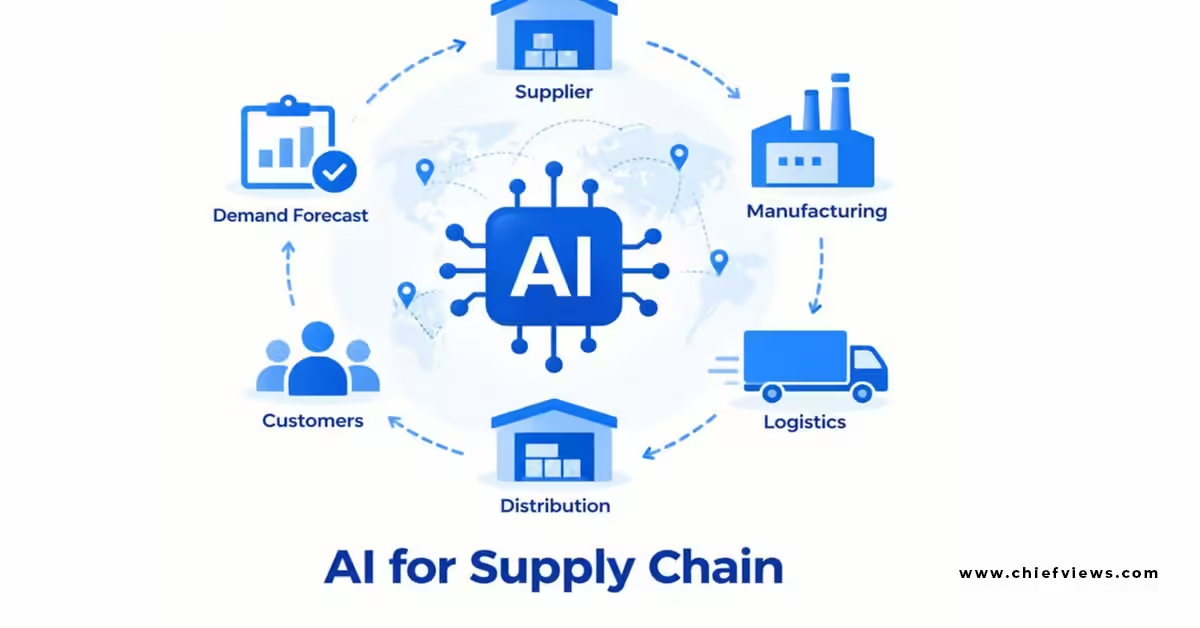
AI-driven supply chain optimization strategies turn reactive networks into systems that sense, decide, and act in near real time. The shift is no longer optional. Companies that still run planning cycles measured in weeks lose ground every day to those that compress those same cycles into hours or minutes.
Here’s what matters right now:
- Demand sensing, inventory positioning, and logistics routing deliver the fastest measurable gains.
- Agentic systems move beyond recommendations to autonomous execution within clear guardrails.
- Data quality and process redesign determine success far more than the choice of algorithm.
- Leading deployments cut cost of goods sold, free working capital, and raise service levels simultaneously.
- The biggest lever is treating the supply chain as one connected decision system rather than siloed functions.
In my experience, the teams that pull ahead start with one high-decision-density process, clean the data that feeds it, and only then layer on intelligence. Everything else follows.
Why Traditional Supply Chains Struggle in 2026
Most supply chains still operate on sequential handoffs. Forecasts get built in one tool. Inventory targets get set in another. Logistics reacts to whatever shows up. When a port backs up or a supplier slips, the response cascades through emails and emergency meetings.
AI changes the equation by collapsing those sequential steps. Machine learning improves the quality of predictions. Optimization engines evaluate thousands of trade-offs at once. Agentic systems then execute the chosen actions across systems. McKinsey estimates that fully realized agentic approaches can reduce cost of goods sold by 4-7 percent and lift supply chain productivity 20-50 percent while shrinking decision cycles dramatically.
The difference shows up in cash and service. Better forecast accuracy frees inventory. Dynamic routing cuts miles and fuel. Continuous risk sensing reduces the size of the next disruption.


Core AI-Driven Supply Chain Optimization Strategies That Actually Work
1. Multi-Horizon Demand Sensing
Static monthly forecasts are dead. Modern systems blend point-of-sale data, promotions, weather, social signals, and macroeconomic indicators to generate rolling predictions across multiple time horizons.
Walmart’s internal multi-horizon neural networks illustrate the approach: they store past predictions at different planning windows and continuously update them with new signals. The result is earlier detection of demand shifts and fewer last-minute expedites.
What I’d do first: instrument the top 20 percent of SKUs by volume and margin. Improve those forecasts before you touch the long-tail items.
2. Continuous Inventory and Safety-Stock Optimization
Static service-level policies waste money. An inventory agent can recalculate optimal safety stock at the individual part or SKU level every day based on current demand variability, supplier reliability, and holding costs.
Deloitte highlights this as one of the highest-value agentic use cases. Agents sense structural supplier risk and external disruptions, then generate ranked options such as dual sourcing or inventory repositioning.
3. Dynamic Logistics and Network Routing
Route optimization has moved far beyond classic vehicle routing problems. Systems now factor real-time traffic, weather, port congestion, driver hours, and customer delivery windows simultaneously. Adaptive large-neighborhood search models help drivers find the lowest-cost path while the broader network agent decides which distribution center should fulfill an order.
Documented results include tens of millions of avoided miles and material reductions in transportation cost as a percentage of revenue.
4. Autonomous Exception Management and Self-Healing Flows
This is where agentic systems shine. When a shipment misses a connection or inventory dips below threshold, the agent diagnoses the root cause, evaluates alternatives, initiates corrective actions, and only escalates true exceptions to humans.
C.H. Robinson’s fleet of agents processed millions of freight tasks and delivered a documented 30 percent productivity increase. That is the difference between firefighting and continuous flow.
5. Supplier Risk and Sourcing Agility
Agents continuously monitor multitier supplier health, geopolitical signals, and capacity constraints. They surface executable options—nearshoring, dual sourcing, or vertical integration—ranked by cost, risk, and time-to-implement. Human teams still make the final call on major shifts, but the analysis arrives fully formed.
How These Strategies Connect to Broader Operations Leadership
Supply chain is often the highest-leverage domain for operations leaders. The same principles that drive results here apply across the enterprise. For a deeper look at the leadership posture required, see how COO can optimize operations with agentic AI systems. The COO who owns the operating model—decision rights, autonomy boundaries, and human-agent handoffs—turns isolated AI wins into sustained advantage.
Practical Comparison of Optimization Approaches
| Strategy Focus | Primary Value Lever | Typical Time to Impact | Data Intensity | Autonomy Level |
|---|---|---|---|---|
| Demand sensing | Forecast accuracy & inventory turns | 3–9 months | High | Recommendation to limited autonomy |
| Inventory optimization | Working capital & service levels | 4–12 months | High | Continuous recalculation with human overrides |
| Dynamic routing | Transportation cost & emissions | 2–6 months | Medium-High | High autonomy within route constraints |
| Exception & self-healing agents | Cycle time & productivity | 6–15 months | Very High | Bounded autonomous execution |
| Supplier risk orchestration | Resilience & cost of goods | 9–18 months | High | Analysis + ranked options |
Step-by-Step Action Plan for AI-Driven Supply Chain Optimization
- Map decision density. Identify the processes where planners make frequent high-stakes trade-offs—inventory allocation, expedite decisions, carrier selection.
- Assess data readiness honestly. Agents amplify whatever data they receive. Harmonize master data for products, locations, suppliers, and customers before you scale.
- Choose one lighthouse process. Prefer high-volume, high-friction flows with clean enough data to show results in two quarters.
- Redesign the workflow first. Remove unnecessary approvals and sequential handoffs. Then insert the agent into the simplified flow.
- Set explicit autonomy boundaries. Define dollar thresholds, service-level floors, and escalation triggers in writing. Review override logs weekly.
- Measure leading and lagging indicators. Track forecast error, inventory turns, perfect-order rate, and decision-cycle time from day one of the pilot.
- Scale component by component. Once the first process is stable, reuse the agent logic and data models in adjacent domains rather than starting from scratch.
Common Mistakes and How to Fix Them
Mistake 1: Starting with technology instead of decisions.
Buying a platform before clarifying which decisions you want to improve produces expensive dashboards. Fix it by listing the five most expensive or frequent decisions in the current process and designing the AI around those.
Mistake 2: Ignoring data governance.
Agents fail loudly when master data is inconsistent. Fix it by treating data quality as a workstream with its own owner and weekly scorecard.
Mistake 3: Over-automating high-stakes exceptions.
Handing unconstrained autonomy to an agent on multi-million-dollar sourcing decisions creates risk. Fix it with graduated autonomy levels and mandatory human review above defined thresholds.
Mistake 4: Measuring only cost reduction.
Service levels and resilience matter equally. Fix it by balancing the scorecard: working capital, OTIF, recovery time after disruption, and planner productivity.
Mistake 5: Treating change management as optional.
Planners will ignore or work around systems they do not trust. Fix it with transparent decision logs, side-by-side comparison periods, and visible leadership sponsorship.
Key Takeaways
- AI-driven supply chain optimization strategies succeed when they target high-decision-density processes first.
- Demand sensing, continuous inventory optimization, dynamic routing, and exception agents deliver the clearest near-term returns.
- Agentic systems create the largest leap by executing across systems rather than merely recommending.
- Data harmonization and workflow redesign are non-negotiable foundations.
- Bounded autonomy plus weekly override reviews keep risk controlled while value compounds.
- The same operating-model discipline that works in supply chain applies enterprise-wide.
- Start with one lighthouse process, prove the model, then scale the components.
The companies pulling ahead in 2026 are not those with the most AI projects. They are the ones that treat the supply chain as a single decision system and give agents clear authority inside well-designed boundaries. Pick the process that hurts most, clean the data that feeds it, and run a tightly scoped pilot. Results compound from there.
FAQs
What is the fastest AI-driven supply chain optimization strategy to implement?
Dynamic routing and exception triage often show measurable cost and cycle-time improvements within a few months because the data requirements are more contained and the feedback loops are short.
How much data quality is “good enough” to start?
You do not need perfection. Focus first on the master data and transactional signals required for the chosen lighthouse process. Use early pilots to surface and fix the remaining gaps.
Can mid-sized companies compete with large enterprises on these strategies?
Yes. Modular agent platforms and cloud planning tools have lowered the barrier. Mid-sized firms often move faster because they have fewer legacy systems and clearer decision rights.
