




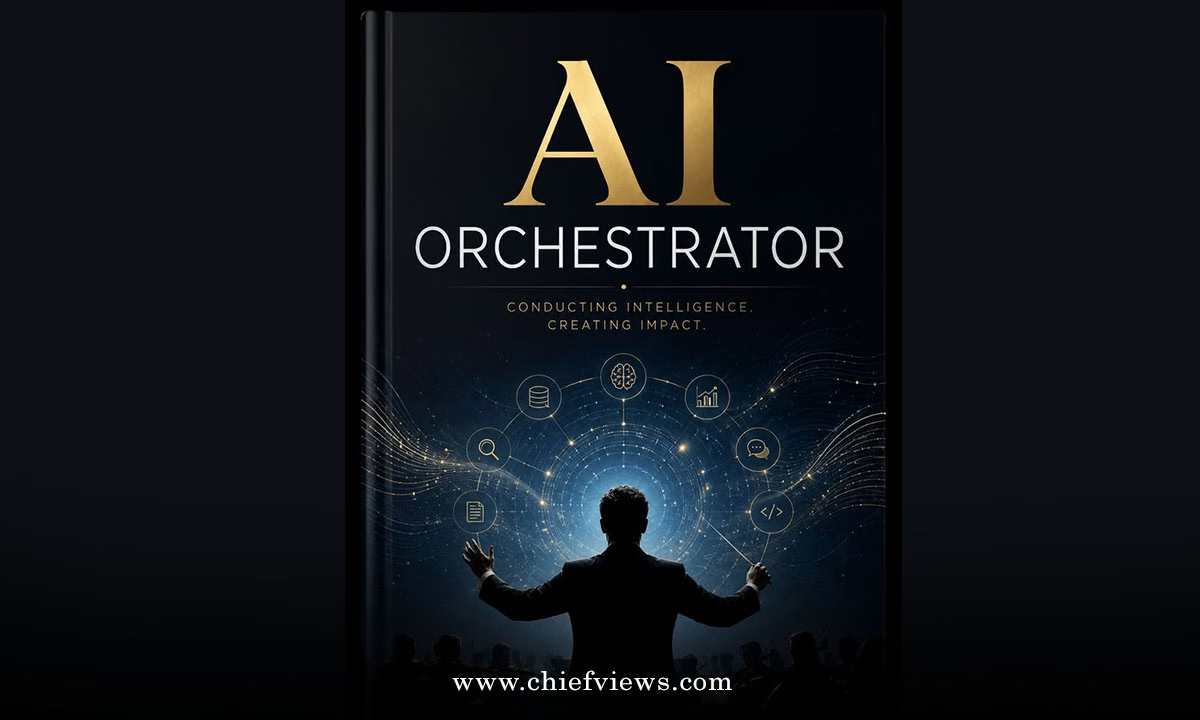
AI orchestration tools for enterprise operations have quietly become the backbone of every serious digital transformation happening right now. Not the flashy chatbot demos. The real infrastructure — the layer that connects a dozen disconnected systems and makes them act like one coordinated machine. If your ops still run on point solutions that don’t talk to each other, this is the gap costing you time and money.
Quick answer, no scrolling required:
- AI orchestration coordinates multiple AI agents, systems, and data sources into one workflow — not just single-task automation.
- It matters because siloed automation tools create more friction than they remove.
- The best tools sit above your existing stack, not inside a single department’s toolset.
- Implementation works best when paired with clear process ownership and clean data.
- This is one of the core pillars behind modern COO strategies for streamlining enterprise processes 2026.
Here’s the thing — most companies already own five or six automation tools. What they’re missing is the layer that makes those tools cooperate.
What AI Orchestration Actually Is (And Isn’t)
Orchestration isn’t a fancier word for automation. It’s the coordination layer above it.
Picture a hospital. Automation is one nurse doing one task really fast. Orchestration is the whole floor — nurses, doctors, lab systems, and scheduling — moving in sync without anyone standing in a hallway waiting on a fax.
That’s the shift enterprises are making in 2026. Individual bots aren’t the bottleneck anymore. Coordination is.

Why This Matters for Enterprise Operations Right Now
Operations teams got automation-happy over the last five years. RPA here, a chatbot there, a workflow tool bolted onto the CRM. The result? A patchwork of tools that don’t share data or context.
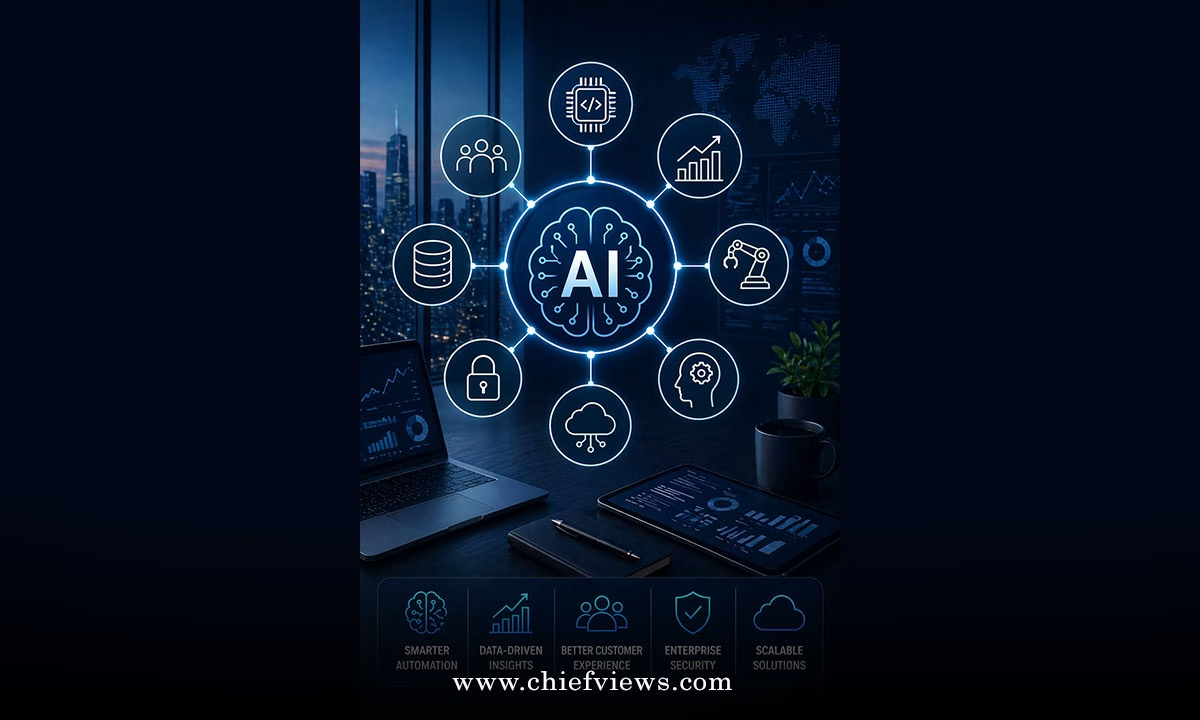
AI orchestration tools fix that by sitting above the patchwork, routing tasks, data, and decisions between systems intelligently. One agent flags an invoice discrepancy. Another checks vendor history. A third routes it to a human only if the risk score crosses a threshold.
No human touches 90% of that chain. That’s the point.
Core Categories of AI Orchestration Tools for Enterprise Operations
Not every tool in this space does the same job. Understanding the categories saves you from buying redundant software — a mistake I see constantly.
Workflow Orchestration Platforms
These manage the sequence and logic of a process — what happens first, what triggers next, and who (or what) gets looped in. Think of them as the air traffic controller for your operations.
Agent Orchestration Layers
This is the newer category built specifically for coordinating multiple AI agents. One agent might handle data extraction, another handles validation, another handles communication. The orchestration layer manages handoffs between them.
Data Integration and Context Engines
Orchestration is worthless without unified data underneath it. These tools pull from ERP, CRM, and legacy systems so agents aren’t working off stale or partial information.
AI Orchestration Tools vs. Traditional Automation Software
| Dimension | Traditional Automation (RPA/Point Tools) | AI Orchestration Tools for Enterprise Operations |
|---|---|---|
| Scope | Single task or single system | Cross-system, end-to-end workflow |
| Decision-Making | Rule-based, static logic | Context-aware, adaptive routing |
| Agent Coordination | None — bots run independently | Agents hand off tasks to each other |
| Data Dependency | Works on isolated data sets | Requires a unified data layer |
| Human Involvement | Frequent manual triggers | Human intervention only at flagged risk points |
| Best Fit | Narrow, repetitive tasks | Complex, multi-step enterprise processes |
Step-by-Step: Rolling Out AI Orchestration Tools for Enterprise Operations
Don’t buy the platform first. That’s backwards, and it’s how half these projects stall out.
- Map one end-to-end workflow. Pick something with multiple handoffs — order-to-cash or procure-to-pay work well.
- Identify the data gaps. Where does information get manually re-entered or double-checked? That’s your friction point.
- Choose a platform that integrates, not replaces. Look for orchestration tools that sit on top of your existing ERP and CRM, not ones demanding a full rip-and-replace.
- Pilot on the smallest viable slice. One sub-process, thirty to sixty days, clear success metrics.
- Set a human checkpoint for edge cases. Full autonomy on day one is a recipe for expensive mistakes.
- Track cycle time and error rate weekly during the pilot. Not monthly — weekly, while you’re still tuning it.
- Expand workflow by workflow. Resist the urge to orchestrate everything at once.
This sequencing mirrors the broader thinking behind COO strategies for streamlining enterprise processes 2026 — data first, small pilots second, scale only what proves itself.
Common Mistakes & How to Fix Them
Mistake 1: Buying orchestration software before fixing data silos.
Fix: Unify the underlying data first. Orchestration on messy data just automates confusion at scale.
Mistake 2: Trying to orchestrate every process simultaneously.
Fix: Pilot one workflow. Prove the ROI. Then expand deliberately.
Mistake 3: Treating orchestration as “set it and forget it.”
Fix: These systems need tuning. Review agent performance weekly during rollout, monthly after that.
Mistake 4: Skipping the human checkpoint.
Fix: Build in a manual review trigger for high-risk or high-value decisions, at least early on.
Mistake 5: No clear owner for the orchestrated workflow.
Fix: Assign one accountable person per process — same principle that applies across COO strategies for streamlining enterprise processes 2026.
What the Data and Research Say
Gartner’s coverage of AI in operations has consistently pointed to integration complexity — not model performance — as the top barrier enterprises face when scaling AI-driven workflows [1]. That lines up with what I’ve seen on the ground more times than I can count.
The National Institute of Standards and Technology (NIST) has published risk management guidance specifically addressing how organizations should govern AI systems operating with increasing autonomy, which is directly relevant once your orchestration layer starts making unsupervised decisions [2].
McKinsey’s operations research has also noted that organizations pairing automation with structural process redesign outperform those that automate existing workflows as-is [3]. Orchestration tools amplify that effect — good or bad, depending on what you feed them.
Key Takeaways
- AI orchestration tools for enterprise operations coordinate multiple systems and agents — they go far beyond single-task automation.
- Clean, unified data is the prerequisite, not an afterthought.
- Pilot on one workflow before scaling across the enterprise.
- Keep a human checkpoint for high-risk decisions, especially early on.
- Integration complexity, not AI capability, is the biggest real-world barrier.
- This approach fits directly into broader COO strategies for streamlining enterprise processes 2026, especially around decentralized decision-making and outcome-based metrics.
- Assign clear ownership per workflow — orchestration without accountability just moves the chaos around faster.
The honest takeaway here: orchestration tools are powerful, but they’re not magic. They amplify whatever process and data quality you already have. Get the fundamentals right first, pilot small, and you’ll see real cycle-time gains within a quarter — not a vague “someday” ROI.
FAQs
Are AI orchestration tools for enterprise operations only useful for large companies?
No. Mid-size companies often see faster ROI because they have fewer legacy systems to integrate. The core principle — coordinating agents and data across one workflow — scales down just fine.
How is AI orchestration different from a standard workflow automation platform?
Standard automation follows fixed rules for a single task. Orchestration coordinates multiple AI agents and systems, adapting the path dynamically based on context, not just a static script.
Do AI orchestration tools replace the need for a COO-led process strategy?
No, and this is a common misconception. Tools execute; strategy still has to come from leadership. That’s exactly why AI orchestration is discussed as a tactic within broader COO strategies for streamlining enterprise processes 2026, not a replacement for them.