




CHRO career path decisions don’t happen by accident — and the executives who land in that seat don’t stumble into it either. They build toward it. Deliberately. Over years.
If you’re somewhere in the middle of an HR career wondering whether the Chief Human Resources Officer title is actually within reach — this is the breakdown you need.
Quick Overview: What Is the CHRO Career Path and Why Does It Matter?
- The CHRO is the top HR executive in any organization — reporting directly to the CEO, sitting on the executive leadership team, and owning enterprise-wide talent strategy.
- It takes 18–25 years of progressive HR and business experience on average, per Korn Ferry’s 2025 CHRO survey. Average hire age is 45.8 years.
- 100% of recently appointed CHROs hold a bachelor’s degree; 77% hold an advanced degree and over 55% carry an SHRM-SCP or SPHR certification.
- There are four distinct feeder routes to the CHRO seat — not just one linear HR ladder — meaning your path may already be further along than you think.
- The role is evolving fast. Understanding current HR leadership trends for CHROs is now a prerequisite, not a bonus, for anyone serious about reaching this level.
What Does a CHRO Actually Do?
Before mapping your path, get crystal clear on the destination.
A CHRO isn’t just a “head of HR.” They’re the executive who translates people strategy into business outcomes — sitting in boardrooms, advising CEOs, and increasingly, owning AI workforce planning decisions. According to Korn Ferry’s 2025 CHRO survey, CHROs spend roughly 33% of their time advising the CEO and leadership team, and another 30% directly leading company-wide transformation efforts.
The remaining time? Talent strategy, executive compensation, succession planning, organizational design, and board reporting.

That’s a fundamentally different job than running an HR department. And the earlier you understand that distinction, the faster you’ll build toward it.
The 4 Proven Routes to the CHRO Seat
Here’s the thing most career guides get wrong: they describe one path — the traditional HR generalist ladder. In reality, Russell Reynolds Associates’ research on Fortune 100 CHROs identifies four distinct feeder routes. Knowing which one you’re on changes everything.
Route 1: The Traditional HR Generalist Track
This is the path most people picture. About 50% of recently appointed Fortune 100 CHROs followed this sequence — though that number has dropped from 64% in earlier cohorts, per hrdegree.org’s 2026 CHRO Career Guide.
The typical progression looks like:
HR Coordinator → HR Specialist → HR Manager → HR Director → VP of HR → SVP/CPO → CHRO
Rough timelines per stage:
- Entry-level to Manager: 7–10 years
- Manager to Director: 5–8 years
- Director to VP: 5–7 years
- VP to CHRO: 3–7 years
It’s a long game. But it’s the most clearly marked trail on the map.
Route 2: Functional Specialist, Then Crossover
This one surprises people. About 41% of Fortune 100 CHROs led Learning & Development before stepping into the top role, while 36% came through Compensation leadership and 10% through Diversity & Inclusion, according to Russell Reynolds Associates data.
The pattern here: go deep in one functional vertical for 8–15 years, build something meaningful at scale, then deliberately broaden into a Senior VP role before competing for the CHRO seat. Boards love this profile because it shows you can build — not just manage.
Route 3: General Management Crossover
Over 25% of Fortune 100 CHROs held general management roles in a business unit before entering the CHRO seat, with 21% coming through finance leadership and 10% through sales or marketing.
This is the “business-first CHRO” model that’s gaining fast. If you’ve run a P&L, managed a customer-facing team, or operated inside a business unit — that experience is now a competitive differentiator, not a detour.
Route 4: International Experience
Nearly 30% of recently appointed Fortune 100 CHROs completed significant international assignments — a 56% increase over earlier appointee cohorts. If you’re targeting a multinational, this isn’t a nice-to-have anymore. It’s closer to a hard requirement.
CHRO Career Path: The Education & Certification Blueprint
You don’t need a specific degree. But you do need credentials that signal credibility at the executive level.
| Credential | Requirement Level | Notes |
|---|---|---|
| Bachelor’s Degree (HR, Psychology, Business Admin) | Required — 100% of recent appointees hold one | Psychology, Political Science, and Economics most common |
| Master’s Degree (MBA, MS in HR, MA in Org Leadership) | Strongly preferred — 77% of CHROs hold one | MBA carries weight in business-heavy cultures |
| SHRM-SCP or SPHR Certification | Preferred — 55%+ of CHROs hold one | Often more valuable than an MBA in mid-market |
| HRCI SPHR | Senior-level preferred | Strong in Fortune 500 hiring decisions |
| AI / HR Analytics Fluency | Increasingly essential | Not yet a formal credential, but practically non-negotiable |
| International Assignment or Global Experience | Critical for multinational targets | 30% of Fortune 100 CHRO appointees have this |
One important clarification: these credentials are table stakes, not differentiators. What actually separates CHRO candidates is what they’ve done — the transformations they’ve led, the restructurings they’ve managed, the boards they’ve earned trust from.
CHRO Career Path Action Plan: Stage-by-Stage Guide
Whether you’re just getting started or five years out from a VP role, here’s how to approach each phase with intention.
Early Career (0–5 Years)
- Choose your foundation role wisely. HR Coordinator or HR Generalist roles at mid-to-large companies give you exposure to the widest range of HR functions. Aim for companies where HR is seen as a business function, not a back-office.
- Complete an HR internship during or immediately after your degree. The hands-on exposure — onboarding, employee relations, recruiting — builds the practical instincts that no classroom teaches.
- Get your first certification. The PHR (Professional in Human Resources) from HRCI is the natural starting point. It signals seriousness early and builds toward the SPHR you’ll want later.
- Act like a future business partner from day one. Learn the P&L of whatever business unit you support. Understand how your HR work affects revenue, retention cost, and productivity — not just “people.”
- Find a mentor who sits at VP level or above. One relationship with someone two levels ahead of you compounds faster than almost any credential.
Mid-Career (5–15 Years)
- Deliberately choose a functional depth. This is the stage where you either go wide (generalist track) or go deep (specialist track). Neither is wrong — but you need to make a conscious call, not drift.
- Own at least one transformation project end-to-end. A merger integration, a workforce restructuring, a new HRIS implementation, a culture overhaul. Boards and executive search firms screen for this experience explicitly.
- Earn your SHRM-SCP or SPHR. More than 55% of sitting CHROs carry one. It’s the signal that you’re serious about the long game.
- Start building your business IQ. Volunteer for cross-functional committees. Ask to sit in on business reviews. Learn CFO language — cost-per-hire as a margin lever, attrition as a balance sheet problem, L&D as a productivity investment.
- Pursue international exposure if possible. Even a 12-month rotation abroad opens doors that domestic experience alone doesn’t.
Senior Leadership (15+ Years)
- Target a VP of HR or SVP role at a company one tier larger than your current employer. According to Russell Reynolds, 82% of sitting CHROs who transitioned to new companies moved to organizations ranked higher in the Fortune 200. The directional move matters.
- Build your CEO and board relationships explicitly. The CHRO role is so tied to CEO agenda that 52% of CHROs turn over within 12 months of a CEO transition. If you don’t have a direct, visible relationship with senior leadership, your position is fragile — even if you’re performing well.
- Develop your AI governance fluency. Per SHRM’s State of AI in HR 2026, 92% of CHROs anticipate increased AI workforce integration. If you’re not already involved in AI strategy decisions at your organization, push your way into that conversation now.
- Become a visible thought leader. Write, speak, publish. Executive search firms aren’t just looking at résumés — they’re Googling you. What comes up matters.
Common Mistakes on the CHRO Career Path — And How to Fix Them
| Mistake | Why It Hurts | The Fix |
|---|---|---|
| Staying in one company too long without stretching | Limits exposure and signals risk-aversion | Average CHROs work at 4.5 companies across 3.5 industries before the top role |
| Skipping the transformation experiences | Executive search firms screen for this explicitly | Volunteer to lead the next restructuring, integration, or systems overhaul |
| Treating certifications as the finish line | Credentials are table stakes, not differentiators | Pair credentials with documented business impact |
| Avoiding the business conversation | Keeps you positioned as a support function | Join financial reviews, ask to present at board meetings, speak CFO language |
| Ignoring AI literacy | Makes you obsolete in 3–5 years | Build AI fluency now — start with HR analytics tools and AI governance frameworks |
| Waiting to be tapped | The CHRO seat rarely comes to people who wait | Actively manage your career trajectory, seek sponsors, pursue stretch assignments |

What the CHRO Career Path Looks Like in 2026 vs. Five Years Ago
The role hasn’t just grown — it’s been fundamentally redefined. And the path to it has shifted accordingly.
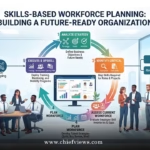
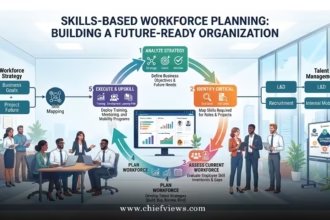
Five years ago, you could reach the CHRO seat with deep HR expertise and solid people skills. That’s no longer the complete package. The HR leadership trends for CHROs shaping 2026 — from AI governance to skills-based workforce planning to board-level influence — mean that the CHRO of today needs to walk in as a business strategist who happens to own HR, not an HR expert who’s learning business on the job.
The kicker? According to SHRM’s 2026 CHRO Priorities and Perspectives survey of 129 CHROs, the top pressures hitting the role right now are economic uncertainty, rising labor costs, shifting workforce expectations, and accelerating AI adoption — all at the same time. That’s not an HR job description. That’s a C-suite mandate.
And the compensation reflects it. Salary.com (January 2026) reports a CHRO median base of $349,724, with Fortune 500 total compensation — including stock — reaching a median of $2.8 million per Equilar’s 2025 data. The top 50 CHROs by total comp reached a median of $4.2 million.
What I’d Do If I Were Building Toward CHRO in 2026
In my experience, the single biggest career accelerator isn’t the degree, the certification, or even the company name on your résumé. It’s documented, measurable impact on a business problem that mattered.
What usually happens is this: an HR professional accumulates credentials, titles, and years — but never owns something that made the CEO take notice. Don’t let that be your story.
If I were mapping this path today, I’d laser-focus on three things before competing for any CHRO role:
- One AI workforce initiative I personally led, with a documented outcome
- One enterprise transformation I owned end-to-end — integration, restructuring, or culture change at scale
- A board-level presentation I delivered — or at minimum, contributed substantially to
Those three experiences, paired with an understanding of where HR leadership is headed, will do more for your CHRO candidacy than any single credential.
Key Takeaways
- The CHRO career path typically spans 18–25 years of progressive HR and/or business leadership. Average hire age is 45.8, per Korn Ferry 2025.
- There are four proven feeder routes — generalist, specialist-to-crossover, general management, and international — and more than half of recent CHROs didn’t follow the traditional ladder alone.
- 77% of sitting CHROs hold an advanced degree and 55%+ hold SHRM-SCP or SPHR certification — but credentials are table stakes, not differentiators.
- Transformation experience is non-negotiable. M&A integration, workforce restructuring, and large-scale organizational change are what executive search firms actually screen for.
- AI fluency is the new baseline. 92% of CHROs anticipate increased AI workforce integration in 2026. Building that fluency now positions you ahead of the next wave of candidates.
- Internal promotions still dominate — 77% of first-time CHROs in 2025 were promoted from within, per Russell Reynolds Associates.
- The CHRO-CEO relationship is your most critical variable. 52% of CHROs turn over within 12 months of a CEO transition. Strategic alignment with your CEO isn’t just good politics — it’s career infrastructure.
- Compensation has grown dramatically. S&P 500 CHRO pay grew 30.4% between 2024 and 2025 — the fastest-growing C-suite role — confirming that boards are treating this seat as a true strategic asset.
The path to CHRO has never been more demanding. And never more worth it. The role sits at the intersection of technology, strategy, and human capability — and the organizations that get it right are building competitive advantages that are genuinely hard to copy.
If you’re reading this and you’re two or three roles away from the seat, your next move is simple: stop collecting credentials and start owning outcomes. Pick the transformation no one else wants to touch, deliver it with business-level results, and make sure the right people see the work.
That’s how you build a CHRO career that doesn’t just arrive — it commands.
Frequently Asked Questions
Q: What is the fastest route on the CHRO career path for someone starting in HR today?
There’s no single “fastest” route — but the general management crossover path is increasingly rewarding candidates who move quickly. Spending 5–7 years in HR, then deliberately rotating into a business unit or finance role before returning to HR at a senior level, signals cross-functional business acumen that boards specifically want. Combine that with an AI or analytics credentialing project and you’re ahead of most traditional-track candidates of the same age.
Q: Do you need an MBA to become a CHRO?
Not necessarily. While 35% of recently appointed CHROs hold MBAs (per hrdegree.org’s 2026 CHRO Career Guide), the SHRM-SCP or SPHR certification often carries comparable weight — especially in mid-market environments. The real differentiator isn’t the degree; it’s the demonstrated ability to operate as a business leader, not just an HR expert. An MBA helps frame that, but it doesn’t replace transformation experience or strategic credibility.
Q: How do current HR leadership trends for CHROs affect what I should be building toward right now?
Significantly. The HR leadership trends for CHROs defining 2026 — particularly AI governance, skills-based workforce planning, and board-level influence — are reshaping what search firms and CEOs look for when hiring into this role. Aspiring CHROs who are building AI literacy, getting involved in workforce transformation projects, and developing executive relationships now will be positioned ahead of candidates who are still treating HR as a purely functional discipline. The CHRO seat increasingly goes to the person who can walk into the boardroom with a workforce thesis — not just an HR update.