





AI readiness for CIOs isn’t just a tech question anymore; it’s a business survival question. If you’re running a company in Dubai, you’re already hearing about AI in boardrooms, investor meetings, and casual coffee chats—but you might still be wondering whether your business is actually ready to use it in a meaningful way.
At the same time, your CIO or tech lead may be focused on tools and platforms, while you’re thinking about growth, costs, and risk. Bridging that gap is where real value happens.
In this article, we’re going to be taking a look at AI readiness for CIOs, and how you can turn technical decisions into real business outcomes. If you would like to find out more, feel free to read on.
Pic – CC0 License
What AI readiness for CIOs really means for your business
When we talk about AI readiness for CIOs, we’re not talking about buying one more shiny system or chasing hype. We’re talking about whether your business is practically set up to use AI in ways that drive revenue, improve customer experience, and reduce friction.
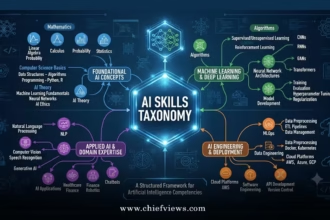
At a basic level, AI readiness has four pillars: clear business goals, usable data, the right talent, and responsible guardrails. A good CIO should be able to translate these into simple decisions you understand.


For you as an entrepreneur or owner, the key is this: AI readiness is not a technical checklist; it’s a strategic conversation. If your CIO can’t explain the AI plan in plain language that ties to your P&L, you’re not ready yet.
In Dubai, this matters even more because regulators, investors, and customers are watching how businesses use technology, not just whether they use it.
Start with business outcomes, not algorithms
AI readiness for CIOs Before you ask your CIO what AI tools they’re considering, we recommend you ask a different question: “What business problems are we trying to solve with AI?”
Common starting points that make sense for Dubai-based businesses include:
- Reducing manual work in back-office operations
- Improving customer response times in service-driven industries
- Better forecasting for inventory, cash flow, or demand
- Personalizing offers for retail, hospitality, and e‑commerce
Your CIO’s AI roadmap should be framed around these kinds of outcomes, not vague goals like “be more innovative.” Once the business outcomes are clear, it becomes much easier to decide whether you’re ready, what to prioritize, and how to measure success.
This is where you step in as the owner: you don’t need to understand the math, but you do need to challenge the business case.
Data: The quiet backbone of AI readiness for CIOs
If there is one area where AI readiness for CIOs is often overestimated, it’s data. Many companies in Dubai have multiple systems that don’t talk to each other, spreadsheets living on people’s laptops, and customer information scattered across tools.
AI doesn’t magically fix that. It magnifies whatever you already have. If your data is messy, incomplete, or siloed, your AI results will be weak or misleading.
Here’s what you should expect your CIO to be doing before any major AI rollout:
- Mapping where your core data lives (CRM, ERP, POS, payment gateways, etc.)
- Checking data quality—are fields complete, consistent, and up to date?
- Setting up secure, compliant ways to bring that data together
- Documenting which data can be used for AI, and under what conditions
This “data housekeeping” is not glamorous, but it saves you from bad decisions and reputational risk later. As the business leader, support your CIO by making data clean‑up a priority project, not an optional chore.
People and skills: Your CIO cannot do this alone
Even the best AI strategy will stall if only one person understands it. AI readiness for CIOs also means AI readiness for teams.
We suggest you look at three layers of skills inside your business:
- Leadership understanding: You and your senior team should understand basic AI concepts, opportunities, and limits. You don’t need to be experts, but you should be able to ask smart questions.
- Operational champions: Managers in finance, marketing, operations, and HR need enough context to spot where AI can help and to adopt new workflows without resistance.
- Technical execution: Your CIO’s team, or partners, should have hands-on skills in data engineering, cloud platforms, and the specific AI tools you plan to use.
If you’re based in Dubai, you have strong access to regional and global talent, but competition is fierce. Many companies blend in‑house teams with specialist partners to move faster. A good CIO will be honest about which skills you have, which you need to build, and where partnerships make sense.
Governance, risk, and trust: The invisible part of AI readiness
One of the biggest gaps we see in AI readiness for CIOs is around governance—clear rules for how AI is used, monitored, and improved over time. Without this, you’re flying blind.
You should be expecting your CIO to push for things like:
- Written guidelines on how employees can and cannot use generative AI
- Clear approval workflows for AI projects that touch customer data
- Regular reviews to check for bias, errors, or unexpected outcomes
- Compliance checks against local and international data protection laws
Global organizations such as the World Economic Forum and OECD publish accessible guidance on responsible AI that your CIO can use as reference points, especially helpful in a diverse, fast-moving market like Dubai.
From a business perspective, responsible AI is not just a legal issue; it’s a trust issue. If customers feel you’re careless with their data or decisions, AI becomes a liability instead of an asset.
Building a practical AI roadmap with your CIO
Once you understand the basics, you and your CIO should be able to build a simple, staged roadmap instead of betting everything on one big project.
Here’s a structure that works well for many growing businesses:
- Discovery phase
- Identify 3–5 priority use cases tied directly to revenue, cost, or experience.
- Assess data, systems, and skills for each use case.
- Pilot phase
- Launch small, low‑risk projects in one department or customer segment.
- Measure clear KPIs: time saved, errors reduced, revenue uplift, or NPS.
- Scale‑up phase
- Roll out winning pilots across the organization.
- Update processes, roles, and training accordingly.
- Review and refine
- Set a quarterly review with your CIO to refine the roadmap based on results and new opportunities.
This kind of roadmap keeps AI grounded in reality. It helps you avoid overspending on platforms you don’t use, while still moving quickly enough to keep up with competitors.
Dubai-specific angles: Regulation, ecosystem, and opportunity
Operating in Dubai gives you a few clear advantages when it comes to AI readiness for CIOs. Government initiatives around digital transformation, smart city projects, and innovation free zones have created a strong ecosystem of vendors, startups, and knowledge-sharing platforms.
At the same time, regulation around areas like data protection and financial services is getting tighter, not looser. This is good for long‑term trust, but it means your CIO must stay on top of local requirements and not just follow global templates.
We recommend you encourage your CIO to tap into local networks—industry events, chamber of commerce groups, and regional tech communities. These spaces often share practical case studies that are closer to your reality than generic global reports.
How you can support AI readiness as the business owner
AI readiness is often treated like a technical project that IT must “handle.” In practice, it works best when you, as the owner or founder, play an active role.
You can support your CIO by:
- Giving clear direction on which business outcomes matter most
- Protecting time and budget for foundational work like data clean‑up
- Backing training programs so teams are not afraid of AI tools
- Rewarding experimentation, as long as it’s within agreed guardrails
When your leadership sends a consistent message—“AI is here to help us, not replace us, and we will use it responsibly”—your CIO’s job becomes much easier and adoption happens faster.
Bringing it all together
We hope that you have found this article enlightening in some way, and that AI readiness for CIOs feels less abstract and more manageable. You don’t need to become a technologist to lead your company into an AI-enabled future—you just need to ask the right questions, insist on clear links to business value, and back your CIO with the support they need.
For entrepreneurs and business owners in Dubai, this is a moment of opportunity. If you treat AI readiness as a shared responsibility between you and your CIO, you can move faster than competitors who are still stuck in either fear or hype. And as you roll out AI step by step—grounded in good data, strong skills, and responsible governance—you’ll be building not just smarter systems, but a stronger, more resilient business.