



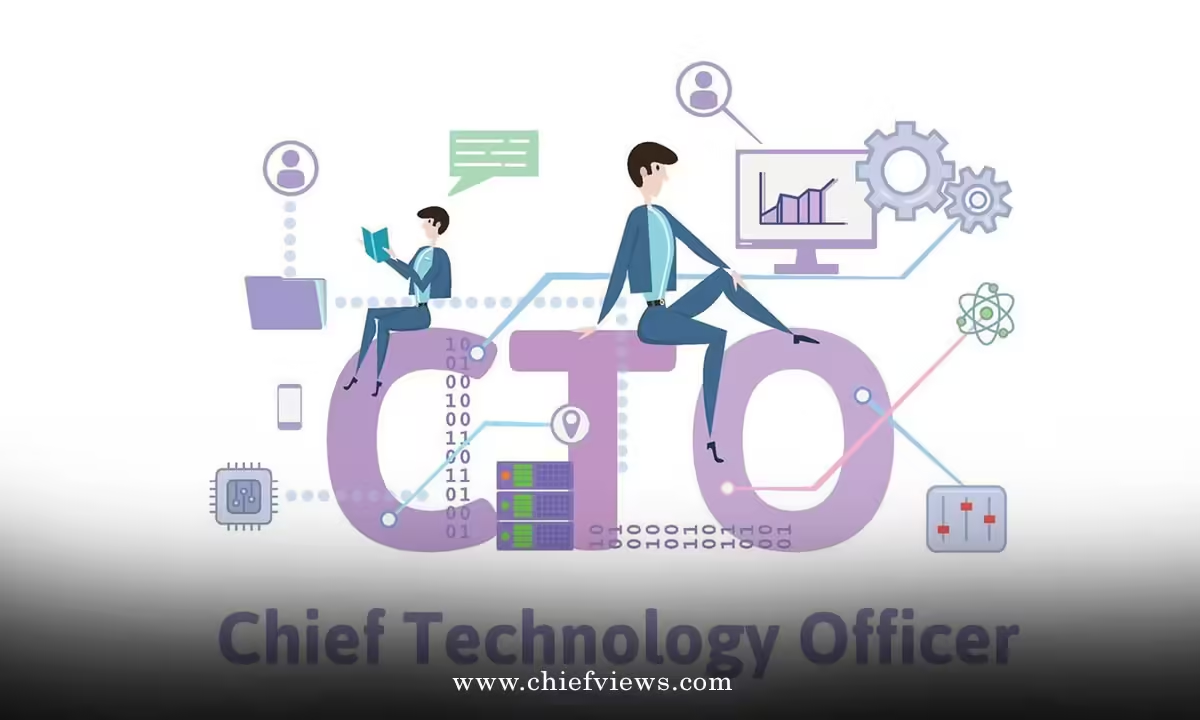
CTO roadmap for enterprise AI adoption and scaling 2026 is about turning AI from hype into a repeatable, governed, revenue-driving capability across your entire organization — not just a few cool pilots. If you’re a CTO or technical leader trying to build something that still works three years from now, not just three quarters from now, this is your blueprint.
Here’s the quick version of what a solid CTO roadmap for enterprise AI adoption and scaling 2026 looks like and why it matters:
- Align AI with 3–5 clear business outcomes, not “innovation theater.”
- Stand up a secure, compliant AI platform (data, models, guardrails) before chasing use cases.
- Start with 3–7 high-ROI pilots, then industrialize what works with MLOps and platform thinking.
- Build an “AI operating model”: governance, policies, roles, and skills for the whole enterprise.
- Treat AI as a product portfolio, continuously improved, not a one-off project list.
What the CTO roadmap for enterprise AI adoption and scaling 2026 actually is
At a practical level, a CTO roadmap for enterprise AI adoption and scaling 2026 is:
- A prioritized sequence of capabilities (people, process, tech) you’ll build.
- A set of guardrails so AI is safe, compliant, and reliable.
- A portfolio of AI products tied to tangible business metrics.
In my experience, when AI programs fail, it’s not because the models are bad. It’s because the roadmap is fuzzy, governance is missing, or the tech stack is a patchwork of one-off experiments.
Think of this roadmap like urban planning for AI in your company. You’re not just dropping random buildings; you’re designing roads, utilities, zoning, and services so the whole city can grow without collapsing under its own weight.


Quick reference: CTO roadmap for enterprise AI adoption and scaling 2026 at a glance
Here’s a compact view of the phases and what they typically involve.
| Phase | Primary Goal | Key Activities | Typical Timeframe |
|---|---|---|---|
| 1. Strategy & Alignment | Define why AI matters for your business | Business outcomes, use-case portfolio, exec sponsorship | 4–8 weeks |
| 2. Data & Platform Foundations | Make data usable and AI-ready | Data platform, security, model access, observability | 3–9 months (parallelized) |
| 3. Pilot & Prove Value | Show measurable impact with 3–7 use cases | Pilots, POCs, user testing, ROI / risk assessment | 3–6 months |
| 4. Industrialize & Scale | Turn pilots into products | MLOps, GenAI ops, integration, SLAs, change management | 6–18 months (rolling) |
| 5. AI Operating Model | Embed AI into how the org works | Governance, roles, training, policies, KPIs | Ongoing |
Phase 1: Strategy — anchor AI to business outcomes
Why this comes first
Without ruthless prioritization, AI turns into a showcase of cool demos that never hit production. What usually happens is every business unit pitches AI ideas, your backlog explodes, and nothing gets properly funded or supported.
Here’s how to keep control.
How to define your AI north star
Use the CTO roadmap for enterprise AI adoption and scaling 2026 to answer three blunt questions:
- What 3–5 business outcomes are non-negotiable for the next 24–36 months?
Think: margin expansion, customer retention, faster product release cycles, lower fraud loss, reduced support volume. - Where can AI change the curve, not just create incremental gain?
Examples:- Generative AI copilots to shrink time-to-quote.
- Predictive models for churn, fraud, or maintenance.
- Recommendation systems for upsell and personalization.
- How will you measure success?
Tie every AI initiative to clear metrics: revenue, cost, risk, or customer experience. No metric, no project.
A good sanity check is to cross-reference your internal priorities with reputable market signals. For instance, major industry surveys by organizations like McKinsey and the World Economic Forum highlight AI’s outsized impact in areas like sales enablement, supply chain optimization, and customer service automation.
Phase 2: Build the AI-ready data and platform foundation
The unglamorous work that makes or breaks you
Here’s the thing: if your data is fragmented, undocumented, or locked in legacy systems, scaling AI will be painful. Most enterprises underestimate this.
Your goal in this phase is to stand up an AI platform that gives you:
- Controlled access to high-quality data.
- Safe access to models (proprietary, open-source, and commercial).
- Standard ways to monitor, log, and govern AI behavior.
Core components of an AI platform in 2026
As part of a CTO roadmap for enterprise AI adoption and scaling 2026, a practical stack usually includes:
- Data platform & governance
- Cloud data warehouse or lakehouse (e.g., Snowflake, BigQuery, Databricks).
- Data catalog, lineage, and quality monitoring.
- Role-based access control aligned to security frameworks such as NIST cybersecurity standards from the National Institute of Standards and Technology.
- Model and AI services layer
- Access to foundational models (OpenAI, Anthropic, etc.), plus open-source LLMs where you need more control.
- Traditional ML infrastructure (feature store, model registry).
- Vector databases or embeddings store for retrieval-augmented generation (RAG).
- Security, compliance, and risk controls
- Content filtering and safety policies.
- Data loss prevention and PII handling.
- Compliance alignment with regulations and guidance, for example, from the U.S. White House AI policy and the European Commission’s AI-related directives.
- Integration and developer experience
- APIs and SDKs so product teams can embed AI into existing apps.
- CI/CD pipelines tailored for ML and GenAI.
- Observability: tracing, logging, and monitoring for latency, cost, and drift.
My advice: don’t over-engineer on day one. Start with the minimum viable platform that supports your first 3–7 use cases, then harden and extend as those scale.
Phase 3: Pilot the right use cases — fast, but not reckless
How to choose your first AI use cases
A strong CTO roadmap for enterprise AI adoption and scaling 2026 starts small but strategic. If I were in your chair, I’d pick use cases that:
- Have clear owners and obvious users.
- Use data you already trust.
- Can show real business impact inside 90–180 days.
- Carry manageable regulatory and reputational risk.
Typical starter use cases in U.S. enterprises right now:
- Customer support copilots for agents.
- Internal knowledge assistants for engineering, legal, or HR.
- Code generation helpers (with guarded workflows).
- Document processing and summarization for contracts, invoices, and reports.
- Forecasting and recommendations in sales or operations.
Guardrails for pilots
Don’t let pilots become shadow IT. Bake in a few non-negotiables:
- Human-in-the-loop for any high-stakes decisions.
- Clear data classification and access rules.
- Logging of prompts, responses, and key decisions (with privacy safeguards).
- Basic red-teaming for prompt injection, data exfiltration, and harmful content.
Authoritative organizations like the OECD and major cloud vendors offer responsible AI guidelines and playbooks you can adapt to your governance baseline rather than starting from scratch.
Phase 4: From pilots to production — industrialize and scale
Here’s where a lot of programs stall. Pilots work. Everyone is excited. Then the engineering reality hits: scaling one-off notebooks into enterprise-grade products is hard.
What “industrialization” actually means
For a mature CTO roadmap for enterprise AI adoption and scaling 2026, productionization usually includes:
- MLOps and GenAI ops
- Automated training, deployment, and rollback.
- Versioning for models, prompts, and RAG configs.
- Canary releases and A/B testing.
- SLAs and performance management
- Defined SLAs for latency, uptime, and response quality.
- SLOs for hallucination rates, false positives/negatives, or accuracy.
- Capacity and cost controls (e.g., max tokens, rate limits).
- Integration into core systems
- Embed AI into CRM, ERP, ticketing, and internal tools.
- Event-driven architectures so AI can trigger or respond to workflows.
- Clear ownership: who fixes things when they break?
- Risk and compliance at scale
- Periodic model risk reviews.
- Policy enforcement for data usage and retention.
- Alignment with sector-specific rules (e.g., HIPAA in healthcare, FFIEC guidance for financial services in the U.S.).
The kicker is: you’re not just scaling technology; you’re scaling trust. Users, regulators, and executives all need to believe these systems behave predictably.
Phase 5: Build the AI operating model around your roadmap
You can’t bolt AI onto a traditional organization and expect magic. The CTO roadmap for enterprise AI adoption and scaling 2026 needs a supporting operating model.
Key pieces of an AI operating model
- Organizational structure
- Central AI platform team (or Center of Excellence) providing shared services.
- Embedded AI/ML and data engineers in product or business squads.
- Clear RACI for data ownership, model ownership, and incident response.
- Governance & policy
- AI ethics and risk committee with cross-functional representation.
- Policies for generative AI usage, IP protection, and third-party tools.
- Approval pathways for high-risk AI deployments.
- Skills & talent
- Upskilling programs for engineers and business users.
- Hiring for ML engineers, data scientists, prompt engineers, and AI product managers.
- Partnerships with universities or reputable training providers to stay ahead of the curve.
- Measurement & incentives
- KPIs tied to AI impact, not just model performance.
- Incentives for responsible use, documentation, and reuse of components.
- Portfolio review cadence (quarterly works well) to prune dead-end initiatives.
Without this operating model, even the best technical roadmap has a ceiling.

Step-by-step action plan for beginners
If you’re earlier in the journey, here’s a simple, executable CTO roadmap for enterprise AI adoption and scaling 2026 you can start on Monday.
Step 1: Identify 3–5 business outcomes
- Sit down with your CEO, CFO, and a few business leaders.
- Lock in the top outcomes AI should support for the next 12–24 months.
- Write them down, rank them, and socialize them.
Step 2: Build a use-case shortlist
- Collect AI ideas from across the business, but score them on:
- Business impact.
- Data readiness.
- Technical feasibility.
- Risk level.
- Shortlist 5–10 use cases; pick 3–7 to pilot.
Step 3: Stand up a minimal AI platform
- Choose your primary cloud and data platform.
- Establish data access controls and logging.
- Integrate with at least one foundation model provider and one open-source option.
- Document a simple “AI project intake and approval” process.
Step 4: Deliver your first pilots
- Assemble small, cross-functional teams: product, engineering, data, and business.
- Time-box pilots (8–12 weeks).
- Define success metrics up front and track them weekly.
- Involve real end-users early and often.
Step 5: Decide what to scale
- For each pilot, decide: scale, pivot, or kill.
- For “scale” decisions:
- Harden the stack (MLOps/GenAI ops).
- Integrate with production systems.
- Define SLAs and support processes.
Step 6: Formalize governance and operating model
- Create an AI steering committee.
- Draft and approve AI usage and risk policies.
- Launch training for developers and business users on safe, effective AI usage.
If you follow this in sequence, you get fast wins without creating unmanageable risk or tech debt.
Common mistakes in a CTO roadmap for enterprise AI adoption and scaling 2026 — and how to fix them
Mistake 1: Chasing tech trends instead of business value
- Symptom: Lots of POCs, no production wins.
- Fix: Only fund AI initiatives with clear business owners and metrics. Treat “coolness” as a nice-to-have, not a driver.
Mistake 2: Ignoring data quality and governance
- Symptom: Models behave unpredictably, stakeholders lose trust.
- Fix: Invest early in data cataloging, lineage, and quality monitoring. Make data ownership explicit.
Mistake 3: Over-centralizing everything
- Symptom: Central AI team becomes a bottleneck; shadow AI pops up everywhere.
- Fix: Centralize the platform and governance, decentralize use-case development with guardrails and shared tooling.
Mistake 4: Underestimating security and compliance
- Symptom: Last-minute security vetoes, legal blockers, or regulator scrutiny.
- Fix: Involve security, legal, and compliance from day one. Align to known standards such as NIST and sector regulations, and maintain clear audit trails.
Mistake 5: No plan for ongoing maintenance
- Symptom: Models drift, costs spike, and no one “owns” fixes.
- Fix: Assign product owners to AI systems. Set budgets and schedules for retraining, refactoring, and continuous improvement.
Mistake 6: Forgetting the people side
- Symptom: Users bypass AI tools or reject them outright.
- Fix: Include change management, training, and feedback loops. Treat AI adoption like any major product roll-out, not like a lab experiment.
How to future-proof your CTO roadmap for enterprise AI adoption and scaling 2026
AI in 2026 is moving fast, but a few principles hold steady:
- Model-agnostic architecture
Design your platform so you can swap models as better options appear or regulations change. - Data as the durable asset
Models come and go. Your governed, well-labeled, high-quality data remains your edge. - Human oversight as a constant
For high-impact decisions, keep humans in control. Automate confidently, but verify where risk is material. - Continuous education
Commit to ongoing training. Technical and non-technical teams both need to understand what AI can and cannot do. - Transparent communication
Internally and externally, be clear about when AI is used, what it does, and how issues get resolved.
Key Takeaways
- A strong CTO roadmap for enterprise AI adoption and scaling 2026 starts with business outcomes, not model choices.
- Your AI platform (data, security, model access) is the backbone; don’t skip or minimize it in the rush to show demos.
- Pick 3–7 pragmatic use cases, prove value fast, then industrialize what works using MLOps and GenAI ops practices.
- Build an AI operating model — governance, roles, policies, and training — so AI becomes part of how the organization runs.
- Avoid common traps: tech-first thinking, weak data governance, centralized bottlenecks, and ignoring risk and compliance.
- Treat AI initiatives as products with owners, SLAs, and continuous improvement, not as one-off projects.
- Design for change: be model-agnostic, data-centric, and ready to adapt as regulations and capabilities evolve.
- The payoff is an enterprise that doesn’t just “use AI,” but competes and innovates through AI at scale.
FAQs
1. How detailed should a CTO roadmap for enterprise AI adoption and scaling 2026 be for a mid-sized U.S. enterprise?
You want enough detail to define phases, capabilities, owners, and milestones, but not so granular that it becomes a rigid Gantt chart. Typically, a 12–24 month CTO roadmap for enterprise AI adoption and scaling 2026 outlines major initiatives per quarter, target outcomes, accountable leaders, and key dependencies across data, platform, use cases, and governance.
2. How does regulation affect a CTO roadmap for enterprise AI adoption and scaling 2026 in the U.S.?
Regulation shapes your guardrails and risk posture more than your innovation agenda. A solid CTO roadmap for enterprise AI adoption and scaling 2026 bakes in data protection, model transparency, and auditability from day one, and aligns with guidance from organizations such as NIST and federal AI policy frameworks so you’re not retrofitting compliance later under pressure.
3. What skills are most important to support a CTO roadmap for enterprise AI adoption and scaling 2026?
You’ll need a blend of ML engineers, data engineers, software engineers familiar with MLOps/GenAI ops, and AI product managers who can translate business needs into AI capabilities. Equally important is upskilling existing teams so they can safely use and extend AI solutions aligned with your CTO roadmap for enterprise AI adoption and scaling 2026.