



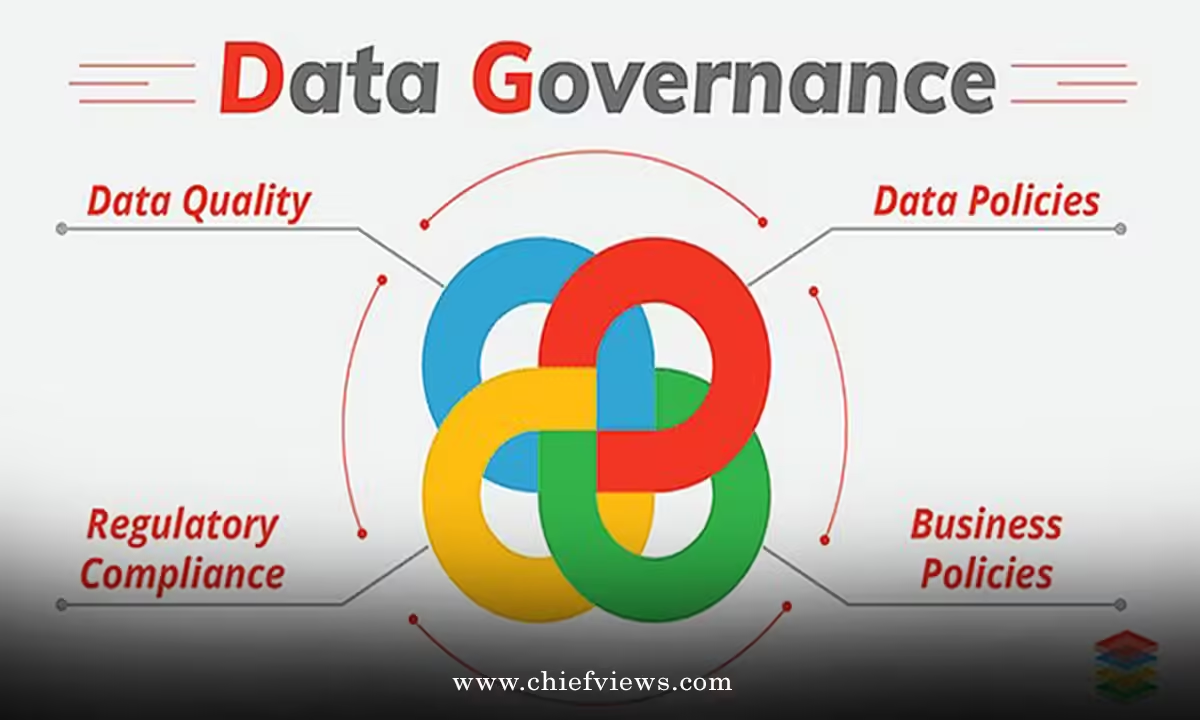
Enterprise data governance framework is the quiet force-multiplier behind every serious AI, analytics, and automation program. If your data is chaos, your AI roadmap is fantasy. It’s that simple.
Before you obsess over models and copilots, you need a governance spine that makes data discoverable, trustworthy, secure, and compliant across the enterprise. That’s what this guide lays out.
Quick summary: What is an enterprise data governance framework?
- It’s the operating system for how data is defined, owned, secured, and used across your company.
- It aligns people, processes, and technology so data is accurate, timely, and usable for analytics and AI.
- It defines roles (owners, stewards, custodians), policies (access, quality, retention), and standards (naming, metadata, classifications).
- It’s essential for meeting regulatory requirements (think GDPR, CCPA, HIPAA, sector rules) and passing audits.
- It’s the backbone for executing a serious CTO roadmap for enterprise AI adoption and scaling 2026 without constant fire drills.
Why your enterprise data governance framework matters more than your latest AI pilot
Here’s the ugly truth from years of watching data and AI programs stall: most “AI failures” are really governance failures in disguise.
- Data is duplicated, conflicting, or undocumented.
- No one knows who owns what.
- Legal and security panic whenever a new AI use case appears.
- Business teams don’t trust the numbers, so adoption dies on the vine.
A strong enterprise data governance framework fixes this by:
- Giving you clear ownership and accountability for data.
- Making it possible to reuse data safely across multiple use cases.
- Letting you say “yes” to AI faster because the rules are already agreed and codified.
If you want your AI and analytics roadmap to scale, governance isn’t overhead. It’s your enabler.


Core components of a modern enterprise data governance framework
A good framework isn’t a 120-page PDF collecting dust. It’s a living system built around a few core pillars.
1. Data governance organization & roles
You need people. Not just tools.
Typical structure:
- Data Governance Council
Cross-functional leadership (IT, security, legal, operations, finance, key business units). Sets direction, resolves conflicts, approves major policies. - Chief Data Officer (CDO) / Head of Data Governance
Owns the framework, reports into the C-suite or close to it, and acts as the tie-breaker for data priorities. - Data Owners
Senior leaders accountable for specific domains (e.g., Customer, Product, Finance). - Data Stewards
Operational guardians of data quality, definitions, and usage in their domain. - Data Custodians / Engineering
Implement the technical controls: access, encryption, lineage, monitoring.
Without roles, “data governance” is just a meeting invite.
2. Data policies & standards
Policies are your guardrails. Standards are your shared language.
Key policy areas:
- Data classification (public, internal, confidential, restricted).
- Access and usage (who can use what, and for which purposes).
- Data quality rules (completeness, validity, timeliness, consistency).
- Retention & deletion (how long you keep data, and how you dispose of it).
- Third-party data & sharing (vendors, partners, cross-border transfers).
Standards typically include:
- Naming conventions and business glossaries.
- Metadata requirements (what must be documented for each dataset).
- Reference data and master data definitions.
Regulators and standards bodies like the U.S. National Institute of Standards and Technology (NIST) and data protection laws such as GDPR or CCPA give you strong starting points for building these policies and standards in a compliant way.
3. Data quality management
If your data is unreliable, your dashboards and models are fiction.
A solid enterprise data governance framework treats data quality as a continuous process, not a one-time cleanup:
- Define quality dimensions: accuracy, completeness, consistency, timeliness, uniqueness.
- Establish thresholds and SLAs for key datasets.
- Implement automated data quality checks and alerts.
- Assign stewards to review, triage, and fix recurring issues.
You don’t need perfection everywhere. You need high reliability where it actually matters for decisions and AI.
4. Metadata, cataloging, and lineage
Imagine trying to run a factory without knowing what’s on each conveyor belt. That’s what operating without metadata feels like.
Key capabilities:
- Data catalog so users can discover datasets, understand fields, and see who owns them.
- Business glossary to keep terminology consistent across departments.
- Lineage to trace where data came from, how it was transformed, and which reports or models depend on it.
This isn’t just convenience. Lineage is gold when auditors, regulators, or executives start asking “Where did this number come from?” or “Which systems will break if we change this field?”
5. Security, privacy, and compliance
Security and privacy are non-negotiable pillars of any serious enterprise data governance framework.
Core practices:
- Role-based and attribute-based access control.
- Encryption at rest and in transit.
- Data masking and tokenization for sensitive fields.
- Privacy impact assessments for high-risk processing.
- Alignment with regulatory requirements (e.g., HIPAA in healthcare, PCI DSS in payments).
Government and public-sector guidance, such as resources from USA.gov and dedicated regulatory websites, provide concrete rules and frameworks you must consider depending on your industry and data types.
6. Data lifecycle management
Data has a life: creation → usage → archival → deletion.
Governance should define:
- Where and how data is captured.
- How it’s validated and enriched.
- When it’s archived or anonymized.
- When and how it’s permanently deleted.
Done right, this reduces storage bloat, security exposure, and compliance risk.
How enterprise data governance powers your AI and analytics roadmap
Here’s where things connect: your enterprise data governance framework is what makes your CTO roadmap for enterprise AI adoption and scaling 2026 actually executable.
Without governance:
- RAG (retrieval-augmented generation) crawls messy, conflicting content.
- LLMs see sensitive data they shouldn’t.
- Models trained on low-quality inputs give low-quality outputs.
- Legal blocks or slows key AI initiatives.
With governance:
- You know which datasets are “AI-ready.”
- You can grant and revoke access quickly with confidence.
- You have documented lineage and policies to show regulators and auditors.
- You can scale AI use cases across domains without reinventing the rules every time.
AI success isn’t about having the “best model.” It’s about having governed, high-quality data and a consistent way to use it.
Comparison table: Ad hoc data vs governed data
Here’s a quick side-by-side to show what changes when an enterprise data governance framework is in place.
| Aspect | Ad Hoc Data Management | Governed Data Framework |
|---|---|---|
| Ownership | Unclear; “IT problem” | Named owners and stewards per domain |
| Data Quality | Reactive fixes, lots of manual cleanup | Defined rules, automated checks, SLAs |
| Discovery | Tribal knowledge, spreadsheets, email | Data catalog, glossary, documented lineage |
| Security & Privacy | Inconsistent; access often too broad | Policies, access controls, masking, audits |
| Compliance | Scramble during audits, high risk | Policy-driven, auditable, easier evidence |
| AI & Analytics | Pilots struggle, low trust, slow approvals | Reusable, trusted data for scalable AI |
Step-by-step: How to build an enterprise data governance framework
You don’t need a three-year transformation plan before anything works. Start small and expand.
Step 1: Define scope and priority domains
- Identify 3–5 critical data domains (e.g., Customer, Product, Finance, HR).
- Prioritize based on business impact, risk, and AI/analytics needs.
- Start your governance rollout with those domains instead of trying to boil the ocean.
Step 2: Stand up the governance organization
- Appoint a sponsor (CDO, CIO, or CTO) with real authority.
- Form a Data Governance Council with key business and risk leaders.
- Nominate data owners and stewards for priority domains; make their responsibilities explicit.
Step 3: Create and approve core policies
Focus on a small, powerful set first:
- Data classification policy.
- Access and usage policy.
- Data quality policy.
- Retention and deletion policy.
Keep them plain-language and actionable. Overly theoretical policies get ignored.
Step 4: Implement tooling and processes
You don’t need every tool on the market. You do need:
- A data catalog or metadata platform.
- Access control integrated with your identity systems.
- Data quality monitoring and issue management.
- Basic lineage tracking for critical pipelines.
Then define repeatable processes for:
- Onboarding new data sources.
- Approving access requests.
- Logging and resolving data issues.
Step 5: Integrate with AI and analytics initiatives
Here’s where you tie it directly to your broader tech strategy:
- Require data governance review for any high-impact AI project.
- Tag datasets used by AI use cases as “AI-critical” and apply stricter quality and lineage standards.
- Coordinate with your CTO roadmap for enterprise AI adoption and scaling 2026 so that governance milestones and AI milestones move in lockstep.
Step 6: Measure, iterate, and expand
Good governance is iterative:
- Track metrics: number of governed datasets, quality scores, time-to-approve access, audit findings.
- Gather feedback from data consumers and AI product teams.
- Extend governance to more domains and systems as your maturity grows.
Common mistakes and how to avoid them
Mistake 1: Treating governance as a one-time project
Governance is ongoing. Regulations change, systems evolve, data grows.
Fix: Frame it as a continuous program with annual goals, not a one-off initiative.
Mistake 2: Making governance purely IT-driven
If it’s “an IT thing,” business won’t own it, and adoption will be weak.
Fix: Put business leaders in data owner roles and make governance decisions cross-functional.
Mistake 3: Over-engineering policies and under-delivering value
Thick policy docs + no visible improvement = guaranteed resistance.
Fix: Start with a minimum set of policies and immediately tie them to real use cases (e.g., faster AI approvals, fewer report discrepancies).
Mistake 4: Ignoring security and privacy until late
Security and legal blockers will surface eventually. Usually when it’s most inconvenient.
Fix: Involve security, privacy, and compliance from day one when defining your enterprise data governance framework.
Mistake 5: No link to AI and analytics strategy
Governance becomes abstract overhead if not connected to outcomes.
Fix: Explicitly connect your framework to your analytics strategy and your CTO roadmap for enterprise AI adoption and scaling 2026 so value is obvious.
How to get started this quarter
If you’re starting from almost zero, here’s what I’d do in the next 90 days:
- Name a sponsor and create a lightweight Data Governance Council.
- Pick two domains (e.g., Customer and Finance) and assign owners and stewards.
- Draft and approve 3 core policies: classification, access, and quality.
- Introduce a basic data catalog and start documenting high-value datasets.
- Pilot governance on one AI or analytics initiative and use the learnings to refine your framework.
You don’t need perfection. You need momentum plus clear ownership.
Key takeaways
- An enterprise data governance framework is the operating system for how data is defined, owned, secured, and used across your organization.
- It combines roles, policies, standards, and tooling to make data reliable, discoverable, and compliant.
- Strong governance is a prerequisite for scalable AI and analytics, tightly linked to your CTO roadmap for enterprise AI adoption and scaling 2026.
- Start with a small set of domains, a clear governance organization, and a handful of practical policies, then iterate.
- Avoid common traps: IT-only ownership, heavy documentation with no visible value, and bolting on security and privacy at the end.
- Governance is not bureaucracy for its own sake; it’s what lets you say “yes” faster to high-impact data and AI use cases without losing sleep over risk.
FAQ :
Q1: What is an Enterprise Data Governance Framework?
A: An Enterprise Data Governance Framework is a structured system of policies, processes, roles, responsibilities, and technologies that ensures data is managed effectively across its lifecycle. It focuses on data quality, security, compliance, accessibility, and alignment with business goals.
Q2: What are the key components of a strong Enterprise Data Governance Framework?
A: Core components typically include data stewardship and ownership roles, data quality standards, security and privacy policies, metadata management, compliance procedures, and technology enablers. Popular models include DGI, DAMA-DMBOK, and PwC frameworks.
Q3: What are the main benefits and best practices for implementing an Enterprise Data Governance Framework?
A: Benefits include improved data quality, regulatory compliance, reduced risks, and better decision-making. Best practices: start small with high-value data domains, assign clear roles, automate where possible, ensure cross-functional collaboration, and measure success with defined metrics.