




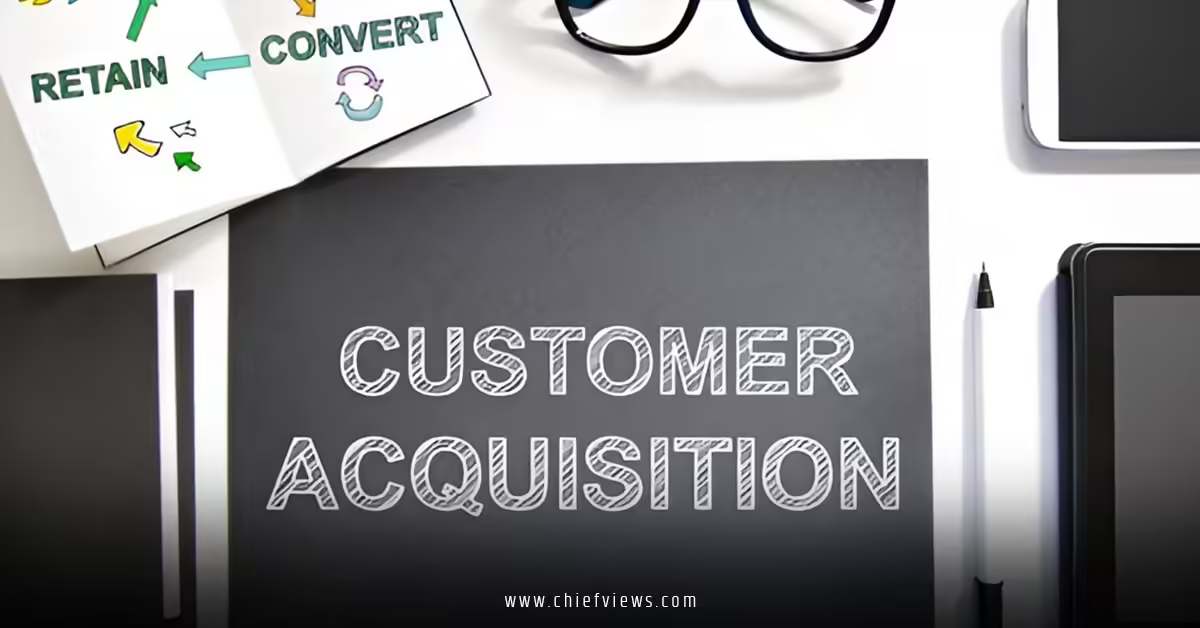
Customer acquisition cost optimization for CMOs isn’t some abstract exercise—it’s the difference between scaling profitably and burning cash on customers who never stick around long enough to matter.
Customer acquisition cost optimization for CMOs means systematically lowering the total sales and marketing spend required to bring in a new paying customer while protecting—or even improving—quality and lifetime value. In 2026, with ad platforms more competitive, privacy rules tighter, and buyer journeys more fragmented, getting this right keeps your margins healthy and your board happy.
Here’s why it matters right now:
- Rising costs hit hard. Paid channels have seen jumps of 40-60% in recent years, making efficiency non-negotiable.
- LTV:CAC balance rules everything. A healthy ratio (typically at least 3:1) ensures every dollar spent on acquisition eventually returns multiple times over.
- Retention compounds savings. Cheaper to keep customers than chase new ones, especially when organic and referral channels kick in.
- Data and AI give real leverage. Tools for better targeting and personalization can cut waste without slashing volume.
You calculate basic CAC like this: divide all relevant sales and marketing expenses (ads, salaries, tools, overhead tied to acquisition) by the number of new customers acquired in that period. Simple on paper. Messy in practice because attribution gaps and hidden costs creep in.
What customer acquisition cost optimization for CMOs actually looks like in 2026
Forget chasing the absolute lowest CAC. The goal is sustainable, predictable acquisition that fuels growth without destroying unit economics.
CMOs who win here treat CAC as a diagnostic, not a vanity target. They segment it by channel, cohort, and customer type. They watch payback period—the time it takes to recover acquisition costs from a customer’s revenue. Shorter is almost always better for cash flow.

Key components to optimize:
- Marketing spend — Ads, content, events, SEO efforts.
- Sales costs — Team salaries, commissions, demos, CRM tools.
- Conversion efficiency — Landing pages, funnels, onboarding.
- Retention signals — Early indicators that predict higher LTV.
The kicker? Optimization isn’t one-and-done. Markets shift. Algorithms change. What worked last quarter can quietly inflate costs this one.
Why CAC optimization deserves your attention as a CMO
Your marketing budget isn’t infinite. Every dollar wasted on low-quality leads or channels that don’t convert means less room for experimentation or brand building.
In practice, teams that nail this see faster payback, healthier margins, and the confidence to scale. Those who ignore it? They hit growth walls or slash spend reactively, which tanks momentum.
Think of CAC like fuel efficiency in a car. You can floor it and guzzle gas, or tune the engine, choose better routes, and go farther on less. The second approach wins marathons.
How to calculate CAC accurately (the no-BS version)
Start simple, then layer in reality.
Basic formula:
CAC = (Total Sales + Marketing Costs) / Number of New Customers Acquired
Include:
- Ad spend across all platforms
- Content creation and distribution
- Marketing and sales team compensation (prorated)
- Tools and software directly tied to acquisition
- Any agency or partner fees for lead gen
Exclude pure brand awareness or retention-only activities unless they directly feed new customers.
For more precision, calculate by channel or cohort. Track over consistent time periods—monthly or quarterly works for most. Factor in attribution models that match your buyer journey. Multi-touch or data-driven models beat last-click in complex sales.
Pro tip from the trenches: Always calculate a “fully loaded” CAC. Under-counting sales time or tool costs makes your numbers look better than they are—and sets you up for nasty surprises.
Customer acquisition cost optimization for CMOs: Core strategies that deliver
1. Audit and segment your channels ruthlessly
Pull reports. Rank every channel by CAC, conversion rate, and LTV contribution.
You’ll usually find one or two channels quietly inflating the average. Cut or fix them fast. Shift budget toward winners—often organic search, referrals, or high-intent paid tactics.
In my experience, teams that segment by customer type (SMB vs enterprise, for example) uncover huge differences. What works for low-ACV customers can destroy margins on high-value ones.
2. Tighten targeting and personalization
Broad audiences waste money. Use first-party data, predictive segmentation, and AI-powered lookalikes to reach people more likely to convert and stay.
Advanced personalization—dynamic creative, tailored messaging—can improve relevance dramatically. Some reports note potential CAC reductions when relevance hits every touchpoint, though results vary by execution and industry.
Test creative relentlessly. Small lifts in click-through or conversion compound into meaningful CAC drops.
3. Obsess over conversion rate optimization (CRO)
A 10-20% better landing page or checkout flow directly lowers CAC without touching ad spend.
Map the customer journey. Find drop-offs. Fix friction with clearer copy, faster load times, trust signals, and streamlined onboarding. In 2026, AI tools help test variations at speed.
Remember: Traffic before conversion fixes is like filling a leaky bucket.
4. Build and nurture organic + owned channels
SEO and content marketing take time but deliver some of the lowest long-term CAC once momentum builds. Focus on intent-driven topics, not vanity traffic.
Email, SMS, and community nurture turn one-time visitors into repeat buyers and referrers. Inbound approaches have historically shown strong cost-per-lead advantages over pure outbound.
Referrals deserve special love—trust is built-in, and well-designed programs often post the lowest CAC of any channel.
5. Prioritize retention to boost effective LTV
Every extra month a customer stays improves the LTV side of the equation, making higher CAC tolerable or allowing you to spend less aggressively.
Post-purchase engagement, loyalty programs, and proactive success motions pay dividends. Retention-focused CMOs often reallocate budget from pure acquisition to lifecycle marketing.
Comparison Table: Common Channels and Typical Optimization Levers (2026 context)
| Channel | Typical CAC Range (varies widely by industry) | Key Optimization Tactics | Pros | Cons |
|---|---|---|---|---|
| Paid Search | Higher (often $200–$800+) | Bid management, negative keywords, landing page CRO | Intent-driven, measurable | Competitive, cost inflation |
| Social Ads (Meta/others) | Moderate to high | Audience segmentation, creative testing, retargeting | Scalable, visual storytelling | Ad fatigue, privacy limits |
| Organic Search (SEO) | Lower over time ($100–$500 once ranked) | Content clusters, technical optimization, EEAT signals | Compounding, low marginal cost | Slower ramp-up |
| Referrals | Often lowest | Incentive programs, easy sharing, tracking | High trust, quality leads | Depends on existing base |
| Email/SMS Owned | Very low for nurtured lists | Segmentation, automation, reactivation campaigns | Direct, high control | List building takes effort |
Step-by-Step Action Plan for customer acquisition cost optimization for CMOs
Beginners and intermediates: Follow this sequence. Don’t boil the ocean.
- Calculate your baseline CAC — Pull last 3-6 months of data. Break it down by channel and customer segment. Be honest about what counts as acquisition cost.
- Define success metrics — Set targets for CAC, LTV:CAC ratio (aim for at least 3:1), and payback period (shorter is better—target under 12 months for most models). Tie to business goals.
- Audit channels and journeys — Identify leaks. Where is spend highest relative to results? Map drop-offs in the funnel.
- Quick wins first — Fix obvious waste: pause underperforming campaigns, optimize bids, improve top 2-3 landing pages. Test one personalization tweak.
- Build testing rhythm — Run controlled experiments on creative, audiences, and offers. Measure incremental impact.
- Layer in retention — Launch or improve post-purchase flows. Track early engagement signals that predict LTV.
- Review and iterate monthly — Use dashboards. Reallocate budget based on data. Refresh content and creative regularly.
- Scale what works — Once you have proven levers, invest more confidently. Monitor for diminishing returns.
This isn’t theoretical. Start small, measure, adjust. What I’d do first as a veteran? Nail the baseline calculation and channel audit. Everything else flows from there.
Common mistakes in customer acquisition cost optimization (and how to fix them)
- Ignoring fully loaded costs — Only counting ad spend makes CAC look artificially low. Fix: Include prorated salaries and tools. Recalculate.
- Chasing volume over quality — Cheap leads that churn fast destroy economics. Fix: Score leads better and align acquisition with ideal customer profiles.
- Set-it-and-forget-it attribution — Last-click models lie in multi-touch worlds. Fix: Move toward data-driven or multi-touch models that reflect reality.
- Neglecting organic entirely — Paid feels faster until costs spike. Fix: Invest consistently in SEO and content as a hedge.
- Focusing only on CAC, not the ratio — Low CAC with terrible retention still fails. Fix: Always pair with LTV analysis and retention metrics.
- No testing discipline — Random changes without controls. Fix: A/B test with statistical significance and holdout groups where possible.
Avoid these, and you sidestep the biggest pitfalls I’ve seen sink marketing budgets.
Key Takeaways
- Customer acquisition cost optimization for CMOs centers on lowering efficient spend per new customer while strengthening LTV and payback.
- Accurate calculation requires including all relevant sales and marketing costs—don’t shortchange the math.
- Channel segmentation and CRO deliver some of the fastest, most reliable improvements.
- Balance paid with organic and owned channels for resilience against rising costs.
- LTV:CAC ratio (target ≥3:1) and payback period matter more than raw CAC alone.
- Retention and personalization are powerful multipliers in 2026.
- Regular audits and testing prevent silent cost creep.
- Start with baseline data and quick wins before scaling.
Conclusion
Customer acquisition cost optimization for CMOs isn’t about squeezing every penny until growth stalls. It’s about building a smarter, more resilient acquisition engine that supports sustainable scaling in a tougher environment.
Get the fundamentals right—accurate tracking, channel discipline, conversion focus, and LTV awareness—and you’ll free up budget for innovation instead of damage control.
Next step: Pull your latest CAC numbers this week and run that channel audit. Small clarity compounds fast.
FAQs
What is the ideal LTV:CAC ratio for most businesses in 2026?
Most experts target at least 3:1, with stronger performers aiming for 4:1 or higher. This ensures acquisition costs are recovered multiple times over the customer’s lifetime. Adjust based on your industry, margins, and growth stage—faster payback often matters more for cash flow.
How often should CMOs recalculate CAC?
Monthly or quarterly is practical for most teams. More frequent reviews during campaign launches or major platform changes help catch issues early. Always use consistent time periods and definitions.
Does customer acquisition cost optimization for CMOs require AI tools?
Not required, but AI helps with segmentation, bidding, creative testing, and personalization at scale. Start with strong fundamentals and data hygiene—tools amplify results when the basics are solid.
Can improving retention lower CAC indirectly?
Yes. Higher retention boosts LTV, which improves your ratio and payback even if raw CAC stays flat. It also fuels referrals and organic growth, reducing reliance on expensive paid channels over time.
What’s the biggest quick win for lowering CAC?
Auditing channels and pausing or optimizing the worst performers. Many teams discover 20-30% of spend delivers disproportionately poor results. Reallocating that budget often yields immediate impact.